Crude Oil (WTI)
West Texas Intermediate (WTI) crude oil is the primary benchmark for U.S. oil pricing. It is one of the most actively traded commodities in the world.
The near-term seasonal picture for WTI carries a notable split. The last 10 consecutive years show a 70% win rate over 30 days with a projected gain to $112.39, suggesting meaningful upside from current levels. But midterm election years tell a sharply different story: a 60% win rate collapses to just 20% at 90 days, with an average return of negative 11.58% and a projected price of $93.29.
That divergence is the key tension here. Crude oil is historically sensitive to election-year demand signaling and policy uncertainty, and midterm cycles have produced some of its worst seasonal stretches. Traders should watch whether the broader 10-year trend or the election-cycle pattern asserts dominance, because the gap between those two outcomes is nearly $20 per barrel.
Seasonal Price Projections
Select a historical basis and projection horizon to see where seasonal patterns suggest Crude Oil (WTI) may be headed.
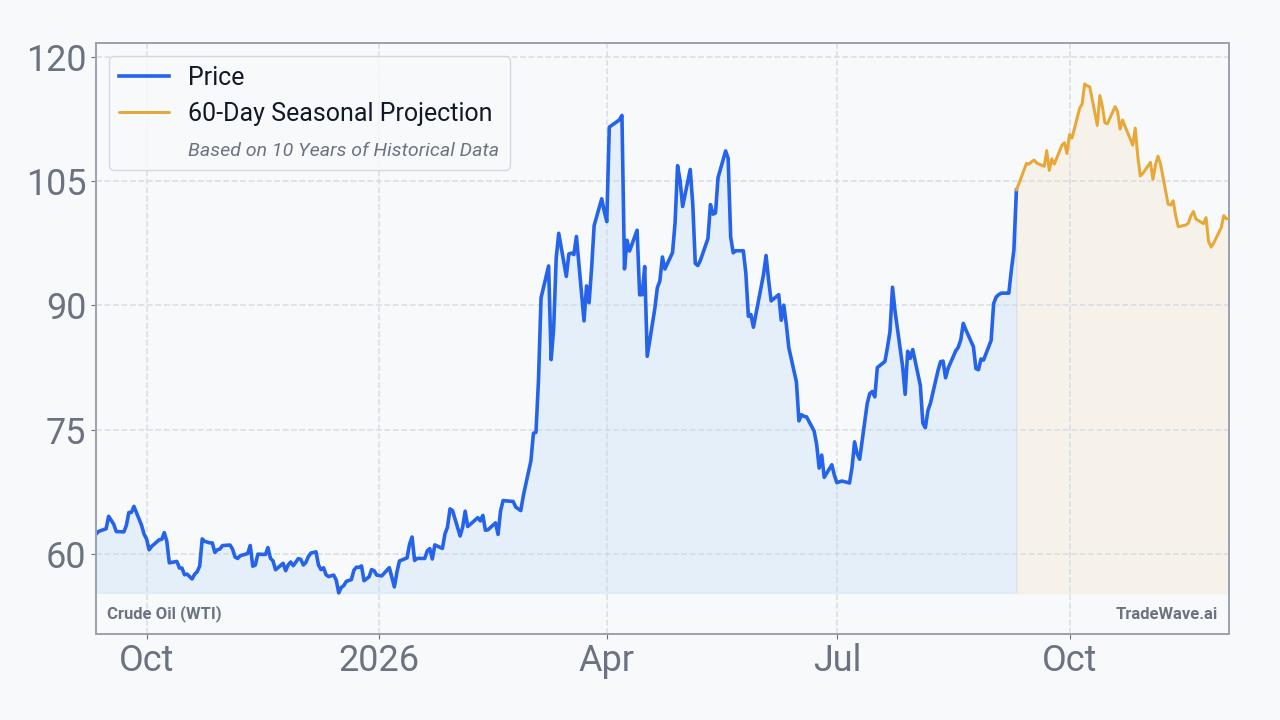
Projection as of Sep 11, 2026 from closing price $101.87
How to Use This Data
Seasonal projection data for Crude Oil (WTI) reflects how the commodity has historically performed during this same calendar period across prior years. The consecutive pattern shows a 50.0% win rate, meaning WTI finished higher in exactly half of those historical instances. The midterm election year pattern shows a lower 40.0% win rate, suggesting softer historical performance during comparable political cycles.
When both the consecutive and midterm election year bases point in the same direction, the signal carries more weight than either pattern alone. In this case, both project negative returns, with the consecutive basis at -3.3% and the election year basis at -17.3%. The median return of -3.9% in midterm years is often more reliable than the average, since averages can be skewed by a single extreme year like the best historical return of +18.5%.
Seasonal patterns cannot account for supply disruptions, geopolitical developments, OPEC decisions, or macroeconomic shifts that may occur during the period. A 50% win rate also means the outcome was negative in the other half of historical years, and no pattern guarantees a specific outcome.
Seasonal data functions as one layer of context among many. Market participants often use it alongside technical analysis and fundamental research to better understand historical tendencies and calibrate expectations for a given period.
This information is provided for educational purposes only and does not constitute financial advice, a recommendation, or a solicitation to buy or sell any security. Seasonal patterns are based on historical data and do not guarantee future performance. All investment decisions carry risk. Consult a qualified financial advisor before making investment decisions.
Understanding Seasonal Projections
Seasonal projections estimate future price movement based on how Crude Oil (WTI) has historically performed during the same calendar period. These are statistical baselines derived from decades of market data, not predictions.
Consecutive Years (Last 10)
Uses the most recent 10 years of data regardless of market regime. This captures the broadest recent behavior, including all economic and political environments. Over the next 60 calendar days, this pattern has been positive 5 of 10 times with an average return of +1.4%.
Midterm Election Years (10 Available)
Uses only years that fall in the same position within the 4-year U.S. presidential election cycle. 2026 is a midterm election year. Markets often exhibit distinct patterns tied to fiscal and monetary policy shifts within this cycle. In 10 historical midterm election years, this 60-day window was positive 4 times with an average return of -3.5%.
Seasonal patterns reflect historical tendencies and do not guarantee future results. All projections are based on past performance and should be used as one input among many in your investment decision-making process. Data provided by TradeWave.ai.
Latest News
Recent headlines related to Crude Oil (WTI), sourced from major financial news outlets with AI sentiment analysis.
- Dow Jones Futures Rise, Oracle Jumps After Oil Prices, Yields Surge; CPI Inflation Due
- Urban Outfitters, Tilly's, and Kohl's Shares Skyrocket and Plummet, What You Need To Know
- Why American Eagle (AEO) Shares Are Plunging Today
- Dow Jones Futures, Oracle Jumps After Oil Prices, Yields Surge; CPI Inflation Due
- Review & Preview: Inflation Watch
- Dow Jones Futures: S&P 500 Breaks Support As Oil Prices, Yields Surge; Oracle Jumps Late With CPI Inflation Due
- Update: US Equity Indexes Decline as Treasury Yields Soar Amid Hot Wholesale Inflation Print, Escalation in Iran War Threatens Red Sea Chokepoint
- Plunging Retail and Travel Stocks Could Signal Trouble Ahead for the Economy
- TSX Closer: Index Falls to Six-Week Low As Base Metals Slide; Oil Surges on Middle East Supply Fears
- ONEOK Closes $9 Billion Minority Equity Investment with Apollo
Explore More
Other markets with seasonal analysis and recent pattern articles.