Gold
COMEX Gold futures are the world's most liquid gold contract. Gold serves as a store of value, inflation hedge, and safe-haven asset during periods of geopolitical uncertainty.
The most striking divergence in Gold's seasonal data appears at the 60-day horizon, where midterm election years show an 83.3% win rate and a projected return of +12.47%, targeting $4,902, while the broader 10-year window produces only a 60% win rate with a far more modest +0.79% average return. The near-term 30-day picture is cautious across both lenses, with win rates of just 30-33% pointing toward a pullback to the $4,224-$4,264 range.
Gold's midterm year pattern is historically its strongest seasonal setup, with the 90-day window delivering an 83.3% win rate and a +26.47% projected return to $5,512. Traders should watch whether the expected short-term softness materializes as a buying opportunity ahead of what history suggests is a powerful multi-month advance.
Seasonal Price Projections
Select a historical basis and projection horizon to see where seasonal patterns suggest Gold may be headed.
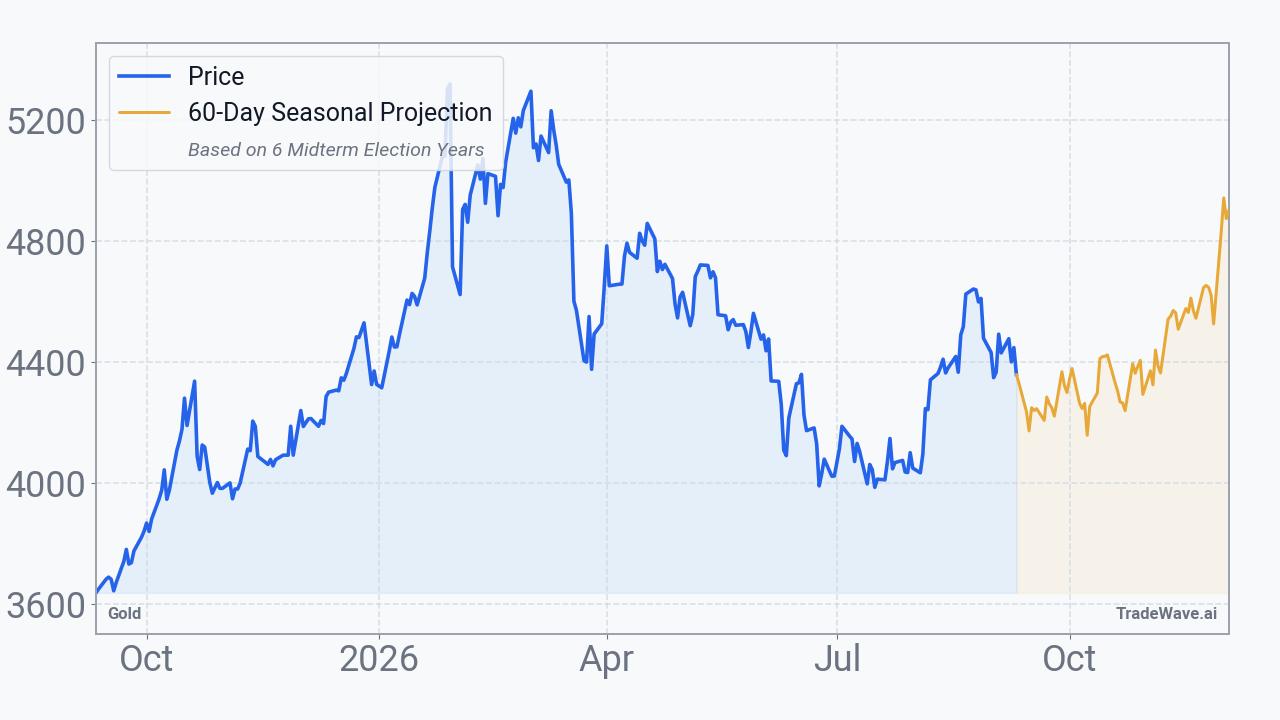
Projection as of Sep 11, 2026 from closing price $4,375.60
How to Use This Data
Seasonal projection data for Gold reflects how the commodity has historically performed during this exact calendar window across prior years. The consecutive pattern shows a 60.0% win rate, meaning Gold finished higher in 60 out of every 100 comparable periods. The midterm election year pattern shows a notably stronger 83.3% win rate, indicating Gold rose in roughly five out of every six such years historically.
When the two bases diverge, as they do here, it signals that the election cycle environment has historically produced meaningfully different outcomes than the general consecutive pattern alone. The midterm base projects a return of +12.5% versus the consecutive projection of -6.3%, a significant spread. Median returns are often more informative than averages because they are less distorted by extreme outlier years in either direction.
Historical patterns cannot account for sudden geopolitical developments, central bank policy shifts, currency moves, or other real-time market forces. A high win rate reflects past tendencies, not a guarantee of any specific outcome in the current year. The projection is a statistical summary, not a forecast.
Seasonal data serves as one contextual lens among many. Market participants typically weigh it alongside macroeconomic conditions, technical analysis, and their own risk frameworks when forming a broader view of an asset's potential behavior.
This information is provided for educational purposes only and does not constitute financial advice, a recommendation, or a solicitation to buy or sell any security. Seasonal patterns are based on historical data and do not guarantee future performance. All investment decisions carry risk. Consult a qualified financial advisor before making investment decisions.
Understanding Seasonal Projections
Seasonal projections estimate future price movement based on how Gold has historically performed during the same calendar period. These are statistical baselines derived from decades of market data, not predictions.
Consecutive Years (Last 10)
Uses the most recent 10 years of data regardless of market regime. This captures the broadest recent behavior, including all economic and political environments. Over the next 60 calendar days, this pattern has been positive 6 of 10 times with an average return of +0.8%.
Midterm Election Years (6 Available)
Uses only years that fall in the same position within the 4-year U.S. presidential election cycle. 2026 is a midterm election year. Markets often exhibit distinct patterns tied to fiscal and monetary policy shifts within this cycle. In 6 historical midterm election years, this 60-day window was positive 5 times with an average return of +2.6%.
Seasonal patterns reflect historical tendencies and do not guarantee future results. All projections are based on past performance and should be used as one input among many in your investment decision-making process. Data provided by TradeWave.ai.
Latest News
Recent headlines related to Gold, sourced from major financial news outlets with AI sentiment analysis.
- Integra Resources (ITRG) Hits Record Output, But At A Cost
- Goldgroup Highlights Its Two Producing Mines and Significant Growth Potential Across the Don David Gold Complex in Mexico
- Wesdome Intersects 7.8 g/t Gold over 57.2 Metres at Kiena Deep, Confirming the Norbenite Footwall Zone; Discovers a New Zone Near Infrastructure
- TSX Closer: Index Falls to Six-Week Low As Base Metals Slide; Oil Surges on Middle East Supply Fears
- Kalshi launches gold and silver perpetual futures with CFTC approval
- Cabral Gold Completes First Gold Pour at the Phase 1 Mine in the Cuiu Cuiu Mine in Brazil
- Stock Market Midday, Sept. 10: Surging Oil Prices Pressure Markets Again
- Copper, FCX Stock Plunge On Tariff Report, Surging Yields; Silver, Gold Also Fall
- Is Most-Watched Stock Agnico Eagle Mines Limited (AEM) Worth Betting on Now?
- Mines Do Not Usually Fail on Geology. They Stall on Land Access
Explore More
Other markets with seasonal analysis and recent pattern articles.