Natural Gas
Henry Hub Natural Gas futures represent the benchmark price for natural gas in North America, heavily influenced by weather patterns and seasonal demand.
The most compelling signal for Natural Gas sits at the 60-day midterm election year window, where price has risen in 7 of 8 historical instances with an average return of 14.63%, projecting a target near $3.18 from the current $2.82. That 87.5% win rate towers above the broader 10-year 60-day win rate of 70%, suggesting the midterm cycle meaningfully amplifies the seasonal tailwind here.
Where traders should stay alert is the 90-day picture, which fractures sharply. The midterm projection turns negative at -6.29% despite a 62.5% win rate, signaling that any near-term rally historically fades by late in the window. Natural Gas rewards patience on entry and discipline on exit. Watch the $3.00 level as the critical near-term confirmation threshold.
Seasonal Price Projections
Select a historical basis and projection horizon to see where seasonal patterns suggest Natural Gas may be headed.
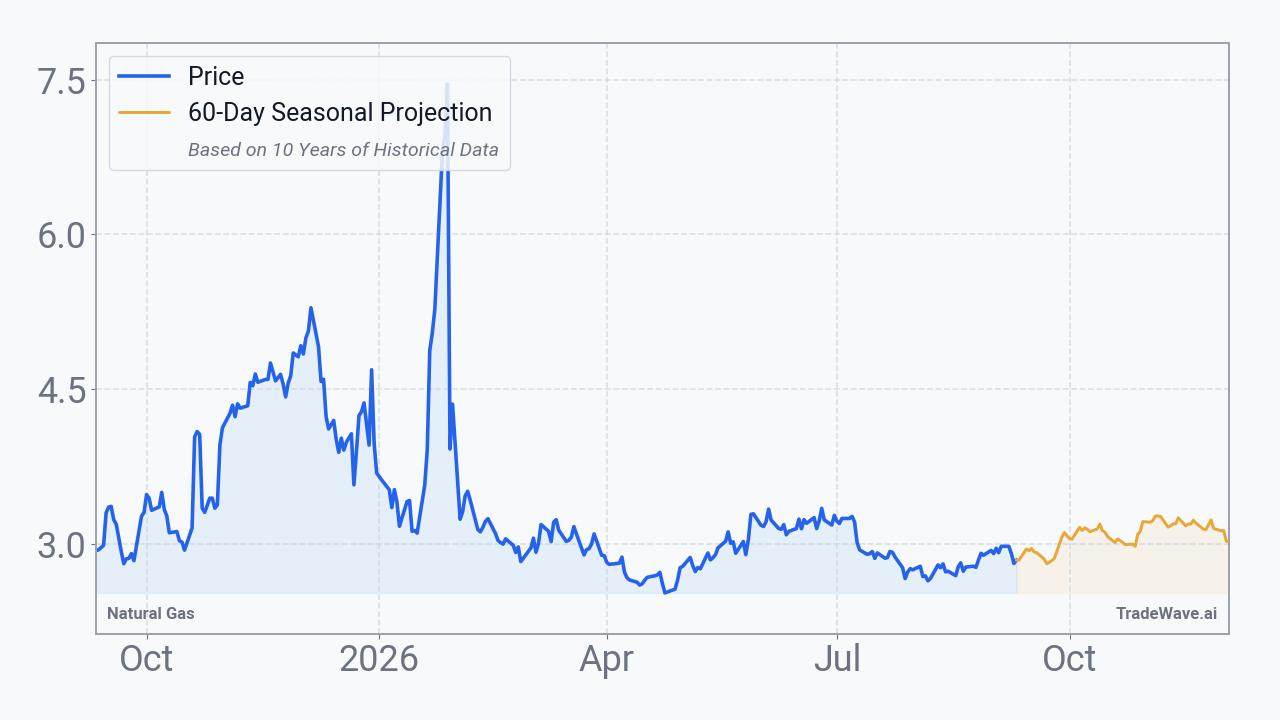
Projection as of Sep 11, 2026 from closing price $2.8200
How to Use This Data
Seasonal projection data reflects how Natural Gas has historically performed during this specific calendar window across comparable years. The consecutive pattern shows a 70.0% win rate, meaning prices finished higher in 70 out of every 100 similar periods, while the midterm election year pattern shows an even stronger 87.5% win rate across those specific cycles.
When both the consecutive and midterm election year bases point in the same direction, the signal carries more weight than either pattern alone. Convergence suggests the tendency is not isolated to one type of year. The median return of 13.8% in midterm years is often more informative than the average, since it is less distorted by outlier years like the historical best of 47.9%.
Seasonal patterns are built entirely from past behavior and cannot account for sudden supply disruptions, geopolitical developments, regulatory changes, or macroeconomic shifts. A win rate of 87.5% still implies roughly one in eight historical periods produced a loss. The projected return of 6.3% to 12.1% represents a statistical tendency, not a guaranteed outcome for any individual year.
Market participants often use seasonal data as one layer within a broader analytical framework, pairing it with fundamental supply and demand analysis, technical price levels, and defined risk parameters. Seasonal tendencies can inform expectations about timing and magnitude, but they function best as context rather than a standalone signal.
This information is provided for educational purposes only and does not constitute financial advice, a recommendation, or a solicitation to buy or sell any security. Seasonal patterns are based on historical data and do not guarantee future performance. All investment decisions carry risk. Consult a qualified financial advisor before making investment decisions.
Understanding Seasonal Projections
Seasonal projections estimate future price movement based on how Natural Gas has historically performed during the same calendar period. These are statistical baselines derived from decades of market data, not predictions.
Consecutive Years (Last 10)
Uses the most recent 10 years of data regardless of market regime. This captures the broadest recent behavior, including all economic and political environments. Over the next 60 calendar days, this pattern has been positive 7 of 10 times with an average return of +10.7%.
Midterm Election Years (8 Available)
Uses only years that fall in the same position within the 4-year U.S. presidential election cycle. 2026 is a midterm election year. Markets often exhibit distinct patterns tied to fiscal and monetary policy shifts within this cycle. In 8 historical midterm election years, this 60-day window was positive 7 times with an average return of +14.6%.
Seasonal patterns reflect historical tendencies and do not guarantee future results. All projections are based on past performance and should be used as one input among many in your investment decision-making process. Data provided by TradeWave.ai.
Latest News
Recent headlines related to Natural Gas, sourced from major financial news outlets with AI sentiment analysis.
- Review & Preview: Inflation Watch
- ONEOK Closes $9 Billion Minority Equity Investment with Apollo
- Sector Update: Energy Stocks Decline Late Afternoon
- Sector Update: Energy
- Sector Update: Energy Stocks Mixed Thursday Afternoon
- Exxon Rally Fades as Brent Crude Jumps 4% Above $105
- Sector Update: Energy
- Williams' NESE Pipeline Faces New Challenge From Court Ruling
- ECB’s Rate Hike Tells the Market What Fed’s Warsh Won’t
- Sector Update: Energy Stocks Advance Premarket Thursday
Explore More
Other markets with seasonal analysis and recent pattern articles.