CBOE Volatility Index
The VIX measures the market's expectation of 30-day forward-looking volatility, derived from S&P 500 index options. Often called the 'fear gauge,' it rises during periods of market uncertainty.
Near-term seasonal signals point toward rising anxiety. Over the next 30 days, the VIX has climbed in 8 of the last 10 comparable periods, with a median gain of 11.15%, suggesting a move toward 18.62. That near-term stress signal is consistent across both the broad 10-year history and midterm election year setups.
Beyond 30 days, the picture shifts decisively. In midterm election years specifically, the VIX has fallen in 6 of 8 comparable 60-day periods, with a projected level near 15.92, signaling meaningful relief for equity markets by mid-cycle. The pattern is clear: expect a brief volatility spike now, followed by a sustained decline in market fear as election-year uncertainty resolves. Watch the 30-day window closely.
Seasonal Price Projections
Select a historical basis and projection horizon to see where seasonal patterns suggest CBOE Volatility Index may be headed.
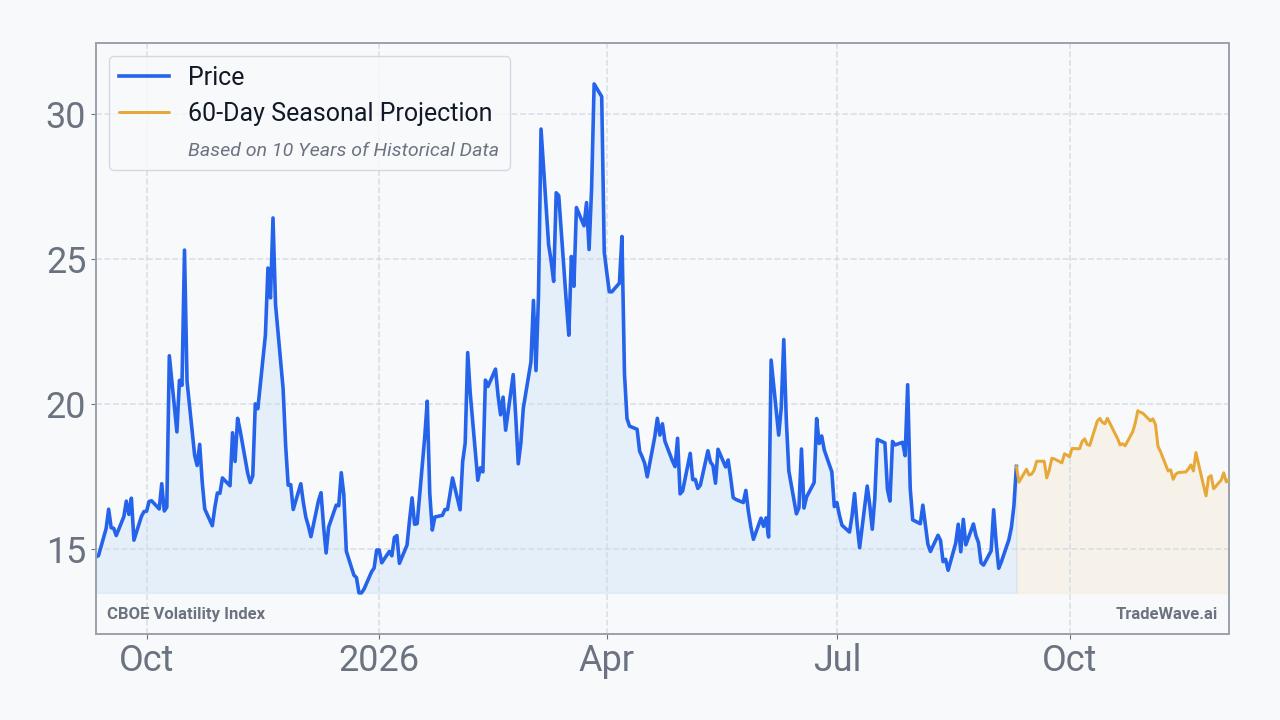
Projection as of Sep 11, 2026 from closing price $17.84
How to Use This Data
Seasonal projections for the CBOE Volatility Index reveal how VIX has historically behaved during this same calendar period across past years. The 60-day consecutive pattern shows VIX increased in 40.0% of those periods, meaning market anxiety was more often subdued than elevated. The midterm election year pattern tells a similar story, with VIX rising in just 25.0% of comparable periods.
When both the consecutive and midterm election year bases point in the same direction, the signal carries more weight than either pattern alone. Convergence suggests the tendency is consistent across different historical lenses. The median return is often more reliable than the average here, as the average can be skewed by extreme outliers like the best historical reading of plus 54.7%.
Seasonal patterns cannot account for sudden geopolitical developments, policy shifts, earnings surprises, or unexpected economic data. A low VIX increase rate does not guarantee calm markets in any specific year. These projections reflect statistical tendencies across history, not predictions of what will happen.
Market participants often use seasonal VIX data as one diagnostic layer among many, pairing it with equity trend analysis, macroeconomic context, and broader risk frameworks. Lower projected VIX readings historically correspond with more stable equity environments, while higher readings suggest preparing for potential turbulence.
This information is provided for educational purposes only and does not constitute financial advice, a recommendation, or a solicitation to buy or sell any security. Seasonal patterns are based on historical data and do not guarantee future performance. All investment decisions carry risk. Consult a qualified financial advisor before making investment decisions.
Understanding Seasonal Projections
Seasonal projections estimate future price movement based on how CBOE Volatility Index has historically performed during the same calendar period. These are statistical baselines derived from decades of market data, not predictions.
Consecutive Years (Last 10)
Uses the most recent 10 years of data regardless of market regime. This captures the broadest recent behavior, including all economic and political environments. Over the next 60 calendar days, this pattern has been positive 4 of 10 times with an average return of +3.9%.
Midterm Election Years (8 Available)
Uses only years that fall in the same position within the 4-year U.S. presidential election cycle. 2026 is a midterm election year. Markets often exhibit distinct patterns tied to fiscal and monetary policy shifts within this cycle. In 8 historical midterm election years, this 60-day window was positive 2 times with an average return of -1.1%.
Seasonal patterns reflect historical tendencies and do not guarantee future results. All projections are based on past performance and should be used as one input among many in your investment decision-making process. Data provided by TradeWave.ai.
Latest News
Recent headlines related to CBOE Volatility Index, sourced from major financial news outlets with AI sentiment analysis.
- Crypto Mining Stocks Fall Harder Than Bitcoin on a Risk-Off Tape: Cipher Mining Sinks 6%, MARA and Riot Drop 4%
- Worried About Lingering Market Volatility? Defensive ETFs to Consider
- Wall Street raises S&P 500 targets past 8,000 amid pullback risks
- Review & Preview: A Slippery Start to Fall
- Stocks stumble after Labor Day. This year’s easy gains may be over.
- Dow Drops 600 Points as Brent Crude Nears $100
- Stock Market Fear Index Rises Along With Oil Prices
- The VIX Is Playing Tricks: Why Stocks Are Volatile, But the Fear Gauge Is Sleeping
- Wall Street Fear Index Slips as Bond Fears Ease
- The jobs report just put Fed chair Kevin Warsh's new playbook to work: One Big Investment Idea
Explore More
Other markets with seasonal analysis and recent pattern articles.