Micron Technology (MU) Has Dropped in All 7 Midterm Windows as Another One Nears
Micron Technology is sprinting higher on AI demand and trading near record territory just weeks before a short midterm-election seasonal window that has never been kind to the stock.
Key takeaways
- A six-day midterm-election window for Micron Technology starting Apr 2 has produced losses in all 7 historical cycles, aligning with a short trade direction.
- Across those years, the pattern shows 100% Percent Profitable for shorts, with 7 winners and 0 losers and an average profit of 5.17%.
- The TradeWave Ratio of 1.92 signals that price has typically moved meaningfully in the trade direction within the window, not just at the close.
- Intraperiod swings have been sharp, with best-case rallies for shorts and notable drawdowns, underscoring a high-volatility setup rather than a gentle drift.
- MU is up about 180% year to date and sits roughly 6.4% below its 52-week high, so any seasonal pullback would be hitting a stock priced for perfection.[2][8]
- Unusual options and volume spikes around prior catalysts show traders are willing to pile into MU quickly when the narrative shifts, which could amplify this window again.[9]
According to historical data from TradeWave.ai, this early-April stretch has behaved very differently from an average week for Micron, especially in midterm election years.
Seasonal window
Micron Technology has declined in all 7 midterm-election-year windows that match this six-day stretch, with an average gain of 5.17% for traders positioned short. Shares finished Friday at $426.13, up 5.1% on the day and about 6.4% below the 52-week high of $455.50, after a blistering 180% year-to-date run that has turned MU into one of the market’s purest AI memory plays.[2][8] Options and volume surges around prior breakouts show how quickly positioning can flip in this name when the story changes, a dynamic that could matter again if a crowded long meets a historically weak calendar pocket.[9]
The pattern is built on the last seven midterm election years, a phase of the presidential cycle that often brings policy uncertainty, tighter financial conditions and choppier tape for high-beta tech. Grouping by the election cycle matters here because memory demand, capex plans and regulatory risk tend to move with Washington’s spending and industrial-policy priorities, not just with the generic business cycle.
This seasonal window begins on Apr 2 and spans 6 trading days. Historically, during this period, Micron Technology has favored the short side, with every iteration delivering a negative net return for the stock and a positive outcome for traders aligned with the short trade direction.
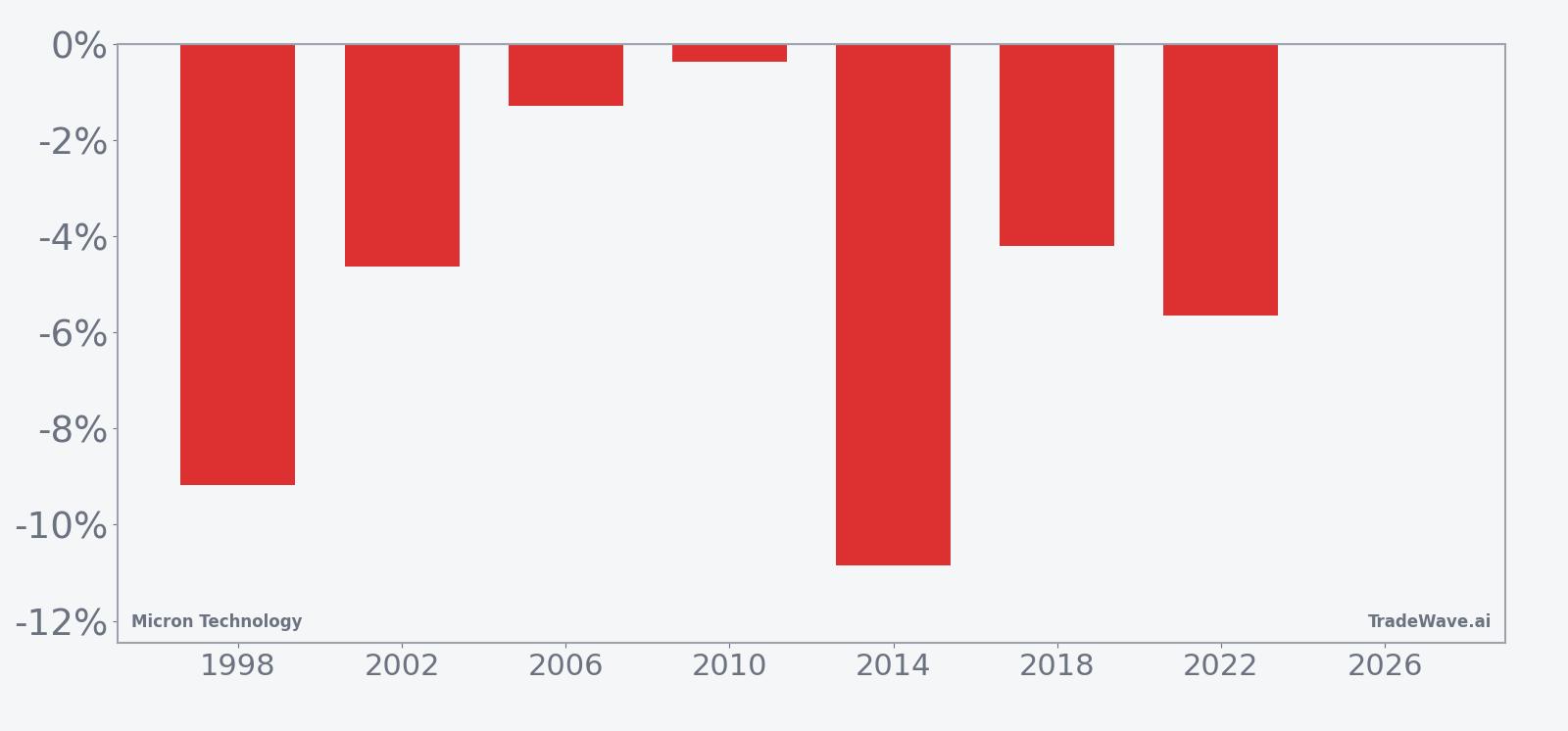
Year-by-year net returns and intraperiod swings show how consistently this short window has worked, and how bumpy the ride has been inside it.
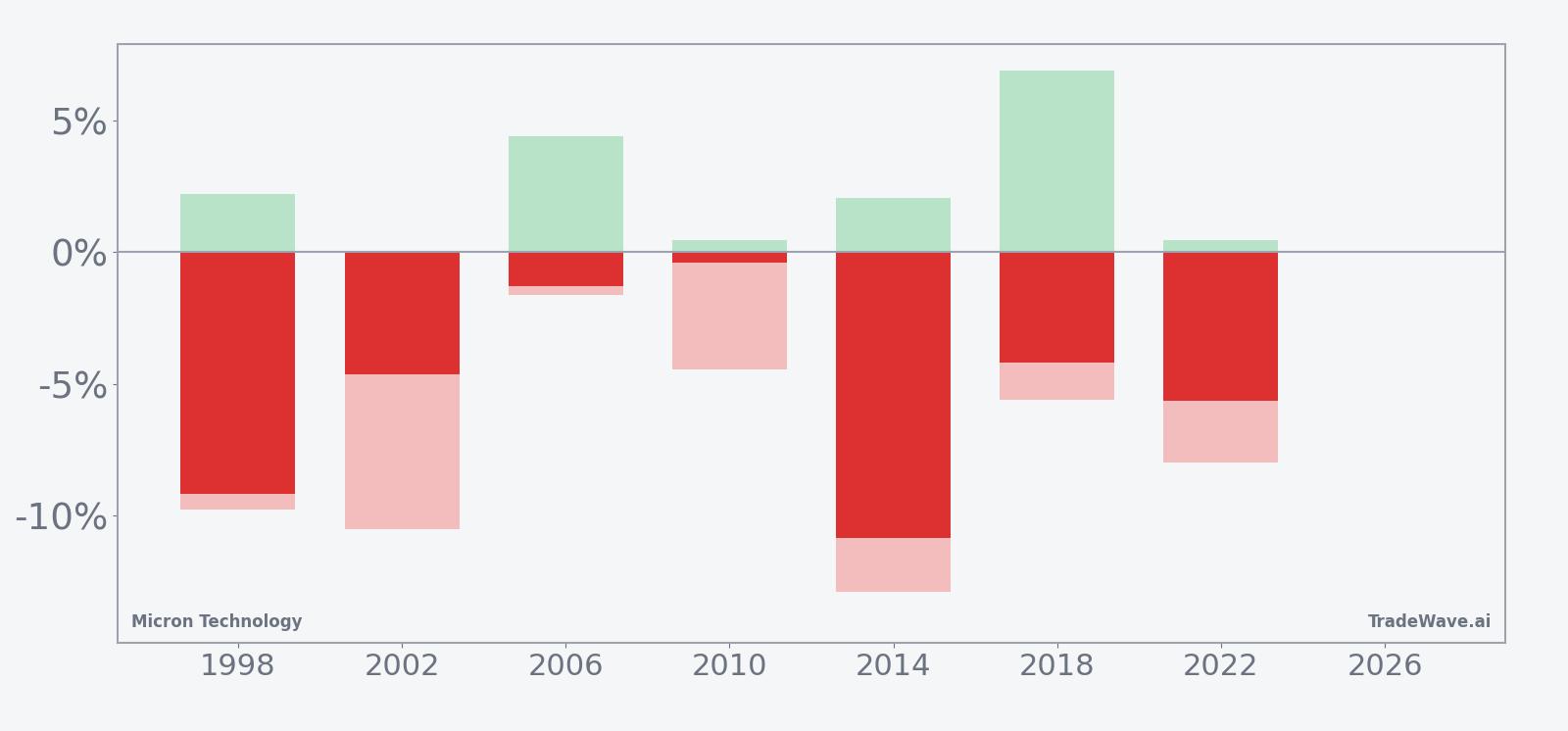
The per-year table behind these charts shows how that plays out in practice. In 2014, for example, MU fell 10.84% over the window, with the worst intraperiod drawdown from entry reaching 12.9% before the trade closed. In 1998, the stock dropped 9.18% across the six days, with a 9.78% adverse move at the worst point and only a brief 2.2% favorable excursion for longs before the decline reasserted itself.
Even the “milder” years have leaned the same way. In 2010, MU slipped 0.38% over the window, with a 4.43% adverse move at the low and only a 0.47% best bounce from entry. In 2018, the stock lost 4.2% across the period, but intraperiod action included a 6.87% move against shorts at the best point for longs and a 5.59% drawdown in the short direction at the worst point.
Put together, the pattern shows a short-biased window that has delivered seven winners out of seven for traders positioned with the trend, but with enough intraday and intraperiod noise to shake out weak hands. The Sharpe ratio of 1.34 reflects that the end-of-window outcomes have been attractive on a risk-adjusted basis, even though the path inside the window has often been volatile.
History does not guarantee future results; adverse excursions can be large even in winning windows, and traders can still lose money if timing or risk management is off.
Price and near-term drivers
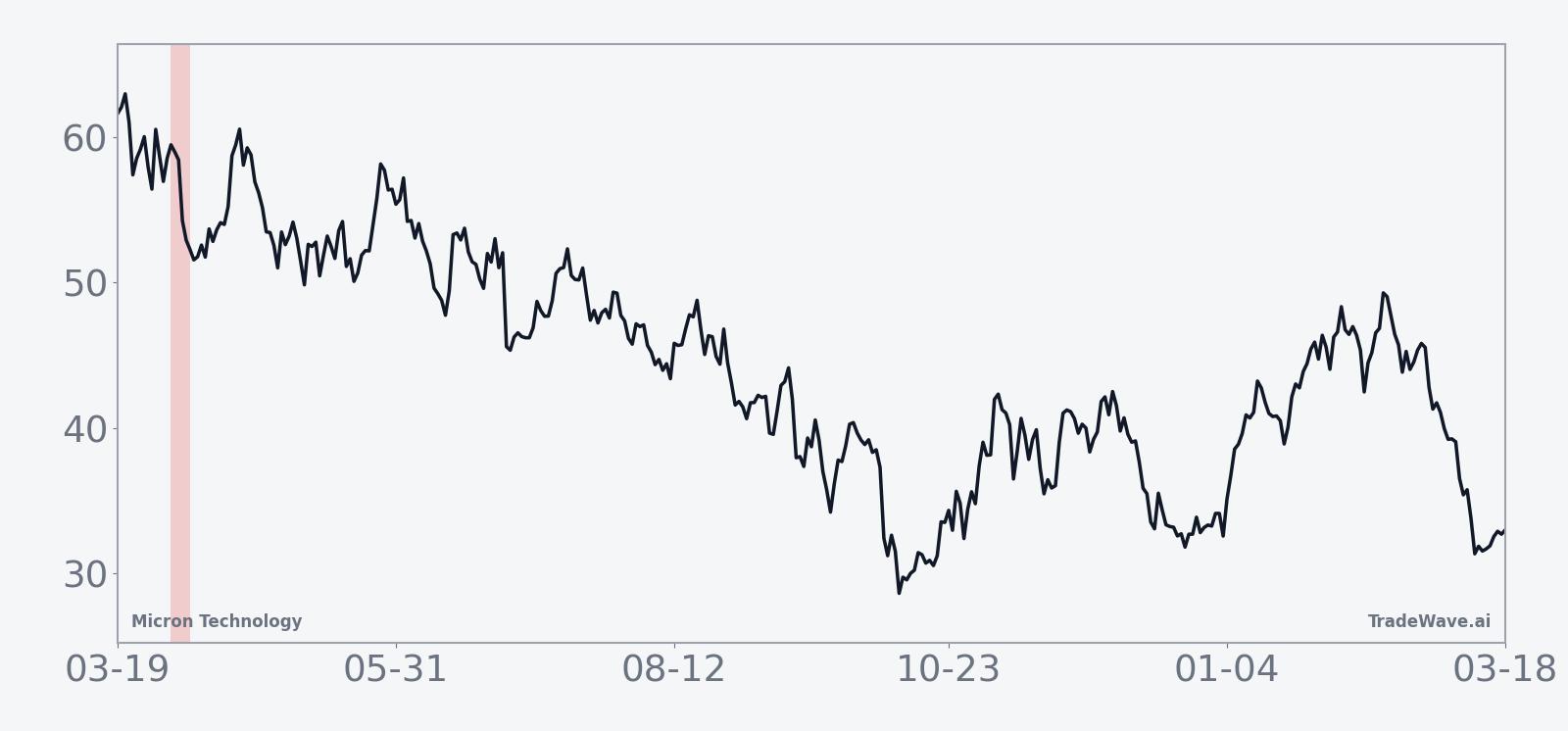
Micron closed Friday at $426.13, up 5.1% on the session, extending a powerful run that has left the stock about 180% higher year to date and roughly 6.4% below its 52-week high of $455.50.[2][8] The move keeps MU well above its 50-day moving average of $387.87, with 20-day average volume running near 31.5 million shares, underscoring how central the name has become to the AI trade.
The chart below situates the latest move in its recent multi-month context.
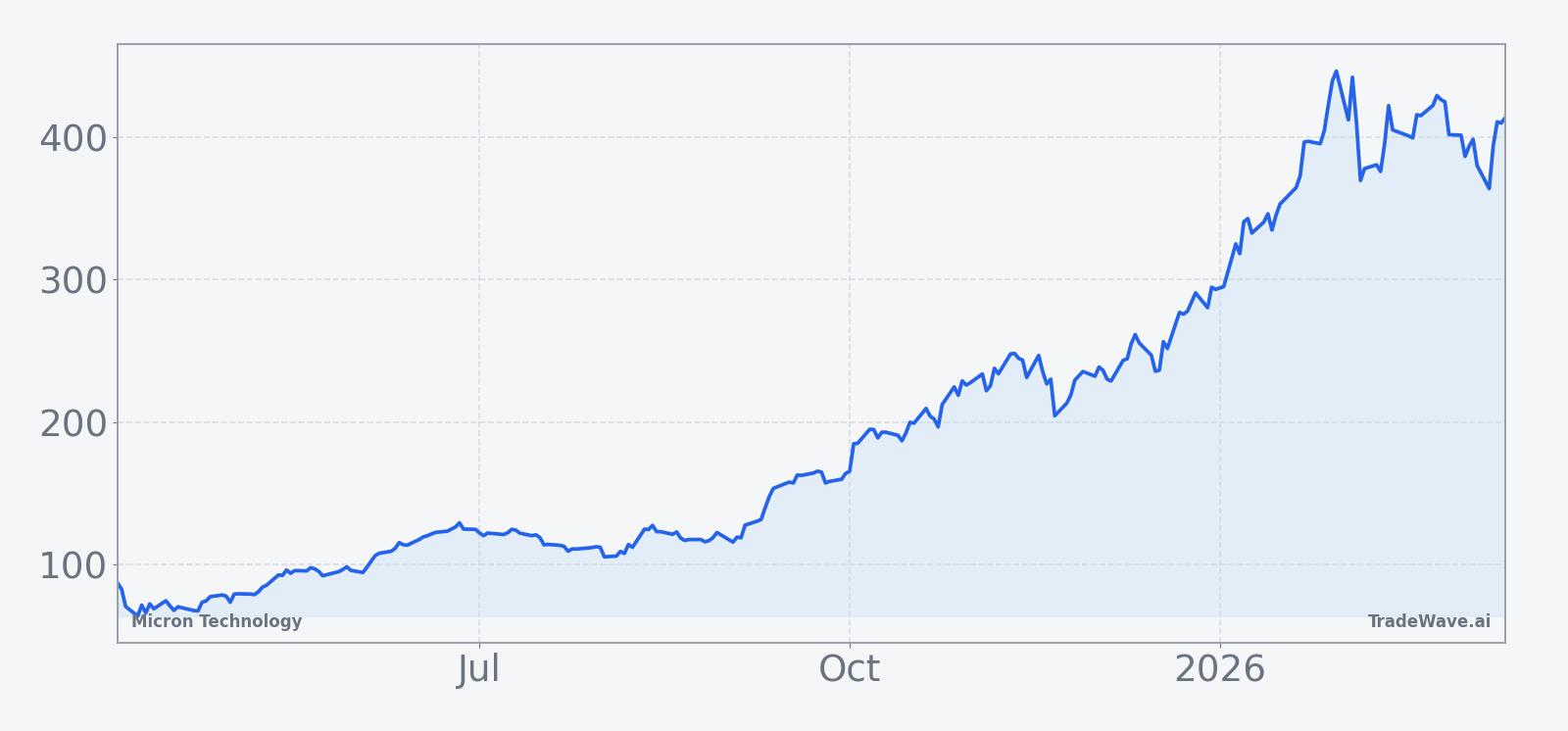
The fundamental backdrop has been unusually strong. On Jan 26, Micron reported that Q1 2026 revenue jumped 57% year over year, with AI memory demand driving high-bandwidth memory volumes that are effectively sold out for 2026.[2] Management has guided to non-GAAP gross margins near 68% in the February quarter and has talked about profits reaching roughly $36 per share by fiscal 2027 if the cycle holds, a profile more reminiscent of a software platform than a traditional memory maker.[2]
That earnings power has pulled in aggressive institutional and retail interest. Zacks noted in mid-February that the surge in Micron stock looked poised to continue as investors chased the AI super-upcycle, highlighting how quickly sentiment flipped from cyclical skepticism to structural growth story.[8] In Dec 2025, Forbes reported that MU’s stock jumped 10% in a single session as options volume hit five times normal levels, with 260,000 calls and 213,000 puts trading and share volume running 139% above the three-month average.[9] That kind of flow shows how crowded the trade can become when the narrative is bullish.
Analysts have leaned into the story as well. In Jan 2026, Seeking Alpha framed Micron as sitting in the middle of an AI super-upcycle, with demand from data centers and mobile devices lifting both DRAM and NAND pricing.[2] Earlier, in Jan 2026, Yahoo Finance reported that tight memory supply through 2026 had driven a wave of price target increases, with some firms flagging MU as a core way to play AI infrastructure rather than just a cyclical chip name.[3] Those calls came on top of a Dec 2025 round of target hikes after a strong Q1 earnings beat, which helped cement the “Strong Buy” narrative around the stock.[1]
All of this leaves Micron in a powerful uptrend heading into the early part of the midterm election year. Even so, the seasonal pattern points to a short, historically negative window in early April that has repeatedly produced sharp downside for the stock. Because MU now sits at the heart of the AI and semiconductor complex, any volatility in that window could ripple through broader tech benchmarks and sentiment around the AI trade.
Macro and policy backdrop
The midterm election year often brings a different policy tone than the presidential election year that preceded it. Fiscal debates tend to shift from stimulus and big-ticket programs toward deficit concerns and oversight, while regulators revisit how fast new technologies are scaling. For a company like Micron, which is tied to data center buildouts, export controls and industrial subsidies, that shift can matter as much as the next quarter’s DRAM price.
Seeking Alpha’s Jan 26 analysis framed Micron as a direct beneficiary of an AI super-upcycle, with demand expected to outstrip supply through at least 2026.[2] That view lines up with broader macro commentary that AI infrastructure spending is becoming a semi-structural line item for hyperscalers rather than a discretionary project.[2] At the same time, tighter monetary policy and any renewed scrutiny of tech concentration could inject more volatility into high-multiple names that have already priced in years of growth.
In that context, the early-April midterm window looks less like a random quirk and more like a period when policy noise, positioning and profit-taking have historically collided. The fact that every one of the last seven midterm cycles saw MU trade lower across this exact six-day stretch suggests that investors have repeatedly used it as a moment to rebalance exposure, even when the longer-term story stayed intact.
What to watch as the window opens
The next iteration of this six-day window starts on Apr 2, so the key question is how Micron behaves as it approaches that date. Traders will be watching whether MU continues to hug its 50-day moving average or starts to stall closer to the 52-week high, which would make any seasonal pullback feel more like a shakeout than a trend change.
Flow and positioning will matter as much as price. The Dec 2025 episode, when options volume hit five times normal and share turnover jumped 139% above the three-month average, showed how quickly MU can become a battleground when the tape gets crowded.[9] If similar spikes in call buying, put hedging or outright volume appear as the window opens, that would signal that large players are actively leaning into or against the historical pattern rather than ignoring it.
Macro and policy headlines are the other swing factor. Any fresh signals on AI-related export controls, data center capex budgets or semiconductor subsidies could either reinforce the bullish structural story or give investors an excuse to lock in gains. Inside the window itself, behavior to watch is simple: if MU starts to roll over with expanding volume and fails to reclaim intraday bounces, it would rhyme with prior midterm-year patterns. If instead the stock shrugs off early weakness and powers to new highs, that would mark the first clear break from a seven-for-seven seasonal record.
For now, the setup is clear. Micron is a high-flying AI winner heading into a short, historically negative midterm-election window that has never favored the stock. The next few weeks will show whether this cycle respects that pattern or finally rewrites it.
Sources
- [1] Yahoo Finance, "Micron Target Raised to $500 After Strong Q1 Earnings Beat" (Dec 23, 2025).
- [2] Seeking Alpha, "Micron: In The Middle Of An AI Super‑Upcycle" (Jan 26, 2026).
- [3] Yahoo Finance, "Micron (MU) Price Target Raised on Tight Memory Supply Through 2026" (Jan 10, 2026).
- [5] Seeking Alpha, "Micron stock jumps after raising Q4 guidance" (Aug 11, 2025).
- [6] The Motley Fool, "Should You Buy Micron Technology Stock Before Dec. 17?" (Dec 12, 2025).
- [8] Zacks Investment Research, "The Surge in Micron Technology Stock Looks Poised to Continue" (Feb 13, 2026).
- [9] Forbes, "Why Did Micron Stock Jump 10% Yesterday?" (Dec 19, 2025).