15-for-15: Nasdaq QQQ Invesco ETF (QQQ) Enters a 40-Day Early-Summer Rally Window
Nasdaq QQQ Invesco ETF is hovering near record highs as it approaches a 40-day early-summer window that has never been negative in the past 15 years.

What is the seasonal pattern for Nasdaq QQQ Invesco ETF (QQQ)?
Nasdaq QQQ Invesco ETF has risen in 15 of 15 years during this early-summer 40-day window, with an average gain of 4.6% in winning years.
- 15 for 15 in this window, with average winning-year gains of 4.6% across the past 15 years.
- The upcoming 40-day Nasdaq QQQ Invesco ETF trading window starts on Jun 10, 2026 and has a 100% Percent Profitable record with 15 winners and 0 losers.
- Across all years, the cumulative return for this QQQ seasonal trend is 95%, supported by a Sharpe ratio of 2.07.
- The pattern is long-biased, with a Trade Direction of “long” and a TradeWave Ratio of 2.46, indicating strong historical travel in the upside direction within the window.
- Intraperiod swings have been meaningful, with some years showing sizable drawdowns before finishing higher, so timing and risk controls have mattered.
- With QQQ trading just above its 52-week high, this historically strong early-summer stretch could intersect with already elevated tech valuations.
According to historical data from TradeWave.ai, this early-summer stretch has behaved very differently from an average month on the calendar for QQQ. The next section walks through how that pattern has played out and what it could mean for traders watching the Nasdaq megacap complex.
How has Nasdaq QQQ Invesco ETF (QQQ) traded in this early-summer window?
Nasdaq QQQ Invesco ETF has posted gains in every single iteration of this 40-day early-summer window over the past 15 years, averaging a 4.6% rise in winning years. The next window begins on Jun 10, 2026, with QQQ last changing hands at 720.61, up 0.8% on the day and sitting about 1.3% above its 52-week high of 711.23.[1] That combination of a perfect historical record and a stretched spot price makes this slice of the calendar one of the more closely watched QQQ seasonal patterns on the board.
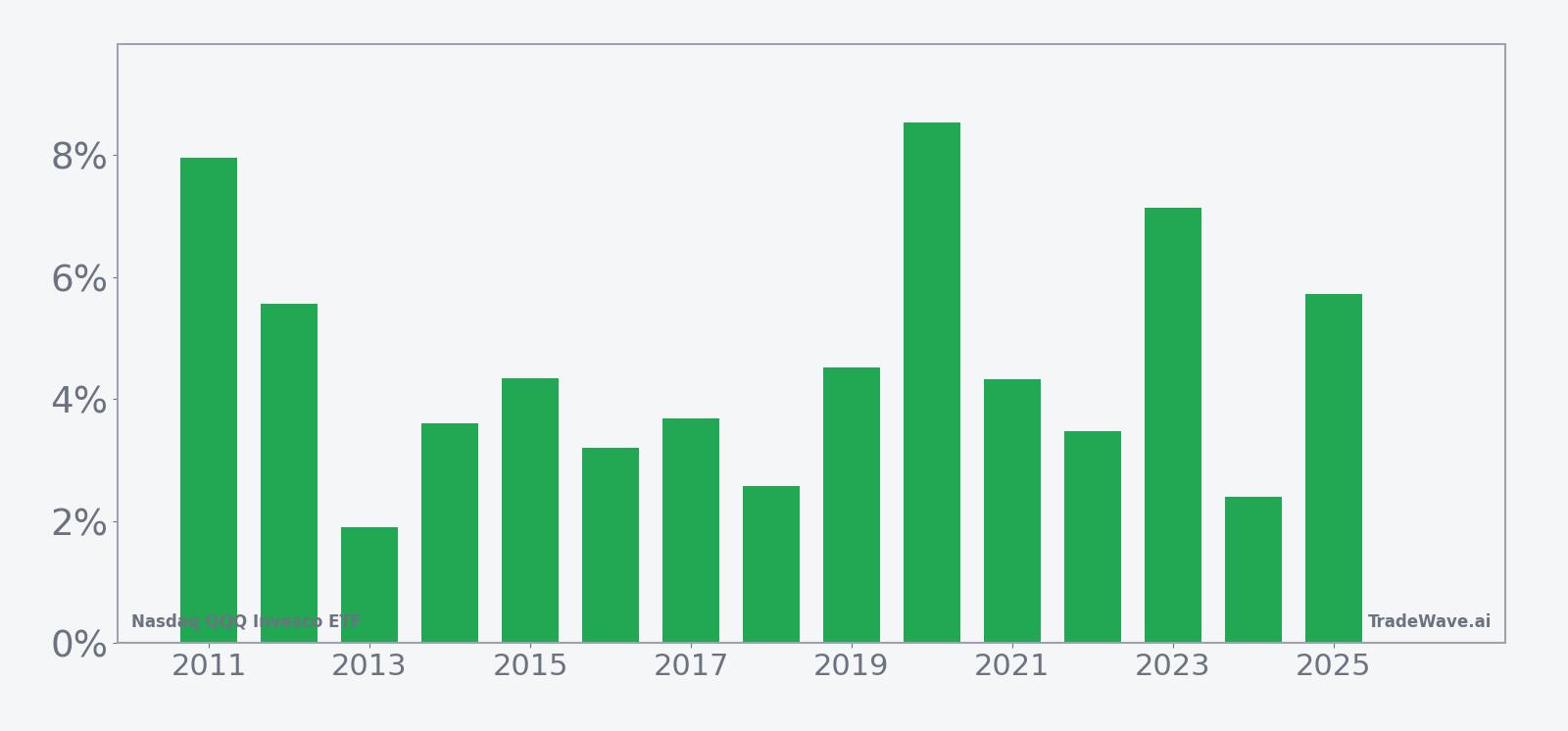
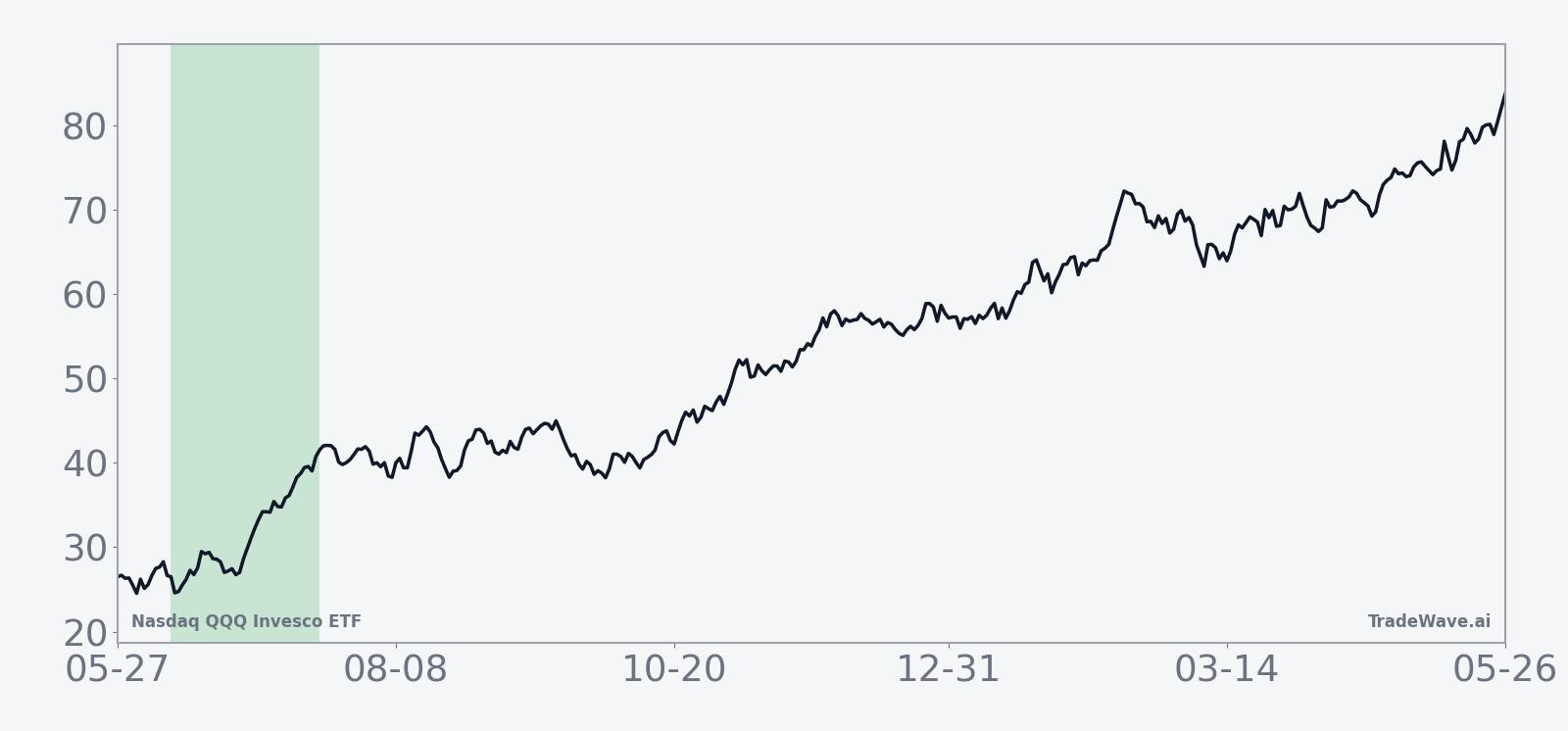
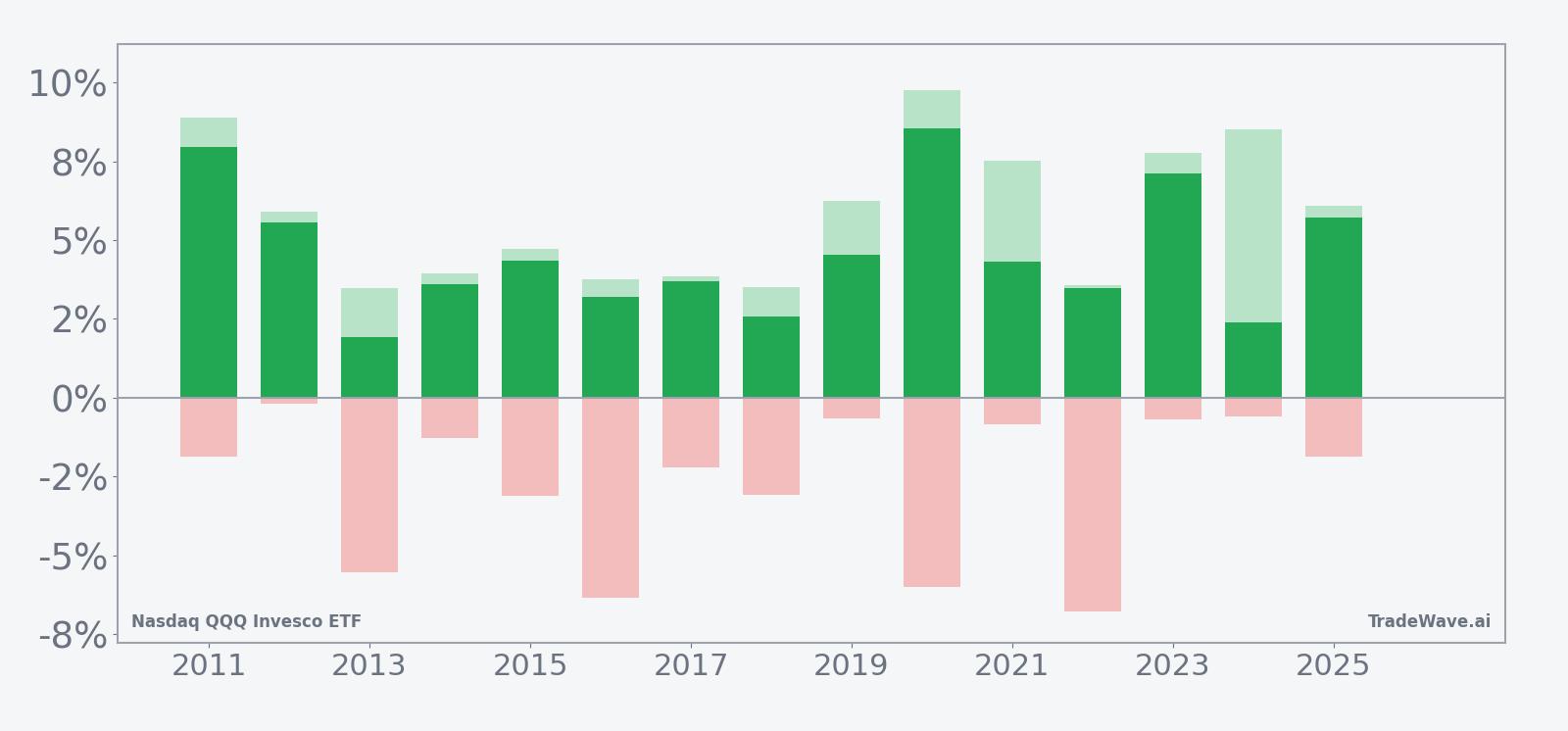
Year-by-year net returns and intraperiod swings show how consistently QQQ has finished higher while still experiencing meaningful drawdowns along the way.
The trade direction for this pattern is explicitly long, and the 100% Percent Profitable record means every one of the 15 historical windows ended in the green. Average profit of 4.6% in winning years lines up with the 5% all-years average, since there were no losing years to drag down the math. The strongest recent example came in 2020, when QQQ gained 8.54% in the window, while the softest was 2016 with a still-positive 3.2% rise.
The intraperiod profile has not been a straight line. In 2016, QQQ’s best point-to-peak move, or maximum favorable excursion, was 3.76%, but the worst drawdown from entry, or maximum adverse excursion, reached −6.35% before the ETF recovered. In 2020, the window saw a 9.76% peak run-up against a −5.99% drawdown, underscoring that even strong years have involved sizable swings. Other years, such as 2019 and 2021, show smaller adverse moves of −0.66% and −0.85% respectively, paired with solid upside, which helps explain the relatively high Sharpe ratio of 2.07.
The 15-year average seasonal curve suggests gains tend to build steadily through the middle of the window rather than arriving in a single burst. The cumulative return chart for the pattern window, which stacks each year’s outcome, climbs in a relatively smooth stair-step from left to right, reflecting the absence of losing years and the clustering of mid-single-digit advances. Add it up and the cumulative return across all 15 windows is 95%, a sizable contribution for a slice of the calendar that covers only 40 trading days each year.
The combined net, maximum favorable move and maximum adverse move bars show a window that has historically offered more upside than downside for long positions, but not without risk. Large positive maximum favorable excursions in years like 2020 and 2023 sit alongside notable drawdowns in 2016 and 2022, which both saw adverse moves worse than −6% before finishing higher. That mix points to a high-conviction bullish seasonal bias paired with volatility that can punish traders who are overleveraged or too tight with stops.
History does not guarantee future results; adverse excursions can be large even in winning windows, and past seasonal strength does not ensure similar outcomes in 2026.
Why does Nasdaq QQQ Invesco ETF (QQQ) follow this seasonal pattern?
This early-summer QQQ seasonal pattern may reflect a cluster of tech and growth earnings revisions, index rebalancing and institutional portfolio repositioning that often follow first-half results. Analysts have also pointed to options expiration cycles and systematic strategies that add exposure into strength, which can reinforce existing trends in megacap tech. For an ETF dominated by large technology and communication-services names, those flows can line up with a supportive macro backdrop and turn this 40-day stretch into a recurring tailwind.
What is driving Nasdaq QQQ Invesco ETF (QQQ) today?
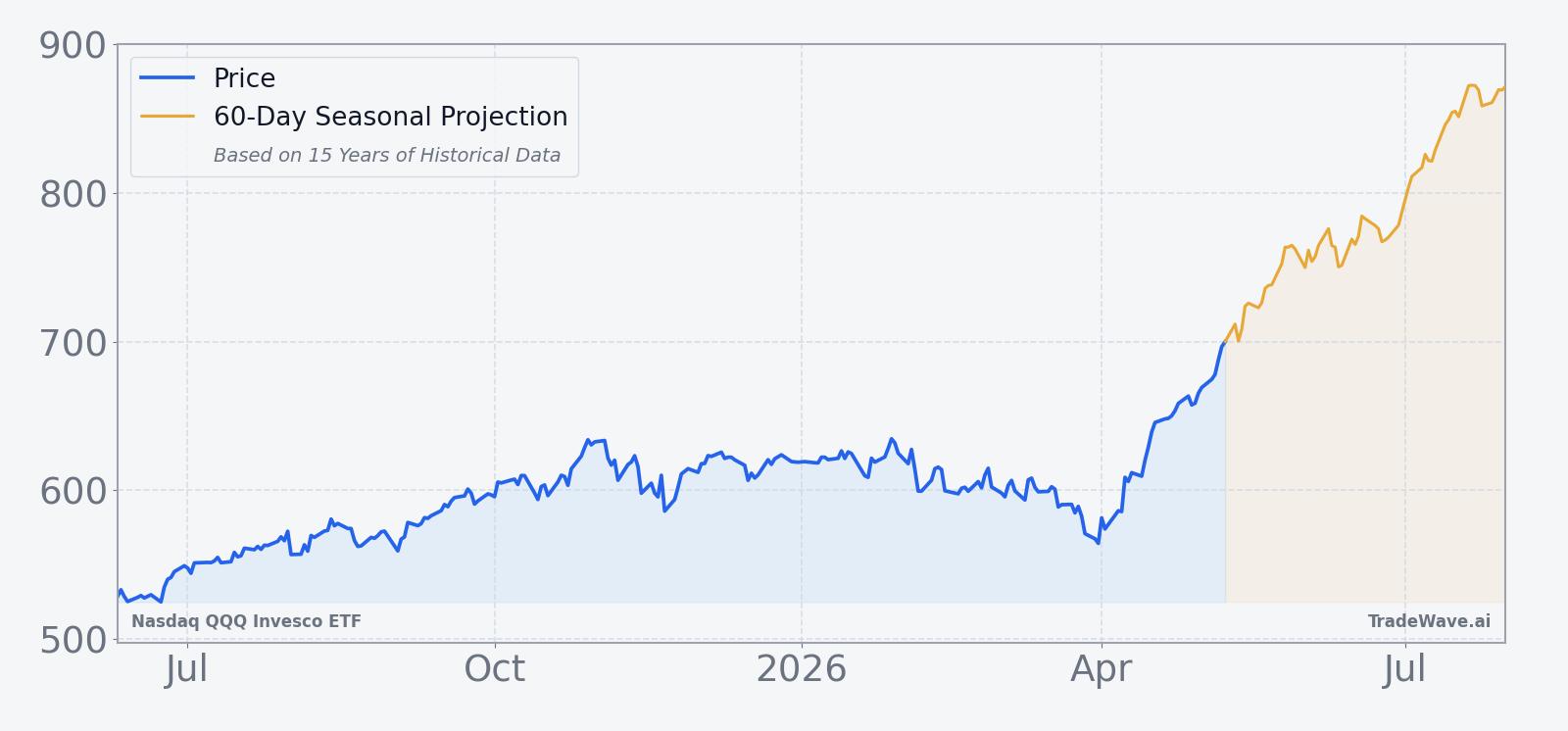
Nasdaq QQQ Invesco ETF closed Friday at 720.61, up 0.8% on the session, extending a powerful run that has left the fund about 1.3% above its 52-week high of 711.23 and roughly 50.3% above its 52-week low of 479.52.[1] The ETF traded between 714.22 and 722.03 during the day on volume of 28.4 million shares, below its 20-day average turnover of about 39.5 million, suggesting the latest push higher came without a surge in activity.[1] With the 50-day moving average down at 620.43, QQQ is also trading well above its intermediate trend line, underscoring how extended the Nasdaq-heavy fund has become after a 16.39% gain over the past month.[1]
The chart below situates the latest move in its recent multi-month context and overlays the next 60 days of seasonal projections.
How does this seasonal window fit into the broader QQQ outlook?
QQQ’s role as a proxy for the Nasdaq 100 means this seasonal window matters well beyond a single ETF. The fund is heavily weighted toward megacap technology and communication-services names, so a historically strong early-summer stretch has often coincided with renewed risk appetite for growth stocks. When this window has lined up with supportive macro conditions in prior years, such as 2019 and 2023, the pattern has delivered mid-to-high single-digit gains that helped pull broader indices higher.
At the same time, the intraperiod drawdowns recorded in years like 2016 and 2022 show that even a perfect win-loss record does not eliminate volatility. In those years, QQQ ultimately finished the window higher but only after absorbing adverse moves of more than −6% from the entry point. For traders, that history suggests the early-summer seasonal tailwind has tended to reward patience and position sizing more than short-term attempts to time every wiggle.
What should traders watch as this QQQ seasonal window approaches?
As Jun 10 approaches, the key watchpoints are whether QQQ can hold above its 50-day moving average, how far it stretches relative to the 52-week high band, and whether volume begins to expand as the window opens.[1] A continuation of the current uptrend with only modest pullbacks would be consistent with the historical pattern of steady gains, while a sharp break below the recent range would mark a clear departure from the typical early-summer script. Traders will also be watching how QQQ trades around any macro or policy headlines that hit during the window, since those events can amplify the intraperiod swings that have shown up in past years.
Inside the window itself, behavior around pullbacks may be the tell. Historically, some of the strongest years have seen QQQ absorb early drawdowns before grinding higher into the end of the period, while others have trended more cleanly from the start. If 2026 follows the former pattern, deeper but contained dips could still fit within the long-biased seasonal framework. If instead the ETF fails to recover from early weakness or sees unusually muted upside despite calm conditions, that would be a sign that this long-running seasonal edge is fading, at least for this cycle.
Sources
About this seasonal analysis
Seasonal pattern data is sourced from TradeWave.ai, which analyzes historical price behavior across annual calendar windows going back up to 30 years. Read the full data methodology or the book The 100-Year Pattern by Afshin Moshrefi (2026 edition). Past performance of seasonal patterns does not guarantee future results. This article is for informational purposes only and does not constitute investment advice.