Boeing (BA) Has Dropped in 5 of 6 Midterm Spring Windows as the Next One Nears
Boeing is up about 16% this year, but a mid-April seasonal window that has historically favored downside in midterm election years is coming into view just as the turnaround story meets a tougher regulatory and production backdrop.

Key takeaways
- A 118-day seasonal window for Boeing that begins on Apr 19 in midterm election years has historically favored short setups, with 5 winners and 1 loser for the short side.
- Percent Profitable for the pattern is 83%, with average gains of 8.63% in winning short years and a 7% average move when all years are included.
- The window sits in the early part of the midterm election year, a phase that often brings policy noise, regulatory scrutiny and choppy risk appetite for aerospace names.
- Intraperiod swings have been wide: the worst year saw a maximum adverse move of about 39% against the short before finishing lower, underscoring the potential for sharp squeezes.
- Boeing shares last closed at 195.12, about 23.3% below their 52-week high of 254.35 and roughly 51.4% above the 52-week low of 128.88, after a 3% drop on Friday.[1]
- With the stock already up about 16% year to date and consensus still skewed positive, the upcoming historically weak midterm window could test conviction in the turnaround narrative.[1][3][7]
According to historical data from TradeWave.ai, this specific mid-April stretch has behaved very differently from an average quarter for Boeing in past midterm election years, and the next iteration is less than a month away.
Seasonal window
Boeing has delivered profitable short-side results in 5 of the last 6 midterm election years during the 118 trading days that start on Apr 19, with average winning moves of 8.63% and a 7% average across all years. Shares finished Friday at 195.12, down 3% on the day and about 23.3% below the 52-week high of 254.35, even after a roughly 16% gain so far in 2026.[1]
The pattern is built on the last six midterm election years, a grouping that matters because aerospace spending, trade policy and regulatory pressure often move with the political calendar. In the early part of the midterm year, Washington tends to be noisy on budgets and oversight while markets are still digesting the prior year’s policy shifts, a mix that has historically lined up with softer stretches for Boeing in this window.
For this pattern, the trade direction is explicitly short. In other words, years where Boeing drifted or fell during the window count as wins, while sharp rallies are losses for the setup. Across the six-sample history, Percent Profitable sits at 83%, with 5 winners and 1 loser for the short side, a relatively high hit rate for a single-stock seasonal regime.
Avg Profit of 8.63% reflects only the winning short years, while Avg Profit - All of 7% includes every year in the sample, winners and the lone losing year together. That gap between winners-only and all-years averages is modest, which suggests the one unfavorable year did not fully erase the gains from the stronger cycles.
Intraperiod behavior has been anything but quiet. In 2022, the short setup ultimately finished with an 8.34% gain as Boeing fell from 185.98 to 170.47, but the stock first swung as much as 2.08% in favor of the short and as much as 39.23% against it at the worst point in the window. In 2002, the short gained 14.26% from entry to exit, yet the stock still rallied as much as 8.08% at one point before rolling over.
Those swings illustrate what traders call maximum favorable excursion and maximum adverse excursion, the best and worst intraperiod moves from the entry price. In this window, the maximum adverse excursions have sometimes been large relative to the final net result, which means even historically successful short years have featured painful squeezes along the way.
The historical seasonal trend line for this window slopes lower on average, with the bulk of the downside accruing in the middle third of the 118-day stretch. Early days have often been choppy, with Boeing sometimes pushing higher before the short-friendly phase asserts itself, while the final weeks tend to flatten as the stock stabilizes into the late-summer policy lull.
Viewed cumulatively across the six midterm years, the pattern adds up to a 49% total return for the short side and an annualized return of 6.98%. The Sharpe ratio of 1.05 points to a reasonably strong risk-adjusted profile for a single-name seasonal trade, while a TradeWave Ratio of 1.22 indicates that price has typically traveled meaningfully in the trade direction within the window, even when the final close did not capture the full swing.
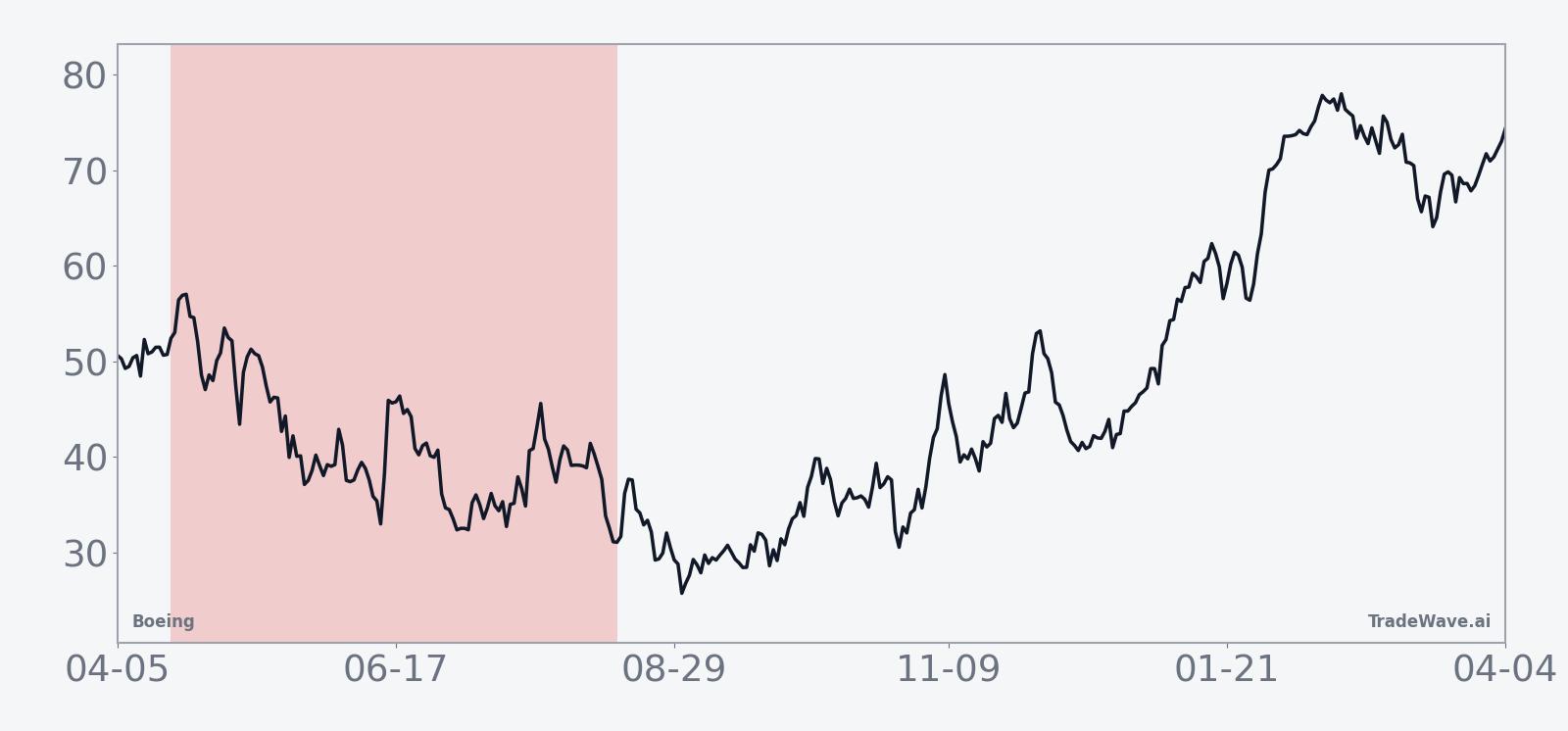
A stacked view of yearly net results alongside best and worst intraperiod swings shows how often downside has ultimately prevailed despite sharp rallies.
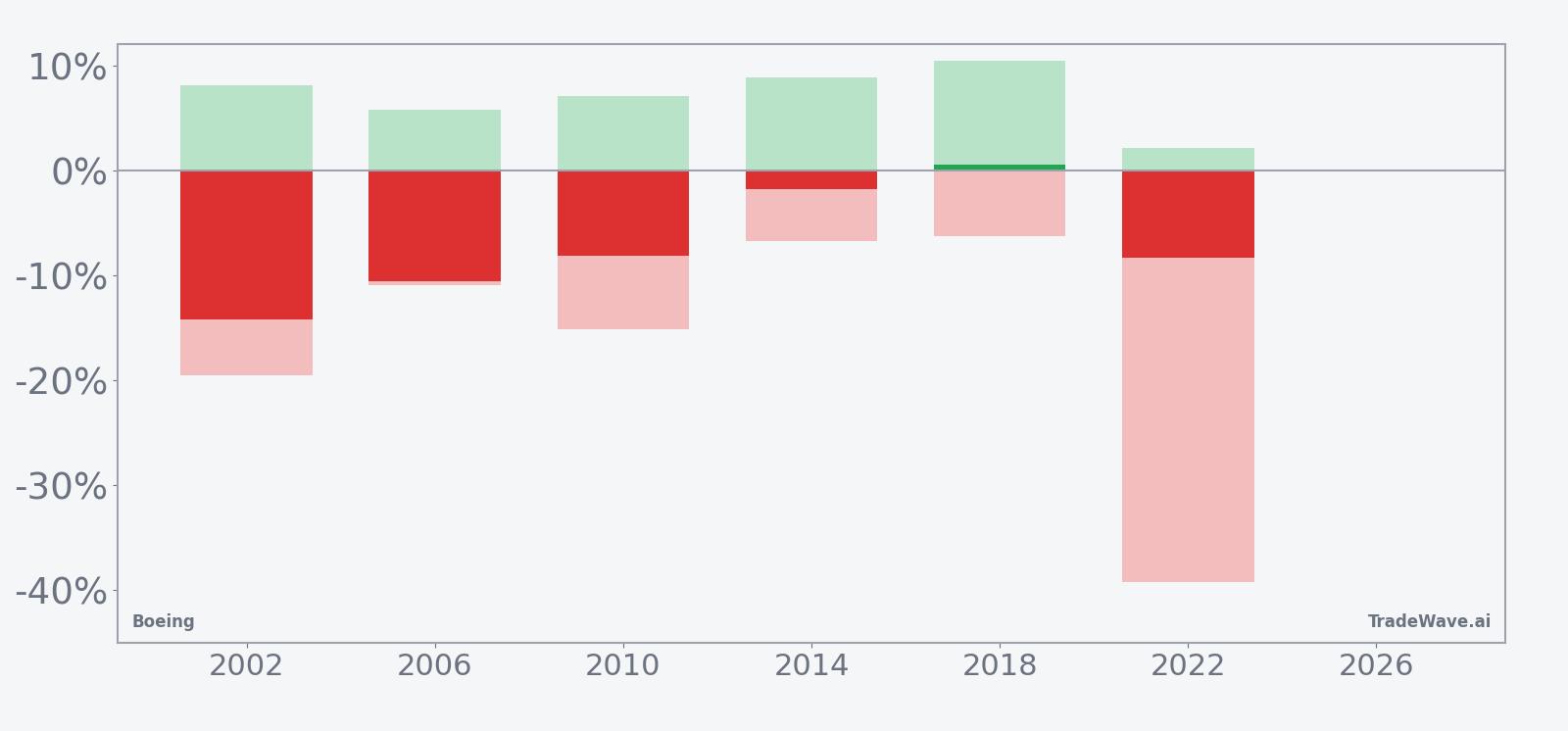
History does not guarantee future results, and maximum adverse excursions can be large even in years that ultimately finish in the trade direction.
Price and near-term drivers
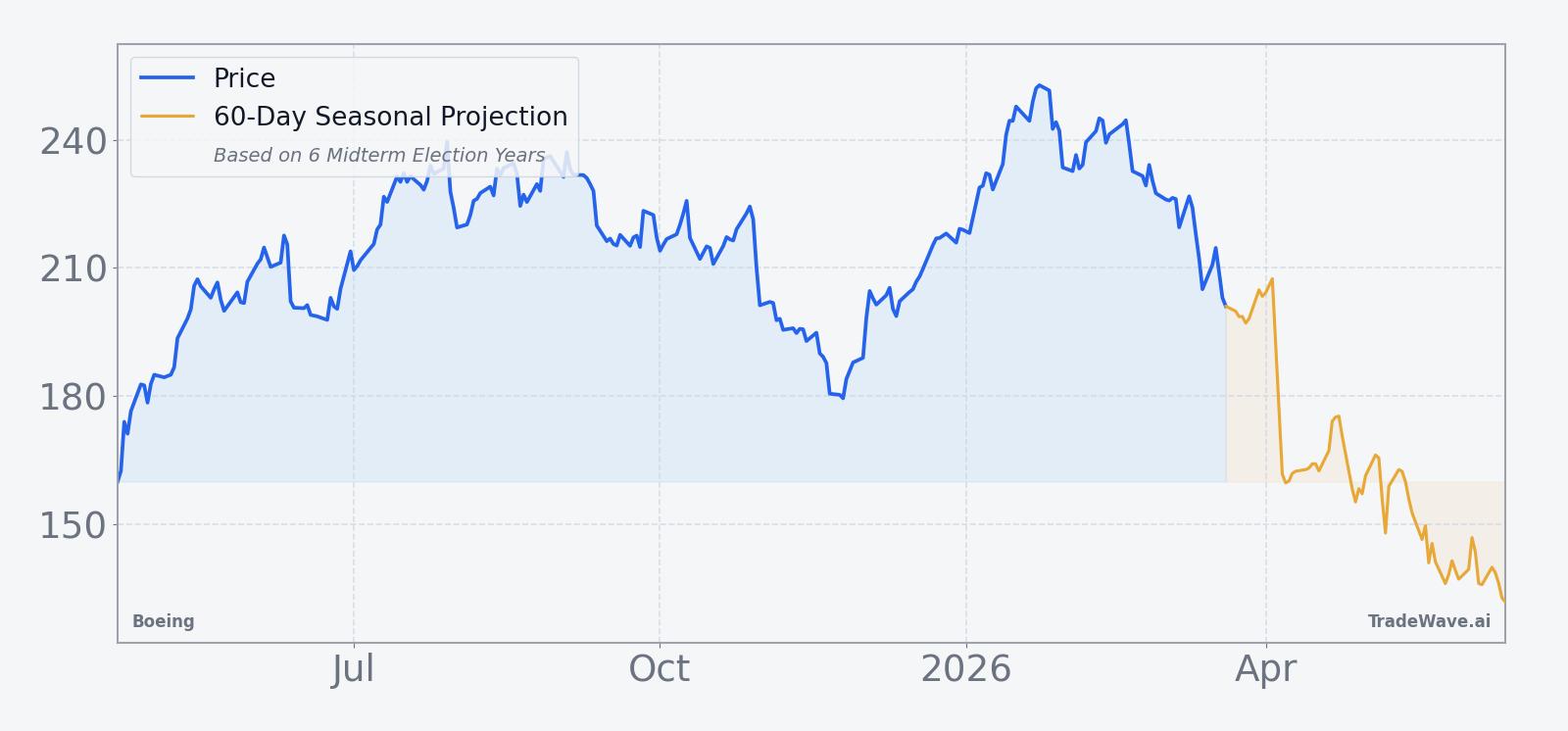
Boeing closed Friday at 195.12, down 3.01% on the session, extending a one-month slide of 15.91% but still leaving the stock up about 16% year to date and roughly 23.3% below its 52-week high of 254.35.[1] The shares sit well above the 52-week low of 128.88, yet they are trading under the 50-day moving average of 232.19 and against a backdrop of heavier-than-usual volume, with Friday’s turnover of about 12.8 million shares topping the 20-day average of roughly 7.4 million.[1]
That pullback comes after a stretch of better-than-expected results. On Jan 27, 2026, Boeing reported quarterly earnings that trounced expectations, helped by a gain on an asset sale and firmer delivery projections, even as the stock reaction was cautious.[3] Fresh reporting from The Wall Street Journal the same day highlighted how stepped-up plane deliveries lifted sales and narrowed losses, reinforcing the idea that the operational turnaround is gaining traction even if investors remain focused on execution risk and cash generation.[7]
The near-term earnings calendar is quiet, with the next scheduled report not until the next Q4 cycle, so the tape is likely to trade more on production headlines, order flow and regulatory developments than on formal guidance updates.[1][7] In 2025, Reuters and others chronicled how shrinking quarterly losses and rebounding jet deliveries did not always translate into sustained share-price strength, as investors weighed quality issues and the pace of free-cash-flow improvement.[2][14]
Regulation remains a wild card. In June 2025, Yahoo Finance detailed how the National Transportation Safety Board pressed Boeing over the 737 MAX 9 Alaska Airlines mid-air blowout, raising questions about quality control and oversight that still hang over the brand.[11] That scrutiny intersects with the midterm election-year policy calendar, where lawmakers often lean into safety and industrial policy themes, a combination that can amplify volatility for a stock already sensitive to headlines.
On the more constructive side, sector analysts continue to frame Boeing as central to long-term aerospace and defense megatrends. In late 2025, CNBC cited Citi’s view that the company’s order backlog and production ramp-up could support market-cap growth over time, a stance that underpins a Buy consensus rating and a 265 price target, even if that target was set when the stock traded in a different range.[4] Macro coverage from Reuters has also pointed to the tailwind from rebounding global travel and jet demand, while tariff negotiations have largely spared aircraft and parts, helping preserve Boeing’s export competitiveness.[14]
The chart below situates the latest pullback and year-to-date rebound in the context of the past year’s trading range and a 60-day seasonal projection.
What to watch as the window opens
The next iteration of this midterm-year window begins on Apr 19 and runs for 118 trading days, carrying a history that has favored short setups in 5 of 6 cycles. The key question is whether the current fundamental narrative, which leans on improving deliveries and narrowing losses, can offset a calendar stretch that has often coincided with softer price action for Boeing.
Traders will be watching three things in particular. First, how the stock behaves around the 200 level and the 50-day moving average near 232: sustained failure to reclaim that band as the window opens would rhyme with prior midterm years where rallies faded before the bulk of the downside unfolded.[1] Second, the tone of regulatory and safety headlines, especially any follow-up to the MAX 9 investigations or new oversight initiatives, which have historically magnified moves in both directions.[11] Third, order announcements and delivery updates, which could either reinforce the improving-operations story or revive concerns about execution and cash flow.[3][7][14]
Inside the window, behavior that tracks the historical pattern would likely feature choppy trading early on, occasional sharp squeezes against the short side, and then a more persistent drift lower through the middle of the period before stabilizing. A clean break above recent resistance with contained drawdowns would be one way the stock could defy the seasonal script, while a failure to hold rallies into mid-summer would look more like the prior midterm playbook.
For investors and traders alike, the takeaway is not that the stock must fall, but that this particular slice of the calendar has repeatedly lined up with downside-biased, high-variance trading for Boeing in midterm election years. With the next window less than a month away and the stock already well off its highs yet still up solidly on the year, how Boeing trades through this stretch will offer an important test of both the turnaround story and the power of seasonality.
Sources
- Yahoo Finance: Boeing Q4 Earnings Preview: What To Expect From Upcoming Report (Jan 26, 2026)
- Seeking Alpha: Boeing tops expectations, stock seeks direction on higher deliveries and revenue beat (Jul 29, 2025)
- Barron's: Boeing Earnings Trounced Expectations. Why the Stock Is Dropping. (Jan 26, 2026)
- CNBC: Boeing is set to report earnings before the bell. Here's what Wall Street expects (Oct 29, 2025)
- The Wall Street Journal: Boeing’s Stepped-Up Plane Deliveries Lift Sales (Jan 27, 2026)
- Yahoo Finance: 'This Should've Been Caught Years Ago:' Boeing Faces NTSB Heat Over 737 MAX 9 Alaska Airlines Mid-Air Blowout Incident (Jun 24, 2025)
- Reuters: Boeing's quarterly loss shrinks as jet deliveries rebound, but shares drop (Jul 29, 2025)