Micron Technology (MU) Has Fallen in 10 of 10 Midterm May Windows, Shorts Averaged 21.15%
Micron Technology is trading just off a fresh 52-week high after a massive AI-fueled run, even as a historically bearish midterm-year seasonal window for the stock has just kicked in.

What is the seasonal pattern for Micron Technology (MU)?
Micron Technology has fallen in 10 of 10 midterm election-year windows starting May 10, with an average gain of 21.15% in winning years for short positions.
- 10 for 10 in this window for shorts, with an average 21.15% profit in winning years across the last 10 midterm election cycles.
- Seasonal window starts May 10 and runs 156 trading days, covering the heart of the midterm election year.
- Percent Profitable is 100%, with 10 winners and 0 losers for the short-side pattern in this Micron Technology trading window.
- TradeWave Ratio (TWR) of 1.82 indicates price has typically traveled meaningfully in the short direction within the window, beyond just the final close.
- Sharpe ratio of 1.05 points to a historically strong risk-adjusted profile for the pattern, despite sizable intraperiod swings.
- Individual years have seen net short profits as deep as 50.0%, but also sharp rallies along the way, underscoring the need to respect volatility.
According to historical data from TradeWave.ai, Micron’s midterm election-year behavior around this May-to-autumn stretch has been unusually one-sided for short sellers, and the latest iteration of that window has just begun.
How has Micron Technology (MU) traded in this midterm-year window?
Micron Technology has delivered short-side profits in all 10 of the last midterm election-year windows starting May 10, averaging a 21.15% gain for bears over 156 trading days. The stock finished Friday at $741.43 and traded around $746.81 on Monday, putting it about 0.1% below its 52-week high of $747.21 after a 180% surge year to date.[5] Options traders recently positioned for an 8% post-earnings move with a bullish lean in calls, a sign that positioning and sentiment were skewed toward more upside even as the historical window has tended to favor downside for the stock.[13]
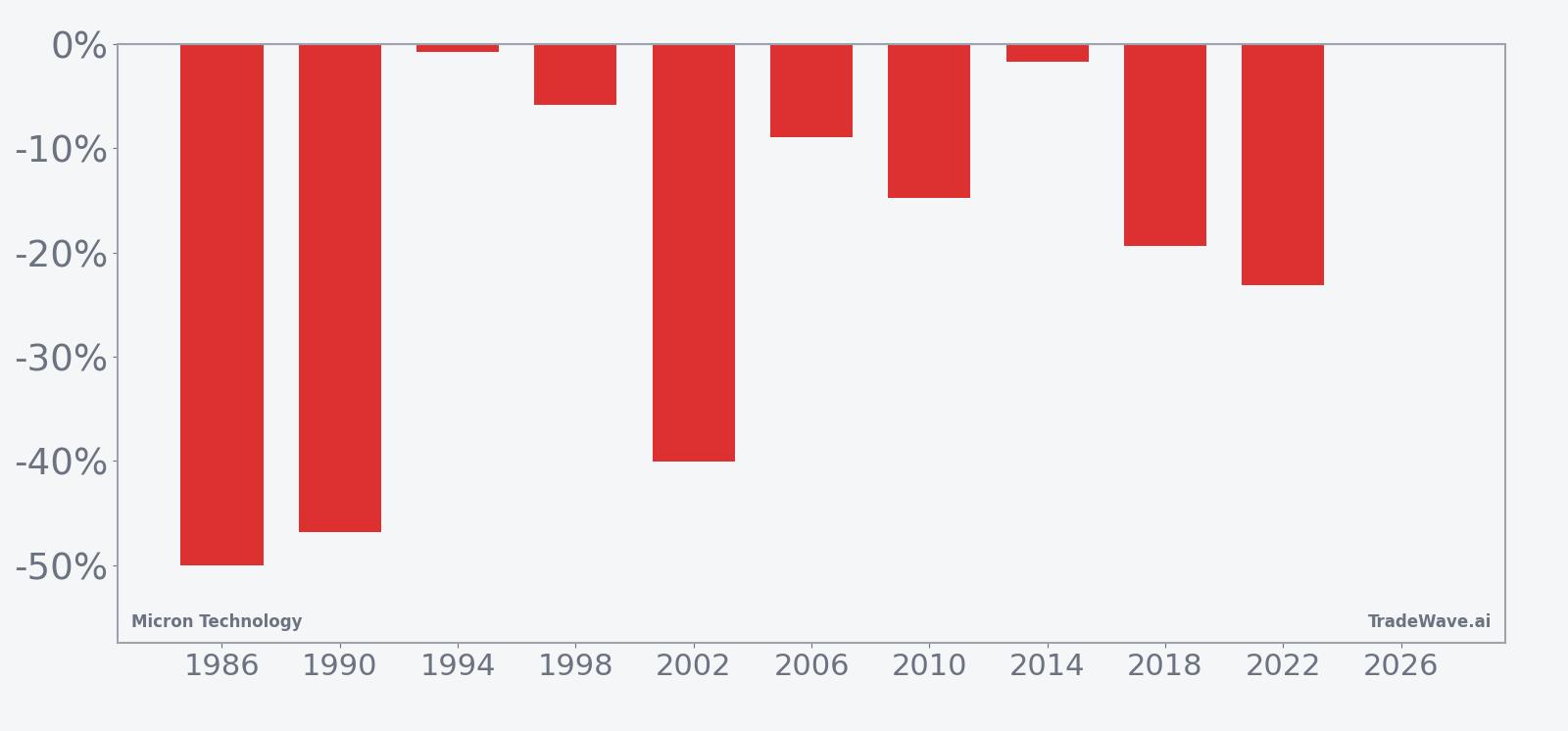
Grouping by the presidential election cycle matters here because this pattern only looks at midterm election years, when policy uncertainty, regulation debates and spending fights often hit risk assets differently than in election or pre-election years. In this specific Micron Technology trading window, the pattern phase is “the last 10 midterm election years,” while the calendar phase is also a midterm election year, so the current setup lines up cleanly with the historical sample.
Across those 10 midterm-year windows, every single one produced a profitable outcome for short positions, with a cumulative return of 515% and an annualized return of 19.92% for the strategy. The strongest year in the sample was 1986, when a short entered around $1.43 and exited near $0.72, a net return of 50.0% as Micron slid through the window. The weakest year for shorts was 1994, which still booked a 0.81% profit from entry to exit, even though the stock rallied as much as 28.85% at one point before rolling over.
The intraperiod path has not been smooth. In 2002, for example, Micron’s best move in favor of the short was a 40.05% decline from entry to exit, but the worst drawdown from entry, or maximum adverse excursion, reached 49.44% before the trade worked. In 1998, the stock rallied as much as 18.02% against the short before finishing the window with a 5.87% profit for bears. That mix of large favorable and large adverse swings is typical of a high-volatility semiconductor name in a policy-heavy midterm year.
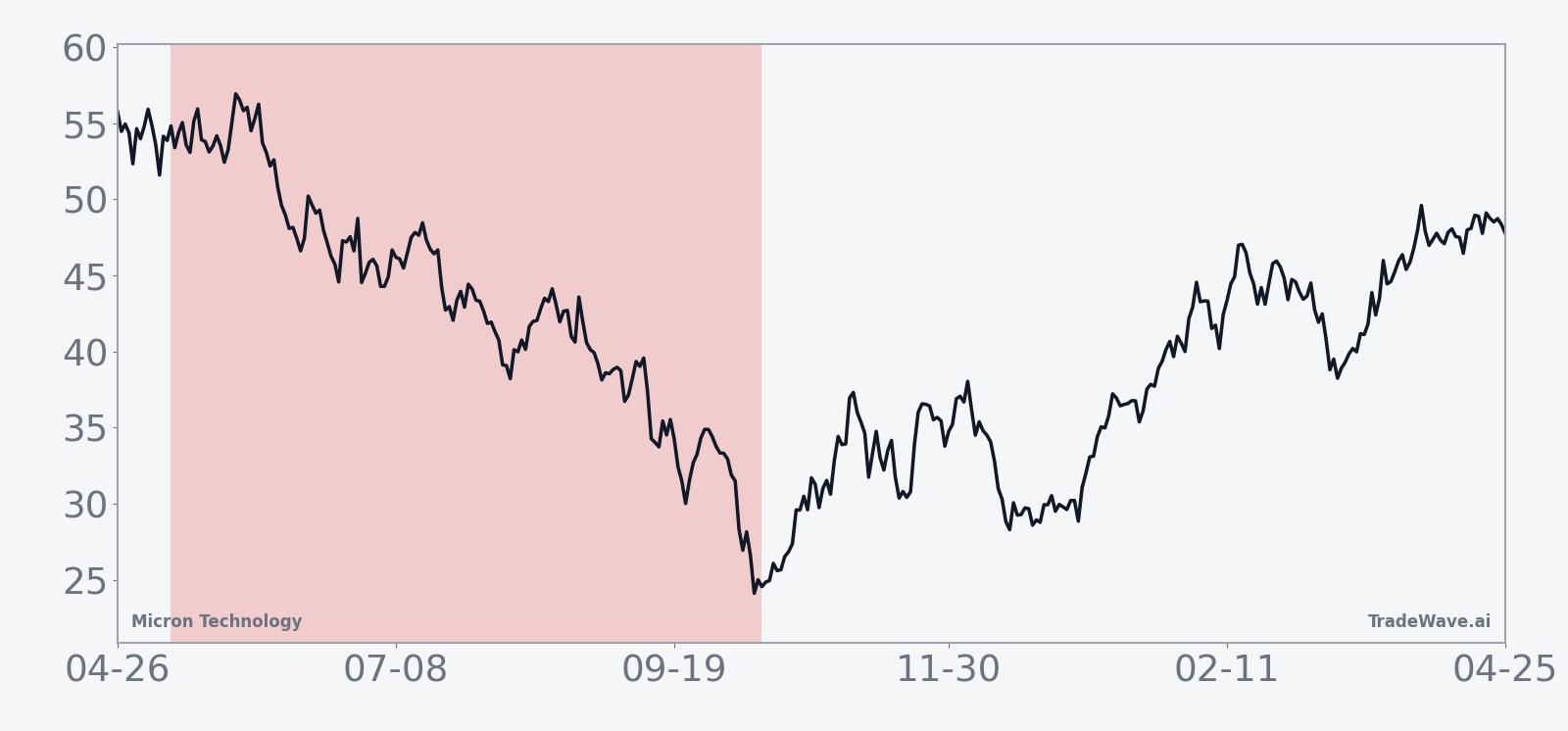
The historical seasonal average trend for this window shows Micron typically weakening in stages rather than collapsing in a straight line. The pattern tends to feature early choppiness, followed by a more persistent drift lower into the back half of the 156-day stretch, which aligns with the midterm-year calendar as Washington’s policy fights intensify.
A per-year view of net returns alongside best and worst intraperiod moves shows how consistently the pattern has favored shorts, even when rallies hit along the way.
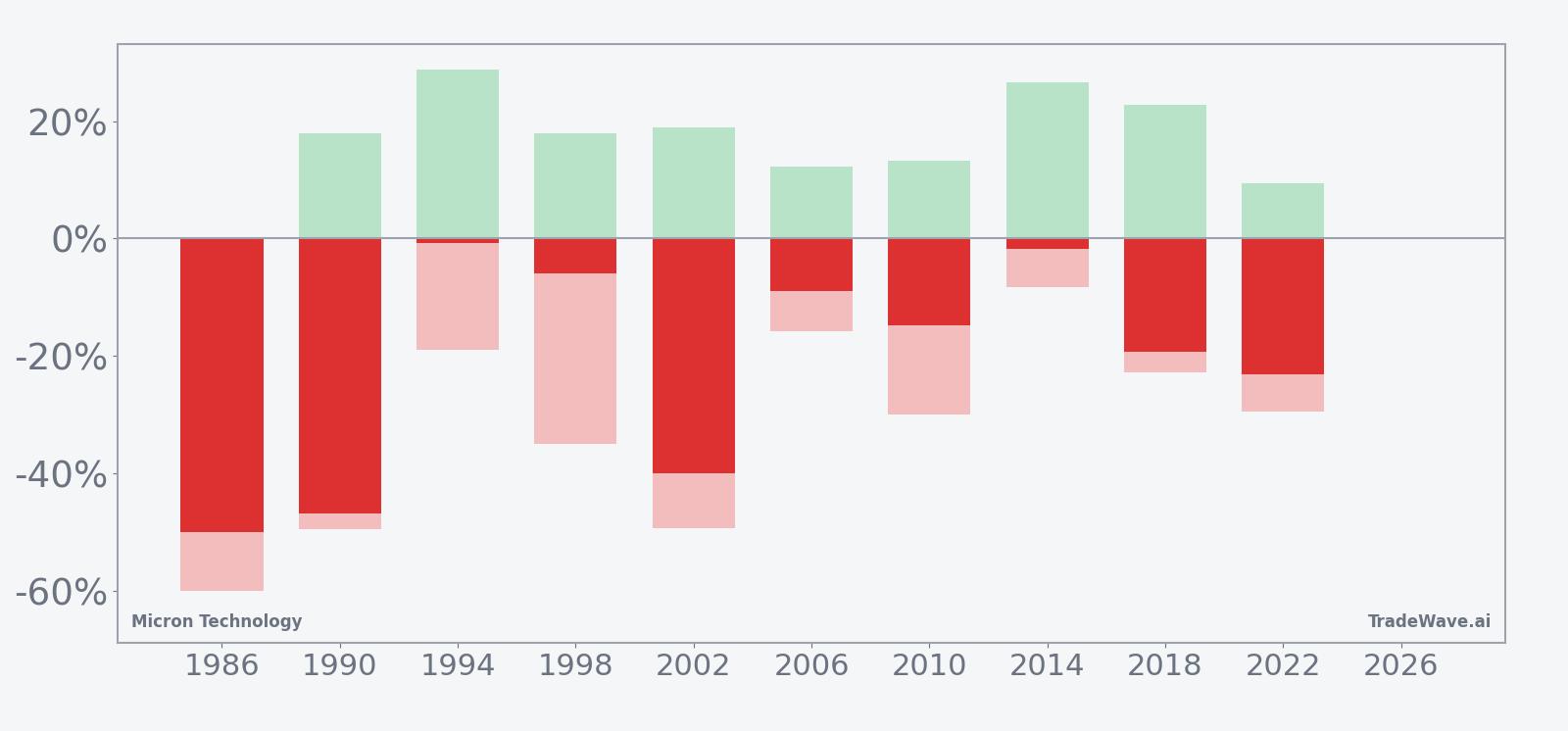
The stacked net, maximum favorable move and maximum adverse move bars show that even in years with deep final declines, Micron often staged sizable countertrend rallies inside the window. Large maximum favorable excursions for shorts sit alongside large maximum adverse excursions, which means the historical pattern has rewarded patience but punished loose risk management.
History does not guarantee future results; adverse excursions can be large even in winning windows, and past seasonal behavior may not repeat.
Why does Micron Technology (MU) follow this seasonal pattern?
One likely driver is the way Micron’s earnings calendar and capital spending plans intersect with the midterm election-year policy cycle. Analysts have pointed to heavy AI data center demand, supply constraints and regulatory scrutiny as factors that can amplify swings in memory-chip pricing and margins during this part of the year.[1] The pattern may also reflect institutional portfolio repositioning around midyear, as investors reassess exposure to high-beta semiconductor names when Washington’s fiscal and regulatory debates heat up.
What is driving Micron Technology (MU) today?
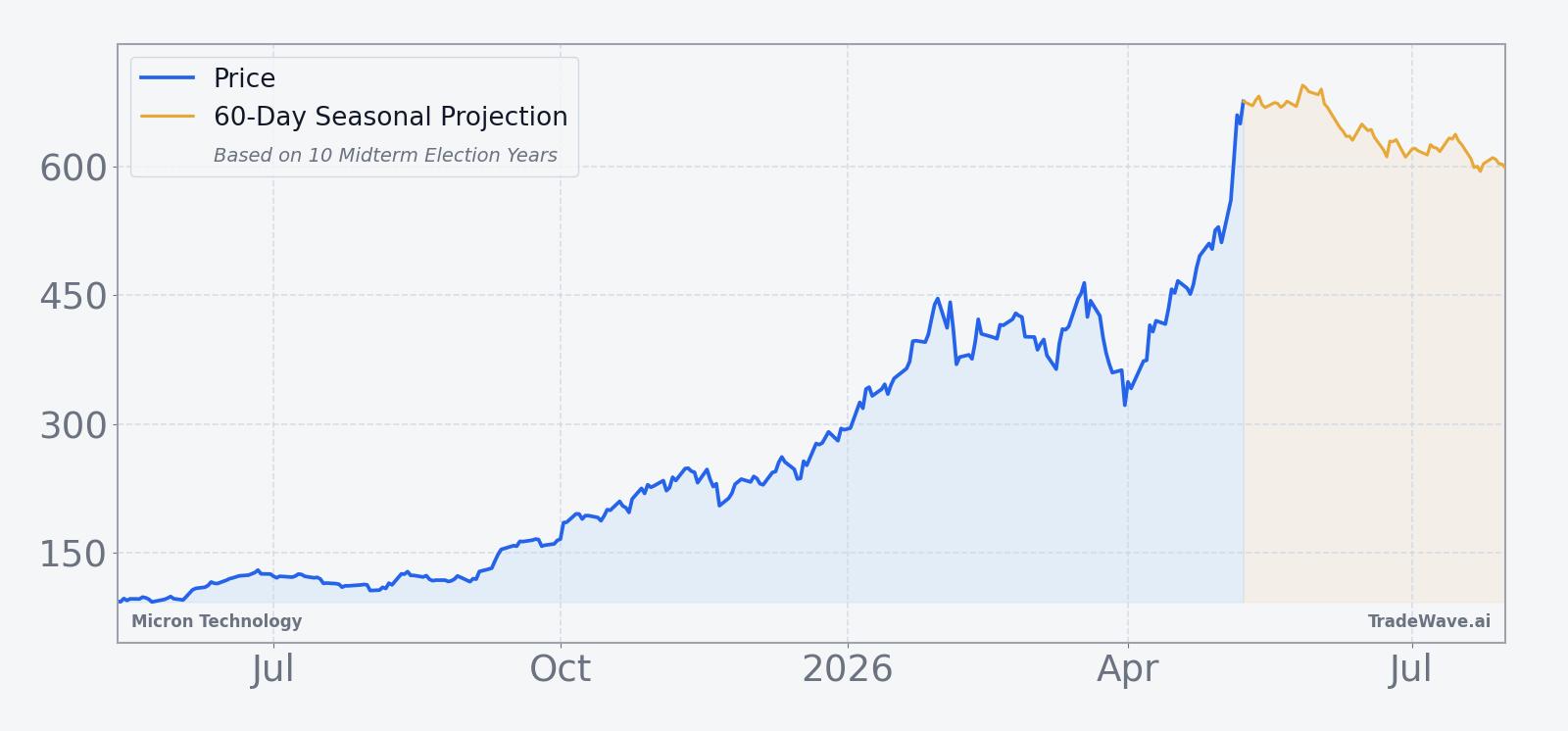
Micron shares have been on a tear, closing Friday at $741.43 after a 14.7% daily jump and trading around $746.81 on Monday, just 0.1% below a new 52-week high of $747.21 and up roughly 180% year to date.[5] The move caps a run that accelerated after Micron smashed its Q2 fiscal 2026 earnings in March, posting revenue of $23.86 billion, up 196% year over year, and earnings per share of $12.20, both well ahead of Wall Street estimates as AI data center demand soaked up high-end memory chips.[1] Management guided for Q3 revenue of $33.5 billion and EPS of $19.15 with gross margins near 81%, reinforcing the view that AI-driven demand and structural supply tightness could support elevated profitability into 2027.[1]
That strength has not come without turbulence. On Mar 19, shares fell nearly 7% in premarket trading as investors took profits after the historic run, even as analysts broadly praised the guidance and reiterated bullish views on Micron’s role in the AI buildout.[4] In the run-up to the March earnings print, options markets priced in roughly an 8% move with a bullish tilt in call activity, signaling that traders were leaning into upside volatility rather than hedging for a reversal.[13] Several commentators have since argued that Micron remains one of the standout stocks in the current market, citing short interest of about 2.60% and the potential for any downcycle fears to draw in more bearish positioning over time.[5]
The chart below situates the latest surge against Micron’s past year of trading and a 60-day seasonal projection overlay.
How does the macro and policy backdrop shape this Micron window?
The macro story behind Micron’s surge is straightforward: AI investments in data centers are booming, and Micron’s high-bandwidth memory and advanced DRAM are central to that buildout.[2] Sector analysts describe a semiconductor memory market defined by strong demand and supply constraints, which has pushed pricing higher and given Micron unusual earnings power for a historically cyclical business.[1] In a midterm election year, that backdrop intersects with debates over tech regulation, data center energy use and industrial policy, all of which can influence how investors value high-growth chip names.
From a policy-calendar angle, midterm years often feature contentious budget negotiations and shifting expectations for fiscal support or restraint. For a capital-intensive company like Micron, which is investing heavily in new fabs and advanced process technology, changes in subsidies, tax incentives or export controls can quickly alter sentiment. That helps explain why the midterm-year seasonal pattern for Micron looks different from its behavior in election or pre-election years, when policy tends to be more supportive of risk assets.
What should traders watch in this Micron Technology (MU) window?
Three things stand out for this midterm-year stretch. First, watch how Micron trades relative to its 52-week high zone around $747 as the 156-day window progresses; historically, this window has favored sustained downside for the stock even when it started from strong levels. Second, monitor whether AI-driven earnings momentum and guidance hold up against any signs of demand digestion or pricing pressure in memory, since the current fundamental story is far stronger than in many of the past midterm cycles.[1] Third, keep an eye on options flow and short interest: if bullish call activity fades and short interest climbs from the current 2.60% area, that would echo prior years when positioning shifted in favor of the short-side seasonal pattern.[5][13]
If Micron shrugs off this historically weak seasonal stretch and holds near or above recent highs, it would mark a clear break from the last 10 midterm election years. If instead the stock begins to roll over while options activity tilts less aggressively bullish and policy headlines around AI and chips turn more contentious, that would look much more like the historical script for this window.[1][5][13] Either way, the combination of a powerful AI uptrend, a fully engaged options market and a 100% short-favorable seasonal record makes this one of the more consequential Micron Technology trading windows on the calendar.
Sources
- Seeking Alpha – Micron Just Smashed Estimates - Buy The Dip (NASDAQ:MU) (Mar 18, 2026)
- CNBC – Micron earnings are out after the bell following a big move higher (Mar 18, 2026)
- Yahoo Finance – Micron Target Raised to $500 After Strong Q1 Earnings Beat (Dec 23, 2025)
- Seeking Alpha – Micron slides as investors take profits after historic run; analysts praise guidance (Mar 19, 2026)
- Seeking Alpha – Micron Is Still One Of The Best Stocks In This Current Market (Mar 26, 2026)
- Seeking Alpha – Micron options lean bullish ahead of earnings with ~8% move priced in (Mar 18, 2026)
About this seasonal analysis
Seasonal pattern data is sourced from TradeWave.ai, which analyzes historical price behavior across annual calendar windows going back up to 30 years. Read the full data methodology or the book The 100-Year Pattern by Afshin Moshrefi (2026 edition). Past performance of seasonal patterns does not guarantee future results. This article is for informational purposes only and does not constitute investment advice.