Corn (CME) (ZC) Has Dropped in Every Midterm May 15 Window, With 100% Short Win Rate
Corn (CME) futures are trading just under a 52-week high as they head into a mid-May seasonal window that has consistently rewarded short positions and often delivered sharp intraperiod swings.

What is the seasonal pattern for Corn (CME) (ZC)?
Corn (CME) has fallen in 6 of 6 midterm-election-year windows starting around May 15, with an average gain of 5.56% in winning short trades.
- 6 for 6 in this window, with short trades averaging 5.56% profits across the last six midterm election years.
- The upcoming 24-day Corn (CME) trading window begins May 15 and has historically favored downside moves for ZC.
- Percent Profitable is 100%, with 6 winners and 0 losers for the short setup in this specific seasonal slice.
- Median profit on winning years is 6.08%, pointing to a fairly consistent payoff profile for shorts.
- The TradeWave Ratio (TWR) of 3.25 indicates that price typically travels meaningfully in the trade direction within the window, independent of the final close.
- A Sharpe ratio of 3.92 for this pattern signals unusually strong risk-adjusted returns for the historical short strategy.
According to historical data from TradeWave.ai, this mid-May stretch in midterm election years has behaved very differently from an average month on the corn calendar, and the next iteration is just days away.
How has Corn (CME) (ZC) traded in the upcoming May 15 midterm window?
Corn (CME) has delivered profitable short trades in all six midterm-election-year windows starting around May 15, with average gains of 5.56% for bears over 24 trading days. Futures settled Friday at 466.25 cents a bushel, up 3.0% on the day and sitting about 1.6% below the 52-week high of 473.75, leaving little margin for error if the historical pattern reasserts itself.
Because this pattern is grouped by the presidential election cycle, it only looks at the last six midterm election years, not every calendar year. That matters for corn because midterm years often coincide with shifting farm policy debates, budget wrangling over crop insurance and biofuel mandates, and mid-cycle adjustments in risk appetite that can amplify moves in grain markets.
Historically, the trade direction for this window has been short. Every one of the six midterm-year samples from 2002 through 2022 shows a negative net return for corn prices over the 24-day span, which translates into a winning outcome for traders positioned for downside. The strongest year for the pattern was 2014, when ZC fell 6.87% from an entry near 484.25 to an exit around 451.00, while the softest win came in 2006 with a 3.46% decline from 260.00 to 251.00.
The average profit of 5.56% reflects those winning short trades only, while the median profit of 6.08% shows that half the years delivered at least that much downside. Because there were no losing years in the sample, the all-years average lines up with the winner average, and the reported 6% cumulative return across the six cycles compounds those individual moves into a sizable seasonal edge for bears.
The intraperiod path has not been gentle. In 2022, for example, corn dropped 6.49% over the window, but the worst drawdown from the entry price reached 10.99%, meaning shorts had to sit through a sizable adverse move before the trade finished in the money. In 2010, the best point-to-peak move in favor of the short position reached 4.99%, while the worst drawdown was 5.76%, underscoring that both maximum favorable excursion and maximum adverse excursion have been large enough to matter for risk management.
Trend metrics in the pattern summary show 68 days of favorable trend for longs and just 2 for shorts across the full history, but within this specific 24-day slice the behavior flips in favor of the short side. The per-year table suggests that in several cycles corn has chopped early in the window before breaking lower, which can make timing tricky for anyone trying to fade the seasonal tendency.
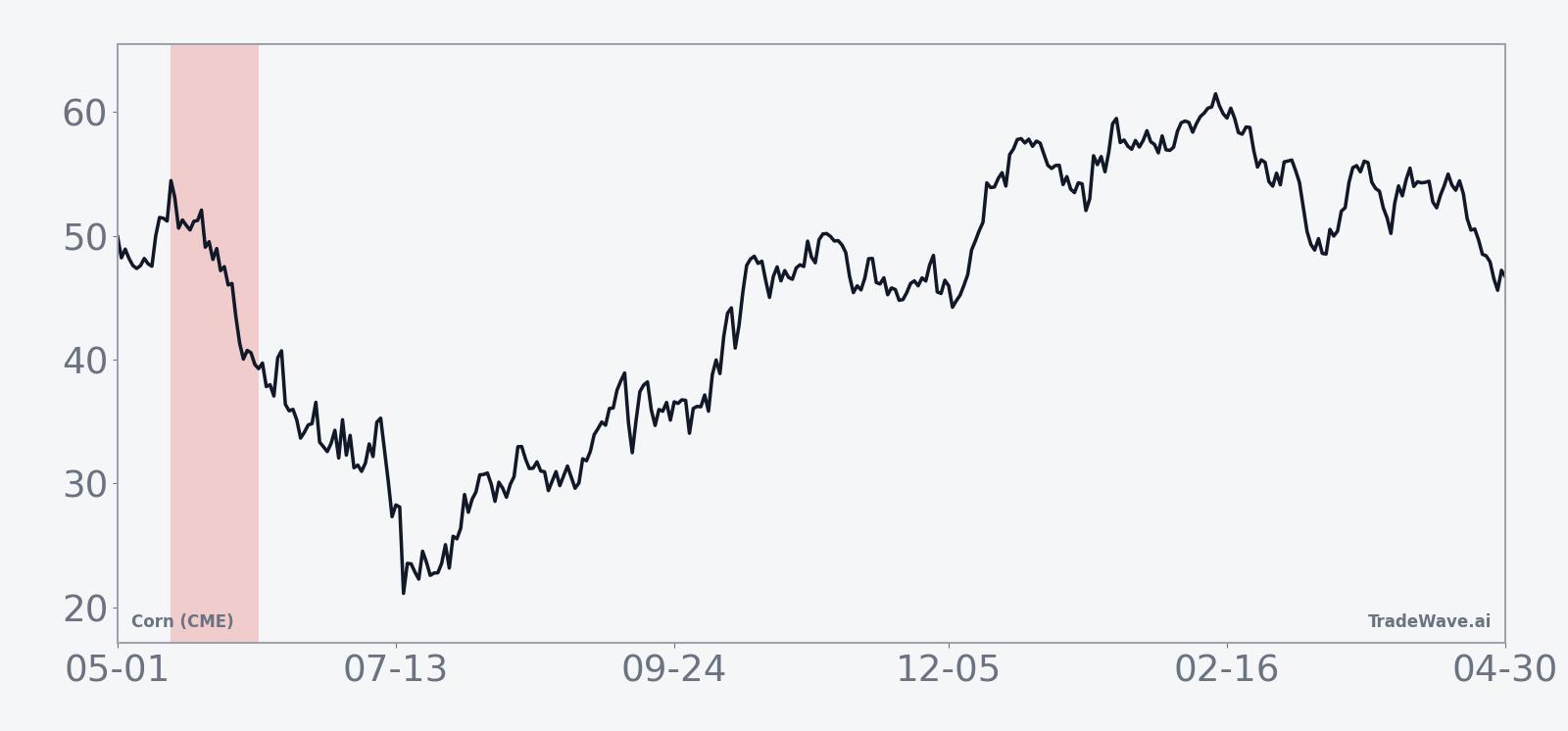
A stacked view of yearly net returns alongside best and worst intraperiod swings shows how consistently this window has leaned lower while still delivering sizable counter-moves.
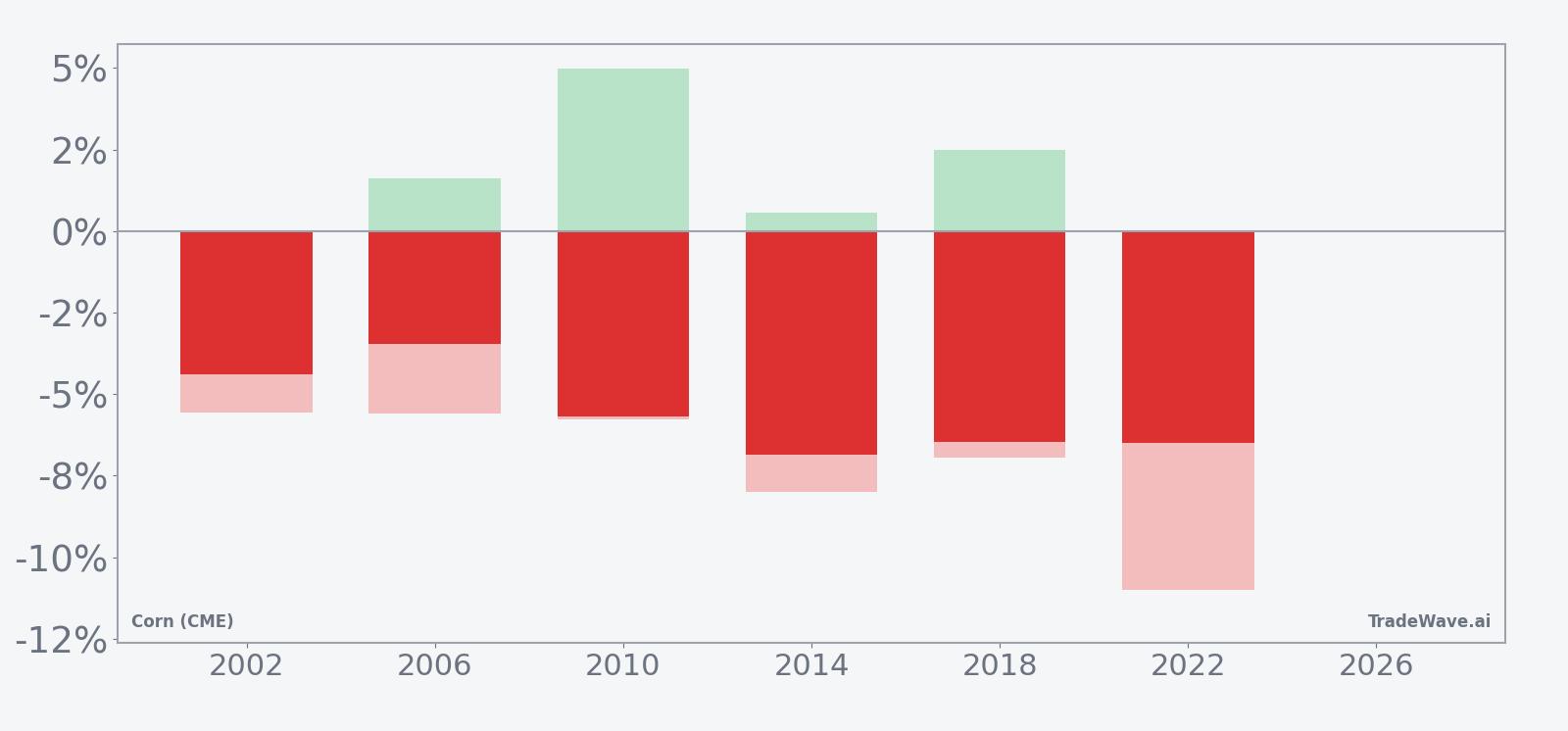
The bar chart makes the pattern clear: every bar ends below zero for price, which is positive for the short strategy, but the intraperiod spikes and dips are wide enough that position sizing and stop placement matter as much as the direction. Add it up and you get six for six winning short trades, but with a history of sharp swings along the way.
History does not guarantee future results, and even in windows with 100% profitable outcomes for the trade direction, adverse excursions within the window can be large.
Why does Corn (CME) (ZC) follow this seasonal pattern?
This mid-May to early-June stretch lines up with key points in the U.S. planting season, when early acreage and emergence data collide with evolving weather forecasts and updated USDA supply estimates. One likely driver is that as planting progress becomes clearer in midterm election years, policy noise around farm support and biofuel mandates can intersect with improving visibility on crop size, encouraging traders to lean against prior weather or supply scares. The repeated success of short setups in this window may reflect a tendency for early-season optimism on demand or weather risk to fade once more concrete information hits the tape.
What is driving Corn (CME) (ZC) today?
Corn (CME) July futures closed Friday at 466.25, up 13.50 cents or 2.98% on the session, with volume just under 10,000 contracts in the front snapshot and 20-day average volume near 177,710. That puts ZC only about 1.6% below its 52-week high of 473.75 and well above the 50-day moving average around 447.52, a setup that leaves the contract elevated heading into a historically bearish seasonal window for prices.
The chart below shows how that rebound fits into the past year’s trading range and the next 60 days of seasonal projection.
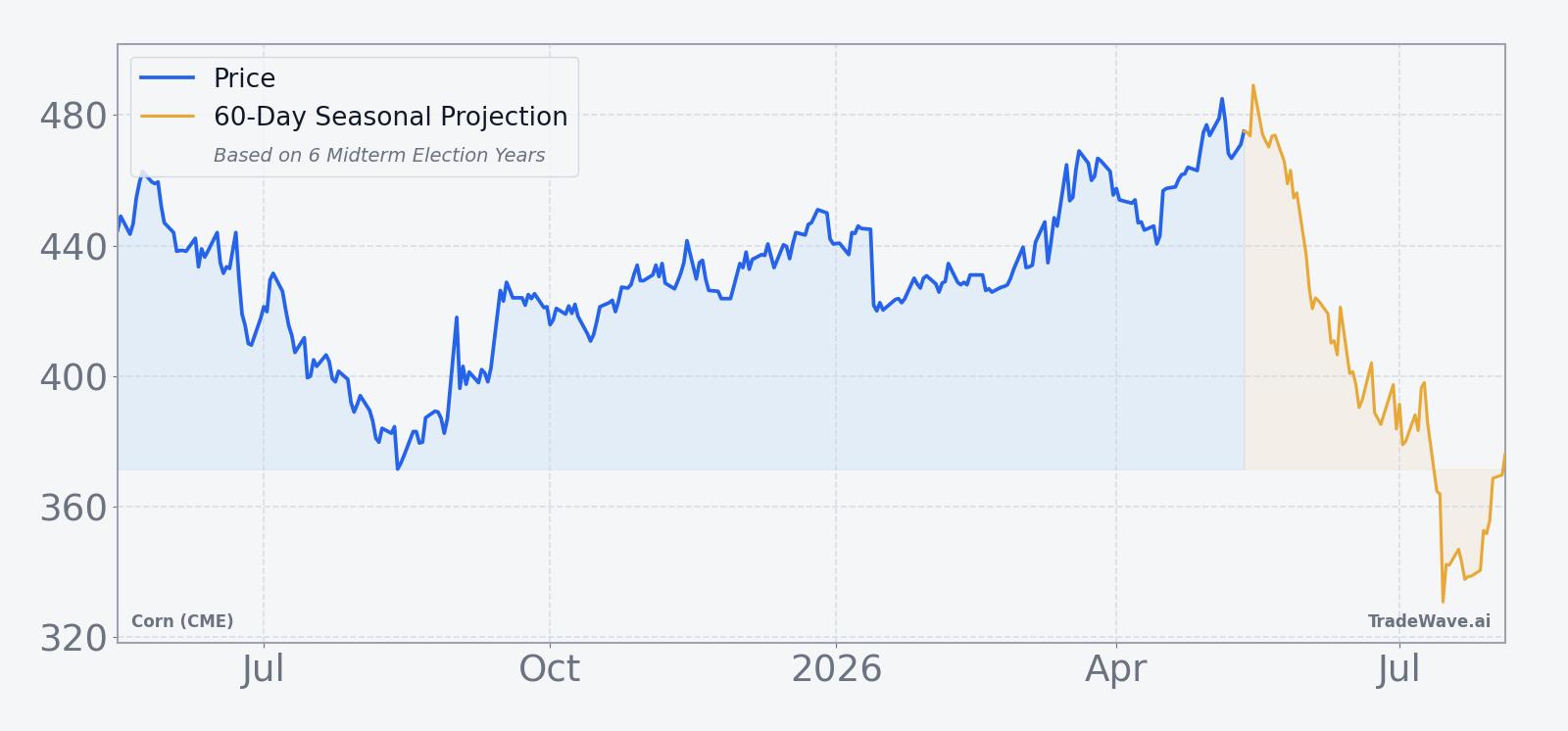
Fundamentally, the market is still digesting higher U.S. ending stocks after the USDA raised its corn inventory estimates, a shift that pressured prices earlier in the year as traders recalibrated supply expectations.[1] At the same time, analysts project 2026 corn plantings at 94.9 million acres, with farmers favoring corn as the best path to break even despite narrow margins and competition from other crops.[1] That combination of ample stocks and large intended acreage keeps a lid on longer-term bullish narratives even as short-term rallies flare on weather scares or commodity-wide rebounds.
Sector-wide, grain markets remain sensitive to export flows and biofuel demand, with corn sitting at the intersection of feed, ethanol and global trade dynamics.[1] When oil prices retreat or weather in the U.S. Corn Belt improves, as has happened in several recent episodes, corn futures have tended to give back gains as fears about planting delays or supply squeezes ease.[1] Against that backdrop, the upcoming midterm-year seasonal window stands out as a period when rallies have historically struggled to stick.
What should traders watch in this Corn (CME) (ZC) seasonal window?
The first marker is timing. The 24-day window begins May 15, so price action in the days just before entry can shape how much room there is for a downside move. If ZC pushes to or through the 52-week high near 473.75 ahead of the window, the historical pattern suggests that elevated levels have often been followed by multi-week softening rather than sustained breakouts.
Second, watch how corn reacts to fresh USDA updates on planting progress and any revisions to stock or acreage estimates. In prior midterm years, the window has coincided with a shift from uncertainty to greater clarity on crop size, and that transition has often favored short positions as early-season weather or demand fears fade. A repeat of that behavior would show up as rallies that stall quickly and intraday spikes that fail to hold into the close.
Third, intraperiod volatility will matter as much as direction. Past windows have seen maximum adverse moves for shorts approach double-digit percentages in some years, even when the final outcome was profitable. Traders who track daily swings relative to entry levels can gauge whether this cycle is following the historical script of choppy early action followed by a more decisive break lower, or diverging into a cleaner trend.
Finally, monitor how corn’s behavior interacts with broader agriculture and energy markets. If oil prices stay soft and weather in the Corn Belt remains cooperative, that would align with the historical tendency for this window to lean bearish on prices. A sharp, sustained rally in crude or a meaningful weather shock, by contrast, would be a clear test of how robust the ZC seasonal trend really is in 2026.
Sources
About this seasonal analysis
Seasonal pattern data is sourced from TradeWave.ai, which analyzes historical price behavior across annual calendar windows going back up to 30 years. Read the full data methodology or the book The 100-Year Pattern by Afshin Moshrefi (2026 edition). Past performance of seasonal patterns does not guarantee future results. This article is for informational purposes only and does not constitute investment advice.