CORN Nears Seasonal Pattern After 10 Straight June Declines
CORN is trading just above its 52-week low as it approaches a short June seasonal window that has delivered consistent downside for the ETF over the past decade.

What is the seasonal pattern for CORN (CORN)?
CORN has fallen in 10 of 10 years during this mid-June 13-day window, with an average loss of 4.22% in winning short years.
- 10 for 10 in this window, with short positions averaging 4.22% gains when CORN moves lower.
- The upcoming pattern runs from Jun 15 for 13 trading days and has historically favored downside in CORN.
- Percent Profitable is 100%, with 10 winners and 0 losers for the short-side setup across the last decade.
- Cumulative return across all 10 windows is 50%, supported by a Sharpe ratio of 1.68 for the strategy.
- The TradeWave Ratio of 2.07 signals that price has typically traveled meaningfully in the trade direction within the window.
- Intraperiod swings have included sizable adverse moves in some years, underscoring that short windows can still be volatile.
According to historical data from TradeWave.ai, this mid-June stretch has behaved very differently from an average month for CORN, and the next iteration is only days away.
How has CORN (CORN) traded in this mid-June window?
CORN has dropped in every single mid-June 13-day window for the past 10 years, with short trades averaging 4.22% gains. The ETF last closed at 17.06, up 0.1% on the day and sitting about 2.7% above its 52-week low of 16.61 while roughly 10.8% below its 52-week high of 19.13. That combination of a tight spot near the bottom of the yearly range and a decade-long bearish seasonal trend makes this upcoming window hard for grain traders to ignore.
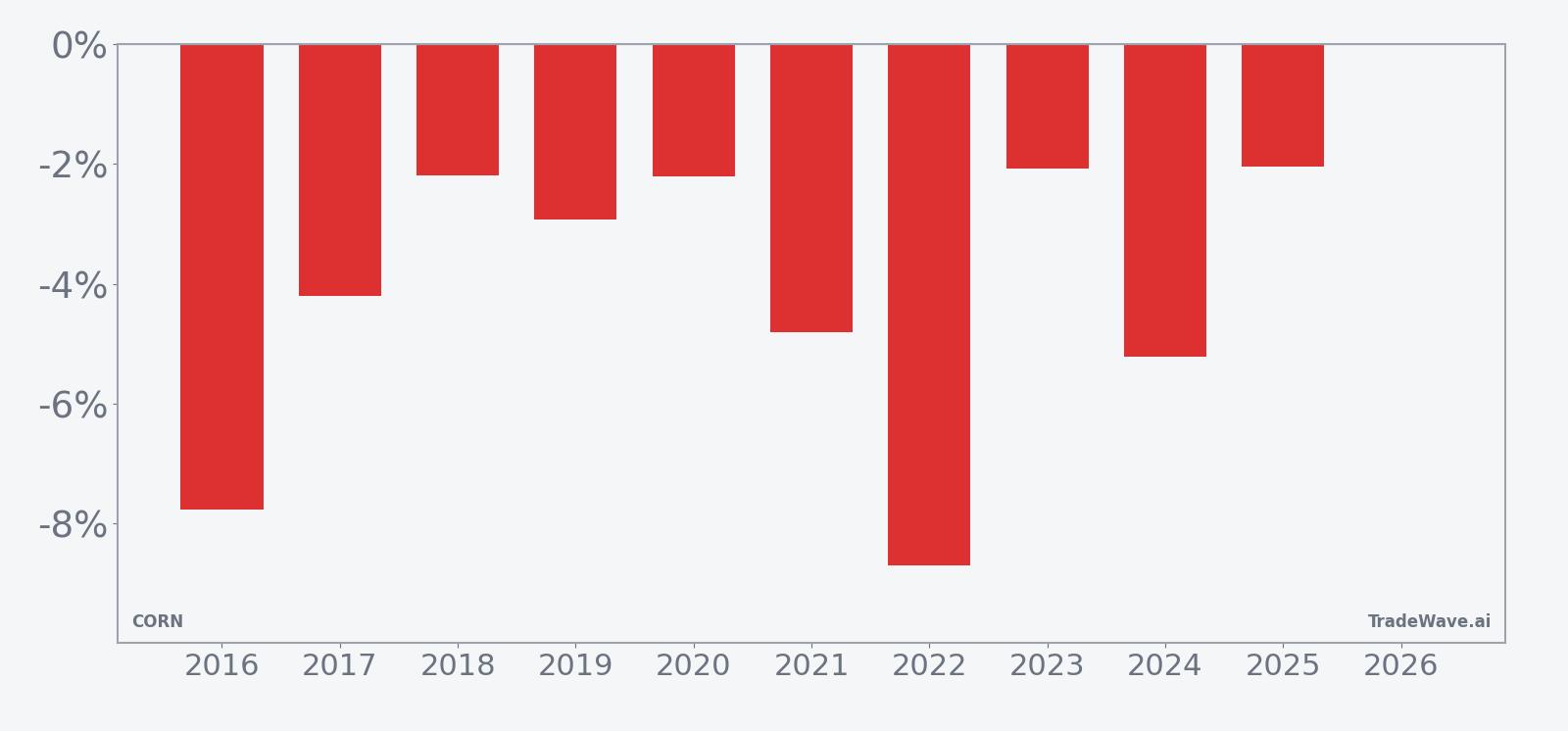
Across the 10-year sample, every mid-June window produced a negative net return for CORN, consistent with the short trade direction. The weakest year for the ETF in this slice of the calendar was 2022, when CORN fell 8.69% from entry to exit, while the smallest decline came in 2018 with a 2.19% drop. Add it up and the cumulative return for the short strategy across all 10 windows is 50%, which is notable for a period that spans just 13 trading days each year.
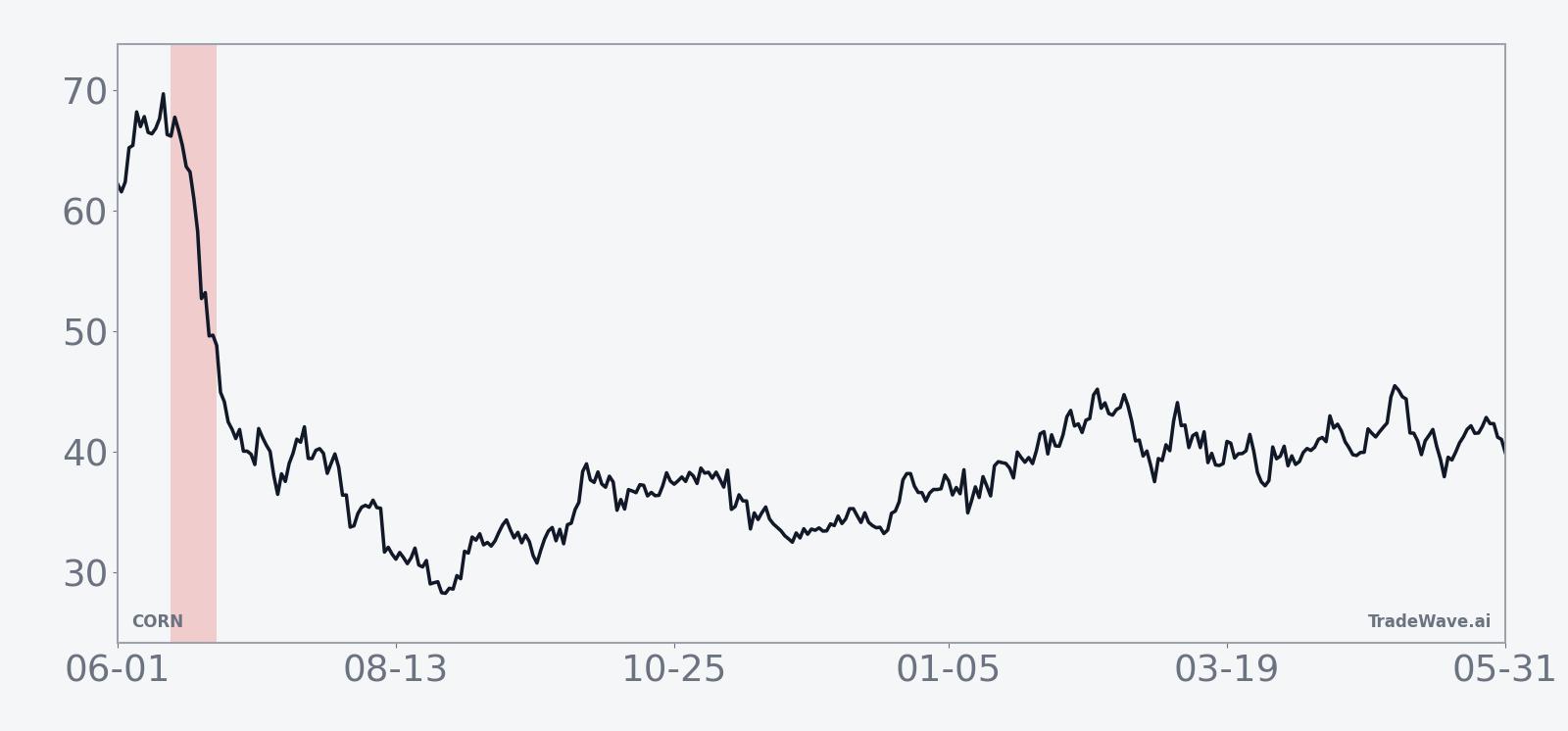
The historical seasonal trend chart for this window shows a fairly steady grind lower rather than a single sharp break. On average, the bulk of the move tends to accrue across the middle of the window, with some years seeing early noise before the trend asserts itself. That profile lines up with the idea of a short, tactical CORN trading window rather than a long, drawn-out bear phase.
Year-by-year bars with maximum favorable and adverse moves show how far CORN has typically swung inside this window.
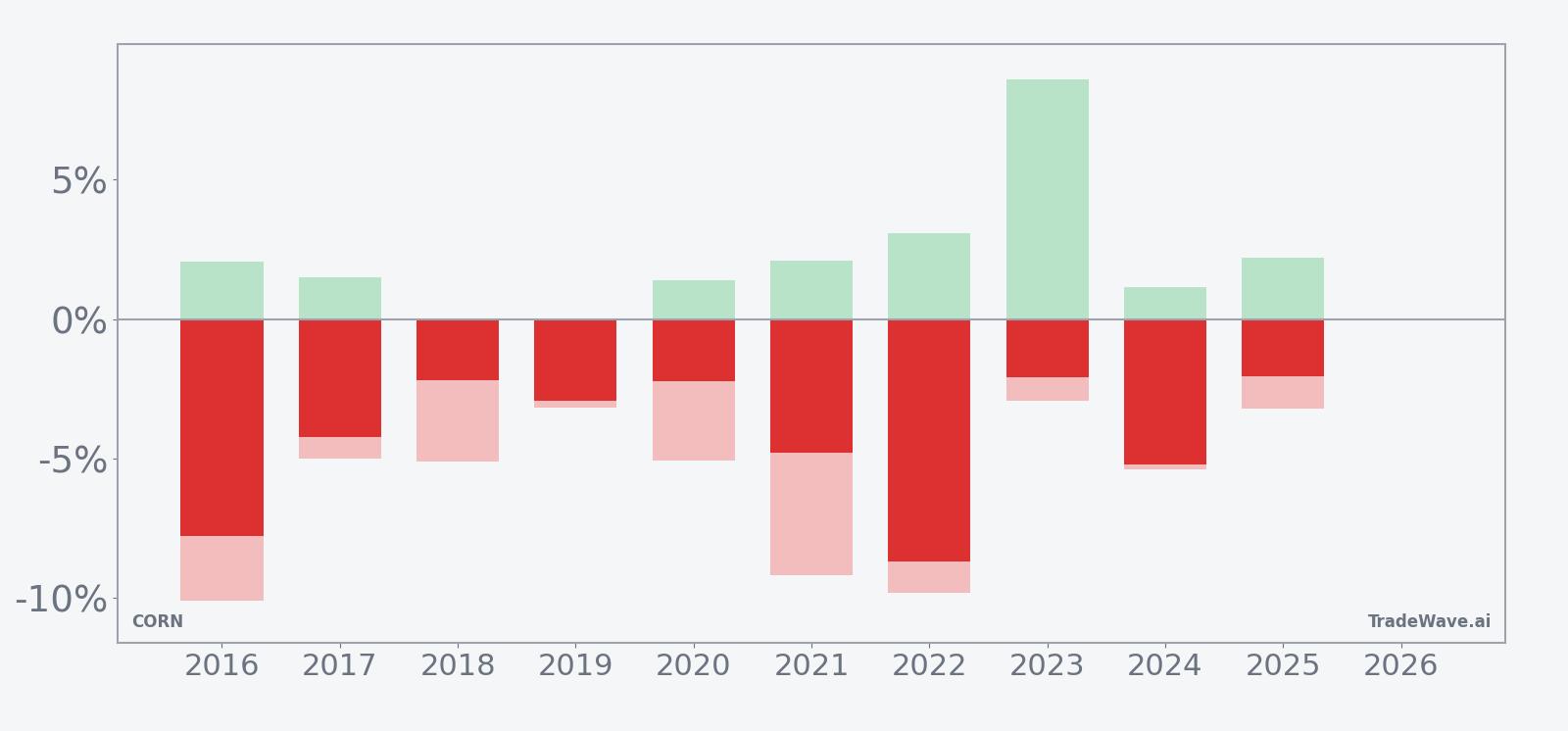
The maximum favorable move, or best intraperiod run in the trade direction, has often been larger than the final net result, which is typical for short-term patterns where traders rarely capture the exact extremes. At the same time, maximum adverse moves have at times been sizable, with years like 2016 and 2021 showing drawdowns of more than 9% against the short before the window closed in profit. The TradeWave Ratio of 2.07 captures this tendency for CORN to travel meaningfully in the trade direction during the window, even when the final close understates the intraday or intraperiod swings.
History does not guarantee future results, and adverse excursions can be large even in windows that ultimately finish in the trade’s favor.
Why does CORN (CORN) follow this seasonal pattern?
This mid-June seasonal pattern for CORN likely reflects commodity supply and demand seasonality around the U.S. growing season. One likely driver is shifting expectations for crop size as early weather and planting data firm up, which can pressure corn prices when supply looks ample. Positioning adjustments by commodity funds and hedgers around key U.S. Department of Agriculture reports may also cluster in this period, reinforcing a tendency for CORN to weaken during this short June window.
What is driving CORN (CORN) today?
CORN closed Wednesday at 17.06, up 0.14% on the day, with roughly 208,000 shares changing hands against a 20-day average volume of about 566,700. The ETF, which tracks front-month corn futures, is trading about 10.8% below its 52-week high of 19.13 and only about 2.7% above its 52-week low of 16.61, underscoring how much grain prices have cooled from last year’s levels.
Flows data for CORN itself are limited in the latest snapshot, but the backdrop for agricultural commodities has been shaped by heavier supply expectations. In January 2026, the U.S. Department of Agriculture projected U.S. corn ending stocks at 2.23 billion bushels, up nearly 200 million bushels from December, a shift that weighed on grain futures and signaled more comfortable inventories for the year ahead.[1] Higher projected grain stocks have tended to pressure benchmark corn prices, and by extension the CORN ETF, as traders recalibrate risk premia around weather and export demand.
Sector-wide, agricultural commodities have been dealing with the same theme. USDA’s January World Agricultural Supply and Demand Estimates raised ending stocks not just for corn but also for soybeans and wheat, contributing to a softer tone across the grain complex.[1] For CORN holders, that means the ETF is entering its historically weak mid-June trading window from a position of already subdued prices rather than from a euphoric spike.
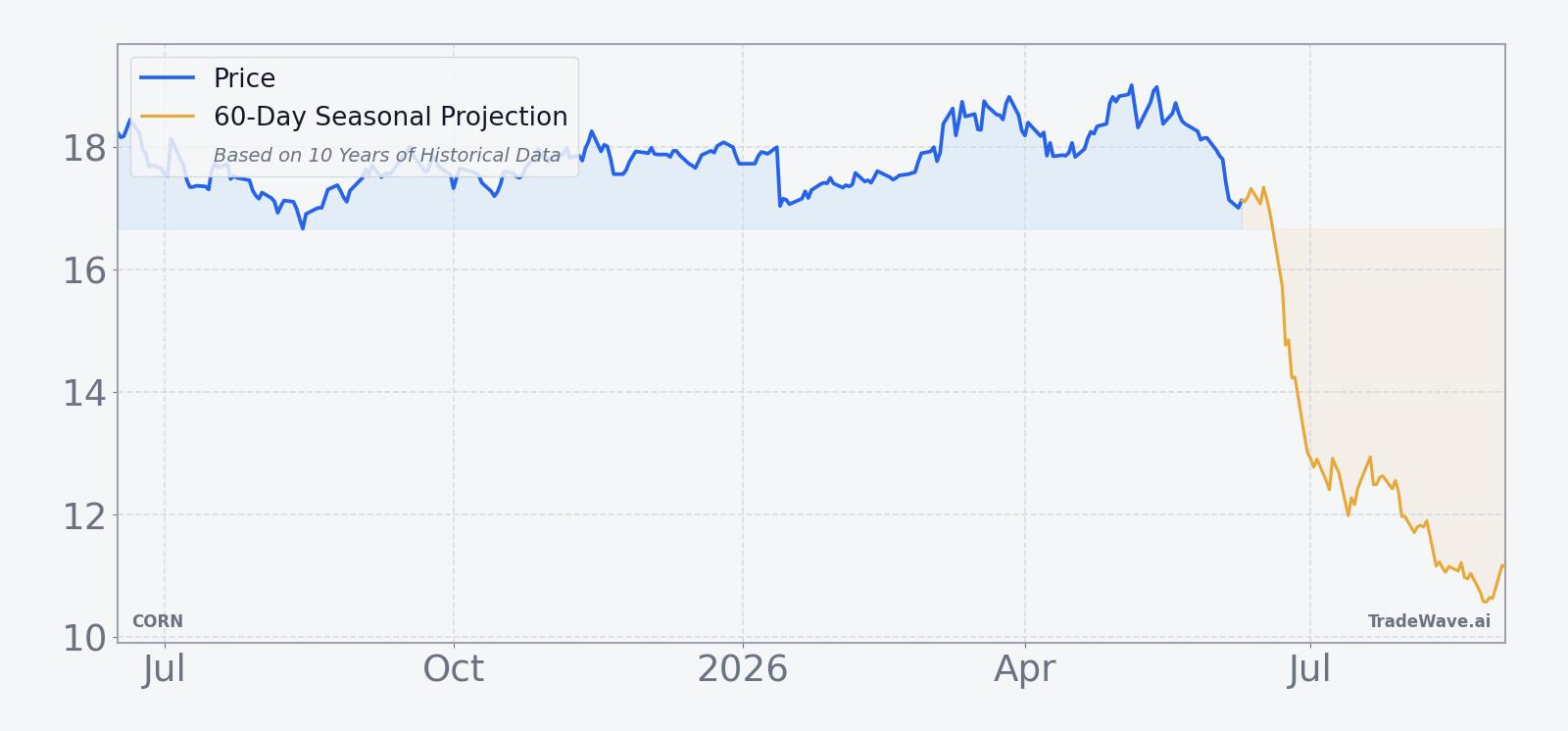
The chart below situates the latest move in its recent multi-month context and overlays a short-term seasonal projection.
What should traders watch in this CORN (CORN) window?
With CORN hovering just above its 52-week low and a 10-for-10 bearish mid-June window approaching, the next few weeks could be pivotal for how traders interpret the ETF’s seasonal trend. The first focal point is price behavior as the window opens on Jun 15: if CORN starts to drift lower in line with the historical pattern, it would reinforce the idea that this short 13-day stretch remains a distinct part of the corn calendar. A firm bounce instead, especially one that pushes the ETF back toward its 50-day moving average near 18.21, would mark a clear break from the past decade’s script.
Macro catalysts will matter as well. Any fresh USDA updates on crop conditions, planting progress, or revised ending stocks could either amplify or blunt the usual seasonal pull, particularly if weather turns more threatening for yields after a period of comfortable supply expectations.[1] Traders will also be watching volume: a pickup toward or above the 20-day average during the window would suggest that institutional money is leaning into the move, while a quiet tape might indicate that the pattern is fading as a tradable edge.
For investors using CORN as a hedge or tactical vehicle, the key levels to monitor are the recent low near 16.61 on the downside and the 18 to 18.50 band on the upside, where the 50-day moving average and prior support converge. How CORN behaves between those markers during the mid-June window will show whether this 10-year seasonal streak still has teeth or whether supply, demand, and positioning have shifted enough to rewrite the pattern.
Sources
About this seasonal analysis
Seasonal pattern data is sourced from TradeWave.ai, which analyzes historical price behavior across annual calendar windows going back up to 30 years. Read the full data methodology or the book The 100-Year Pattern by Afshin Moshrefi (2026 edition). Past performance of seasonal patterns does not guarantee future results. This article is for informational purposes only and does not constitute investment advice.