6-for-6: Nasdaq QQQ Invesco ETF (QQQ) Has Averaged 19.97% Gains in This Midterm Window
Nasdaq QQQ Invesco ETF is approaching a midterm-year seasonal window that has never posted a loss in the last six cycles, even as the tech-heavy ETF trades below its recent peak after a sharp pullback.
What is the seasonal pattern for Nasdaq QQQ Invesco ETF (QQQ)?
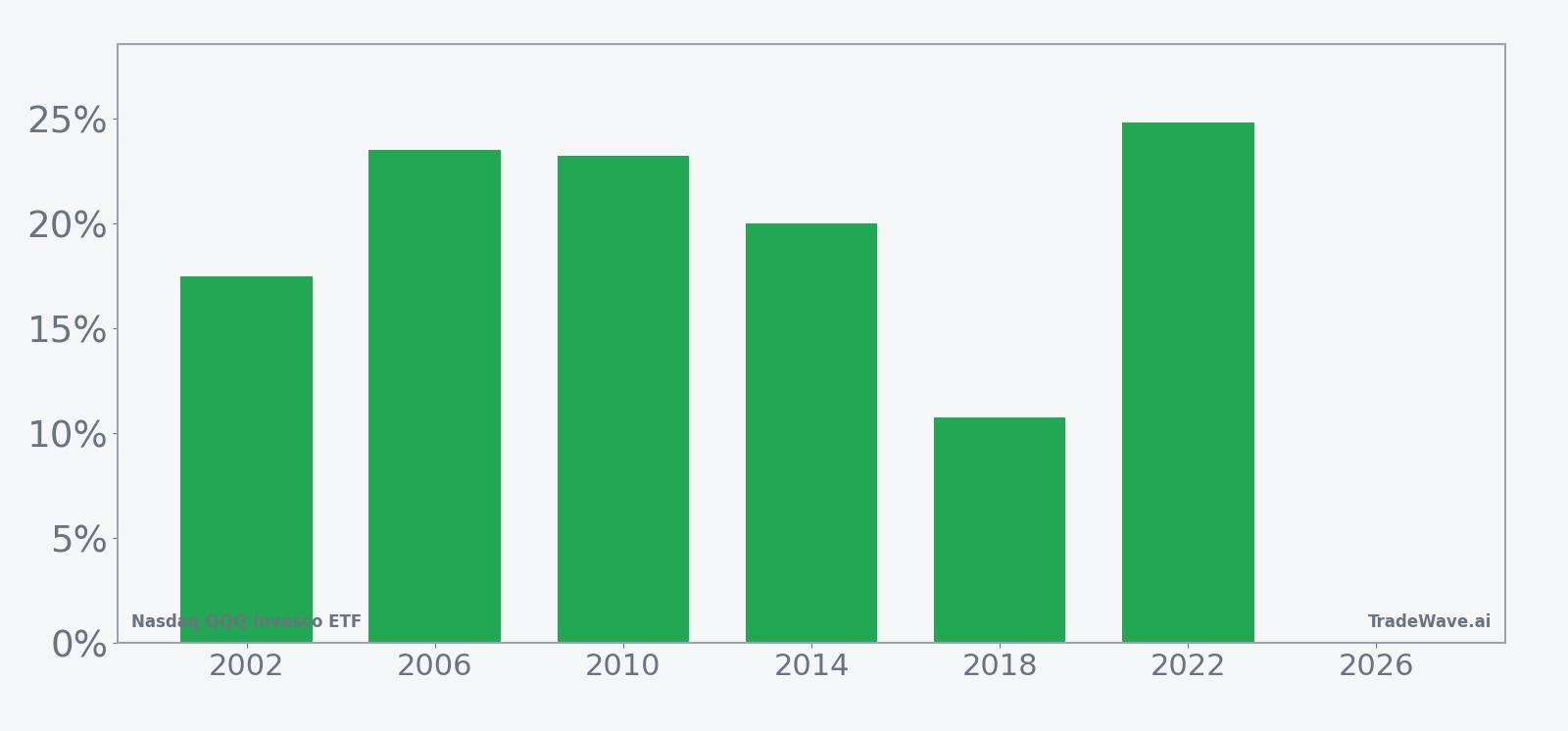
Nasdaq QQQ Invesco ETF has risen in 6 of 6 midterm-election-year windows starting around Jun 25, with an average gain of 19.97% in winning years.
- 6 for 6 in this window, with winning years averaging 19.97% gains across the last six midterm election years.
- Seasonal window begins Jun 25 and runs 364 trading days, covering the back half of the midterm year into the following pre-election year.
- Percent Profitable is 100%, with 6 winners and 0 losers in the historical sample.
- Annualized return across the window is 19.87%, with a Sharpe ratio of 3.04, indicating strong risk-adjusted performance.
- TradeWave Ratio of 2.9 suggests price has typically traveled meaningfully in the long direction within the window, beyond just the final close.
- Individual years have still seen sizable drawdowns inside the window, with adverse moves as deep as roughly 22% before recovering.
According to historical data from TradeWave.ai, this midterm-year stretch has behaved very differently from an average calendar year for QQQ, and the next iteration is about to start.
How has Nasdaq QQQ Invesco ETF (QQQ) traded in this midterm-year window?
Nasdaq QQQ Invesco ETF has posted gains in every one of the last six midterm-election-year windows starting around Jun 25, averaging 19.97% per cycle for long positions. Today QQQ closed at 707.78, down 4.43% on the session and sitting about 5.5% below its 52-week high of 748.65 after a brisk pullback from recent records.[1]
The pattern is grouped by the presidential election cycle, focusing only on midterm election years and how QQQ behaves from late June through the following pre-election year. That matters because policy, regulation and liquidity often follow a four-year rhythm, and tech-heavy benchmarks like QQQ tend to respond differently in mid-cycle years than in election or pre-election years.
Across the six midterm-year samples, the strongest net gain came in 2022, when QQQ finished the window up 24.85% from an entry near 285.71 to an exit around 356.71. The softest outcome was 2018, which still delivered a 10.75% gain from roughly 162.81 to 180.32 by the end of the window. The other years, including 2006, 2010 and 2014, clustered in the high teens to low 20s for net returns, which is why the all-years average sits near 20%.
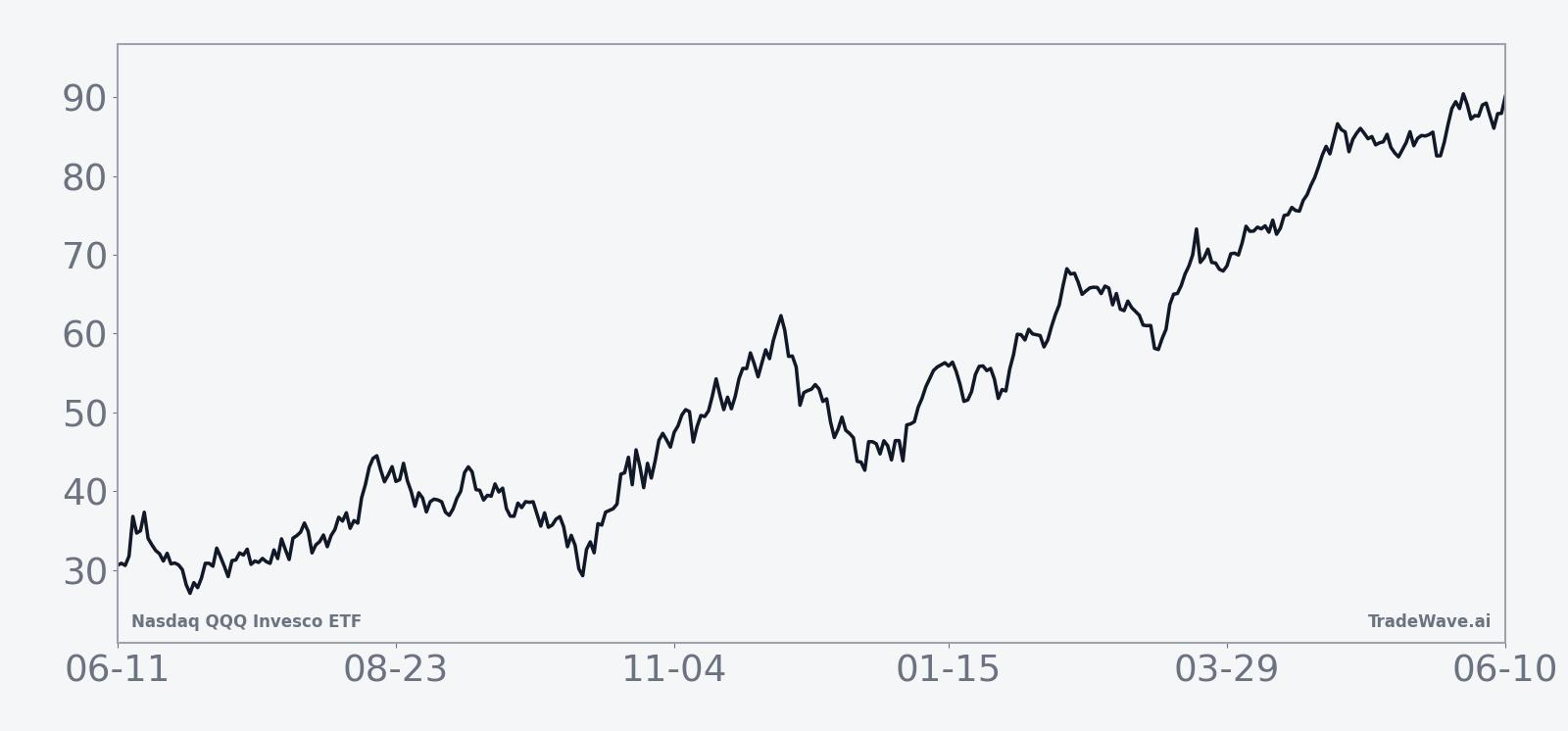
The historical seasonal trend line shows a fairly steady upward slope rather than a single explosive burst. Gains tend to build across the full 364-day span, with only modest pauses, which fits a long trade direction that benefits from persistent strength rather than quick spikes.
A second view combines net results with the typical best and worst intraperiod swings.
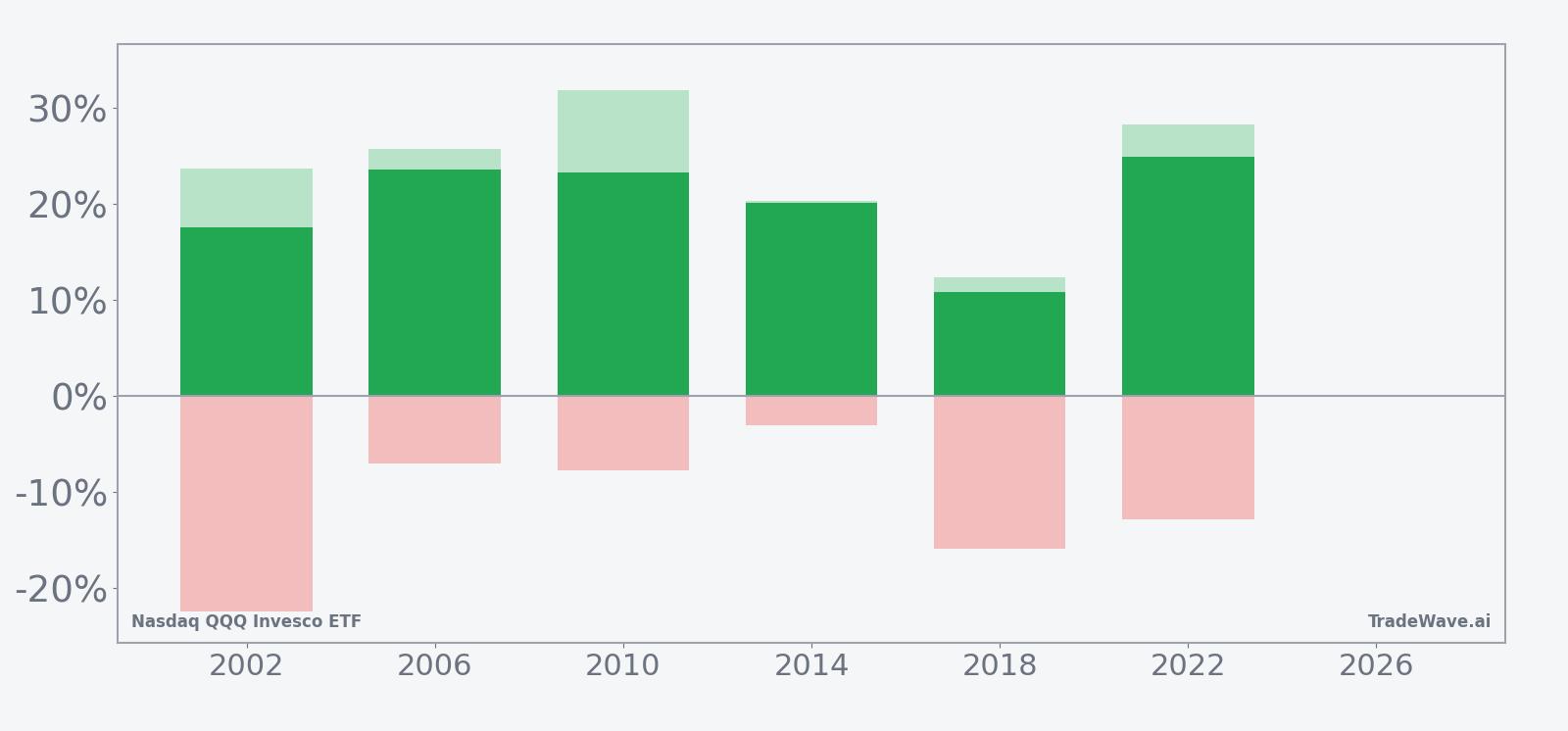
Intraperiod swings have been meaningful. In 2002, for example, QQQ finished the window up 17.48%, but at one point had rallied as much as 23.61% from the entry while also enduring a drawdown of 22.39% below that same entry. Other years such as 2010 and 2022 show maximum favorable moves above 28% with adverse excursions in the high single to low double digits, underscoring that even “all green” windows can involve sharp pullbacks along the way.
History does not guarantee future results; adverse excursions can be large even in winning windows.
Put simply, this midterm-year window has been a clean sweep for long exposure in QQQ across the last six cycles, with strong average gains and a high TradeWave Ratio, but also with enough volatility inside the window that timing and risk management have mattered.
Why does Nasdaq QQQ Invesco ETF (QQQ) follow this seasonal pattern?
One likely driver is the way the policy calendar and earnings cycle line up between the back half of a midterm year and the following pre-election year. Analysts often point to reduced policy uncertainty after midterm votes, combined with renewed fiscal or regulatory support ahead of the next presidential race, as a tailwind for growth and tech-heavy benchmarks. This pattern may also reflect institutional portfolio repositioning, as large managers add risk into a historically strong pre-election backdrop after navigating early-year midterm volatility.
What is driving Nasdaq QQQ Invesco ETF (QQQ) today?
QQQ fell 4.43% to 707.78 on Jun 8, a sharp single-day drop that leaves the ETF about 5.5% below its 52-week high of 748.65 and still well above its 52-week low near 517.64.[1] Trading volume of roughly 79.2 million shares ran well ahead of the recent 20-day average near 38.9 million, signaling heavy repositioning after a strong run that has kept QQQ in frequent market snapshot headlines across broader equity coverage.[1][2]
The chart below situates the latest move in its recent multi-month context and overlays a short-term seasonal projection.
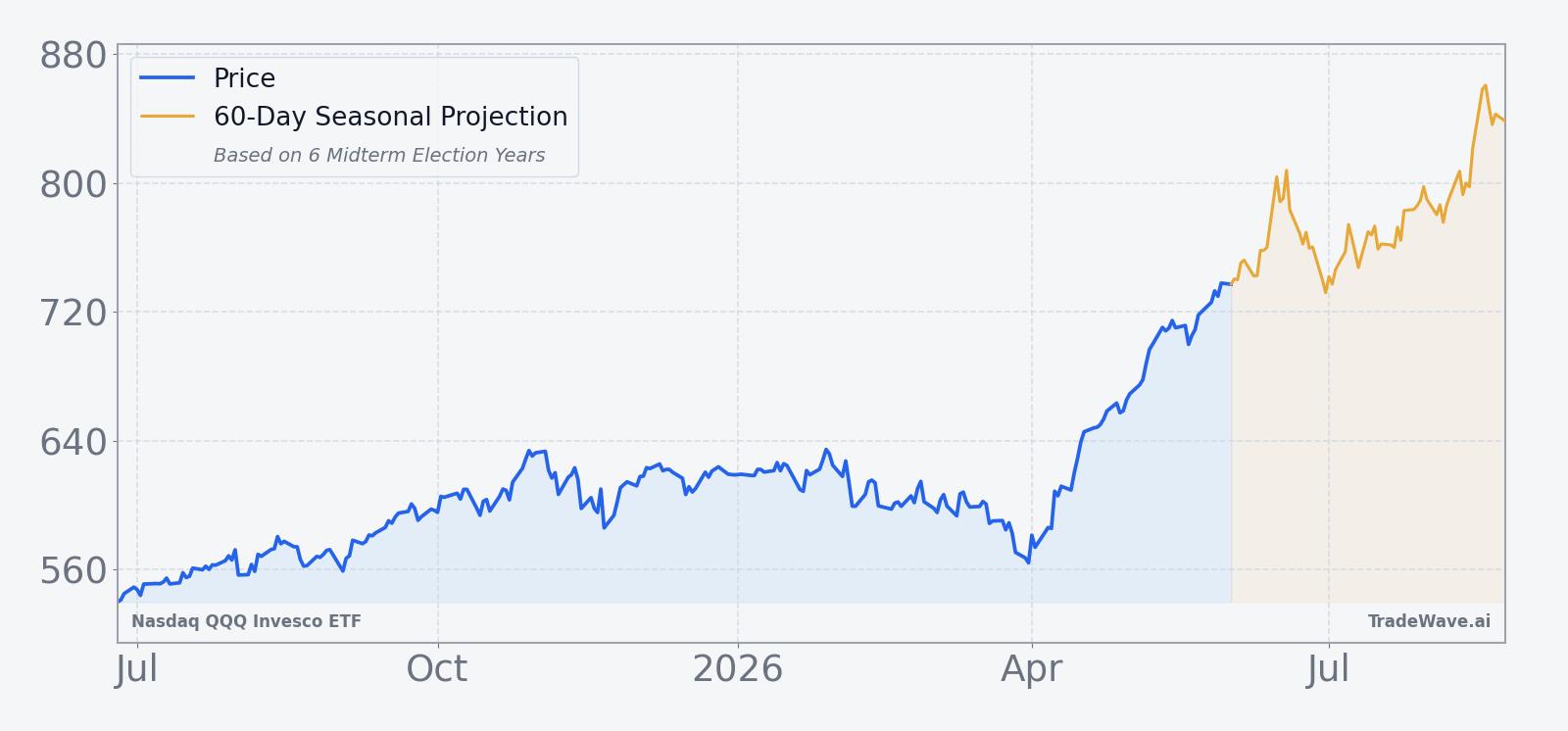
Even with the latest slide, QQQ remains a central reference point for U.S. equity risk appetite, often quoted alongside major indices in market snapshot coverage from outlets such as MarketBeat.[2] The ETF’s role as a proxy for large-cap growth and megacap tech means that any renewed volatility as the seasonal window opens could ripple through broader benchmarks, especially if macro headlines around rates, inflation or regulation intersect with this historically strong but volatile stretch.
What should traders watch as this QQQ seasonal window approaches?
First, the calendar: the 364-day midterm-year window begins on Jun 25, so price action in the next couple of weeks will set the starting point for any historical pattern to play out. A higher base after the recent pullback would leave less room before QQQ retests its 52-week high, while a deeper dip would echo prior years where strong full-window gains still began from uncomfortable drawdowns.
Second, levels: traders will be watching how QQQ behaves around the recent high near 748.65 and the 50-day moving average around 665.46.[1] A sustained break back above the highs early in the window would be consistent with the historical tendency for persistent upside, while a failure to reclaim those levels and a move toward the 50-day line would signal a more volatile, back-and-fill version of the same seasonal trend.
Third, macro and policy catalysts: as the United States moves deeper into the midterm election year, any shifts in rate expectations, tech regulation or fiscal policy could either reinforce or blunt the historical midterm-to-pre-election tailwind for growth stocks. Because this window spans both the latter part of the midterm year and much of the following pre-election year, the way QQQ trades around major policy headlines will be a key tell for whether the historical pattern is tracking or breaking.
Finally, volatility itself is a signal. In prior cycles, even winning years saw maximum adverse moves in the high single to low double digits, so sharp pullbacks inside the window have been normal rather than exceptional. If QQQ rallies into the start of the window and then absorbs a sizable but contained drawdown before pushing higher, that would rhyme with the historical pattern. A sustained breakdown that fails to recover, by contrast, would mark a clear departure from the six-for-six record that has defined this midterm-year stretch so far.
Sources
- [1] MarketBeat, “Wesley Hastie Williams Sells 28,169 Shares of Cipher Mining (NASDAQ:CIFR) Stock - MarketBeat,” May 8, 2026. marketbeat.com
- [2] MarketBeat, QQQ market snapshot references within broader equity coverage, various dates. marketbeat.com
About this seasonal analysis
Seasonal pattern data is sourced from TradeWave.ai, which analyzes historical price behavior across annual calendar windows going back up to 30 years. Read the full data methodology or the book The 100-Year Pattern by Afshin Moshrefi (2026 edition). Past performance of seasonal patterns does not guarantee future results. This article is for informational purposes only and does not constitute investment advice.