6-for-6 Midterm Win Streak: Nasdaq QQQ Invesco ETF (QQQ) Nears Its 19.35% Average Gain Window
Nasdaq QQQ Invesco ETF is trading just below a fresh 52-week high as it approaches a midterm-year seasonal window that has never produced a loss in the last six cycles.

What is the seasonal pattern for Nasdaq QQQ Invesco ETF (QQQ)?
Nasdaq QQQ Invesco ETF has risen in 6 of 6 midterm-year windows starting around late June, with an average gain of 19.35% in winning years.
- 6 for 6 in this window, with winning years averaging 19.35% gains across the last six midterm election years.
- The upcoming window begins Jun 24, 2026 and spans 361 trading days, covering the late midterm year into the following pre-election year.
- Percent Profitable is 100%, with 6 winners and 0 losers across the historical sample.
- Median profit is 20.0%, and cumulative return across all six windows totals 187% on a long-only basis.
- TradeWave Ratio is 2.8, indicating that price has typically traveled meaningfully in the trade direction within the window.
- A Sharpe ratio of 2.59 points to unusually strong risk-adjusted returns for this specific Nasdaq QQQ Invesco ETF trading window.
According to historical data from TradeWave.ai, this midterm-year stretch has behaved very differently from an average year for QQQ, and the next iteration is only weeks away.
How has Nasdaq QQQ Invesco ETF (QQQ) traded in past midterm-year windows?
Nasdaq QQQ Invesco ETF has posted gains in every one of the last six midterm election years during the 361-day window that begins around Jun 24, with average profits of 19.35% and a 187% cumulative return across those cycles. Today QQQ closed at 717.545, up 0.42% on the session and about 0.6% below its 52-week high of 722.12, leaving the ETF effectively at record territory as this historically powerful seasonal regime approaches.[1]
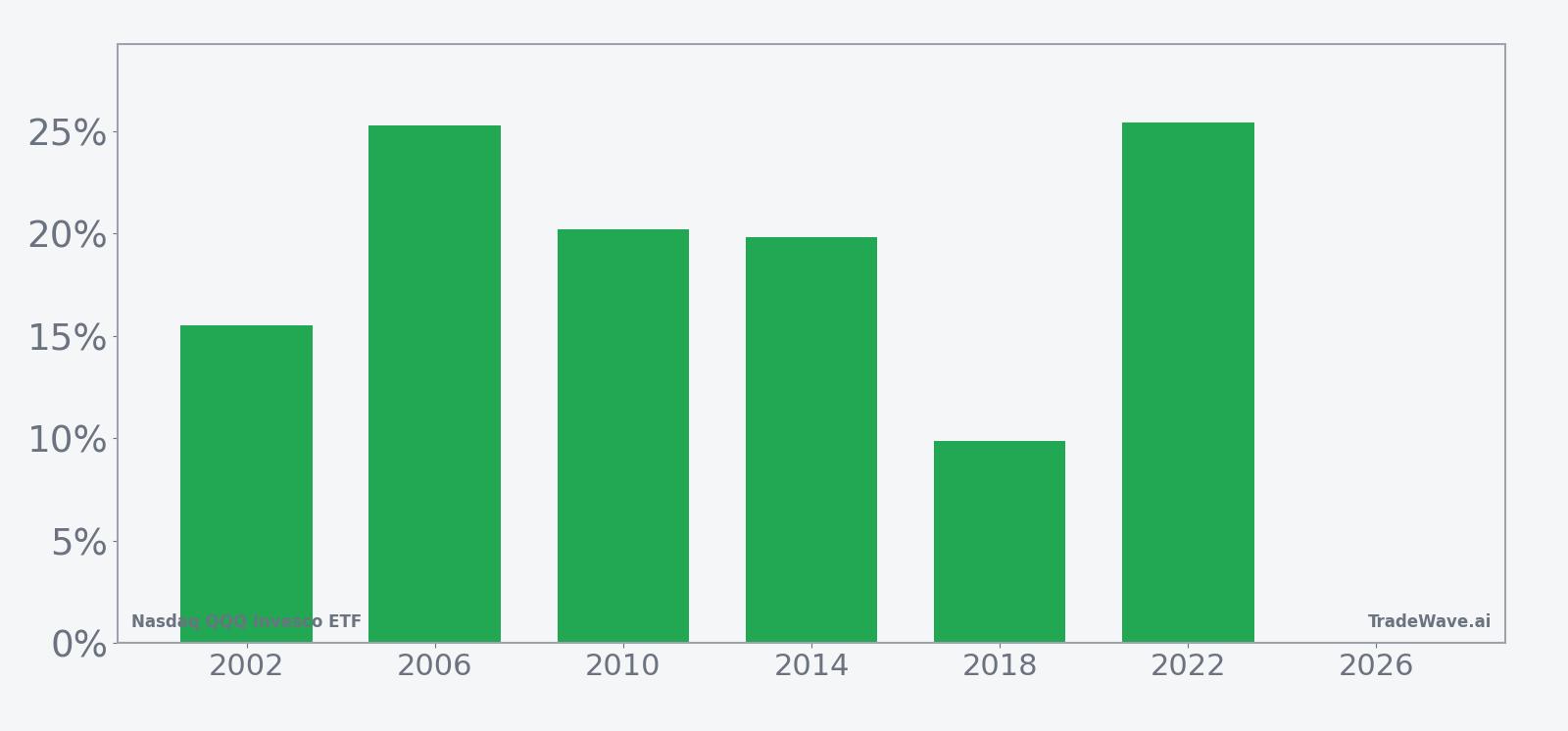
Grouping the data by the presidential election cycle matters here because this window captures the handoff from the midterm election year into the year before the presidential election, a phase that has often coincided with friendlier policy tone and stronger risk appetite for growth stocks. In this pattern, the trade direction is explicitly long, so positive returns and upside excursions are the favorable outcomes, while any deep drawdowns would mark the outliers.
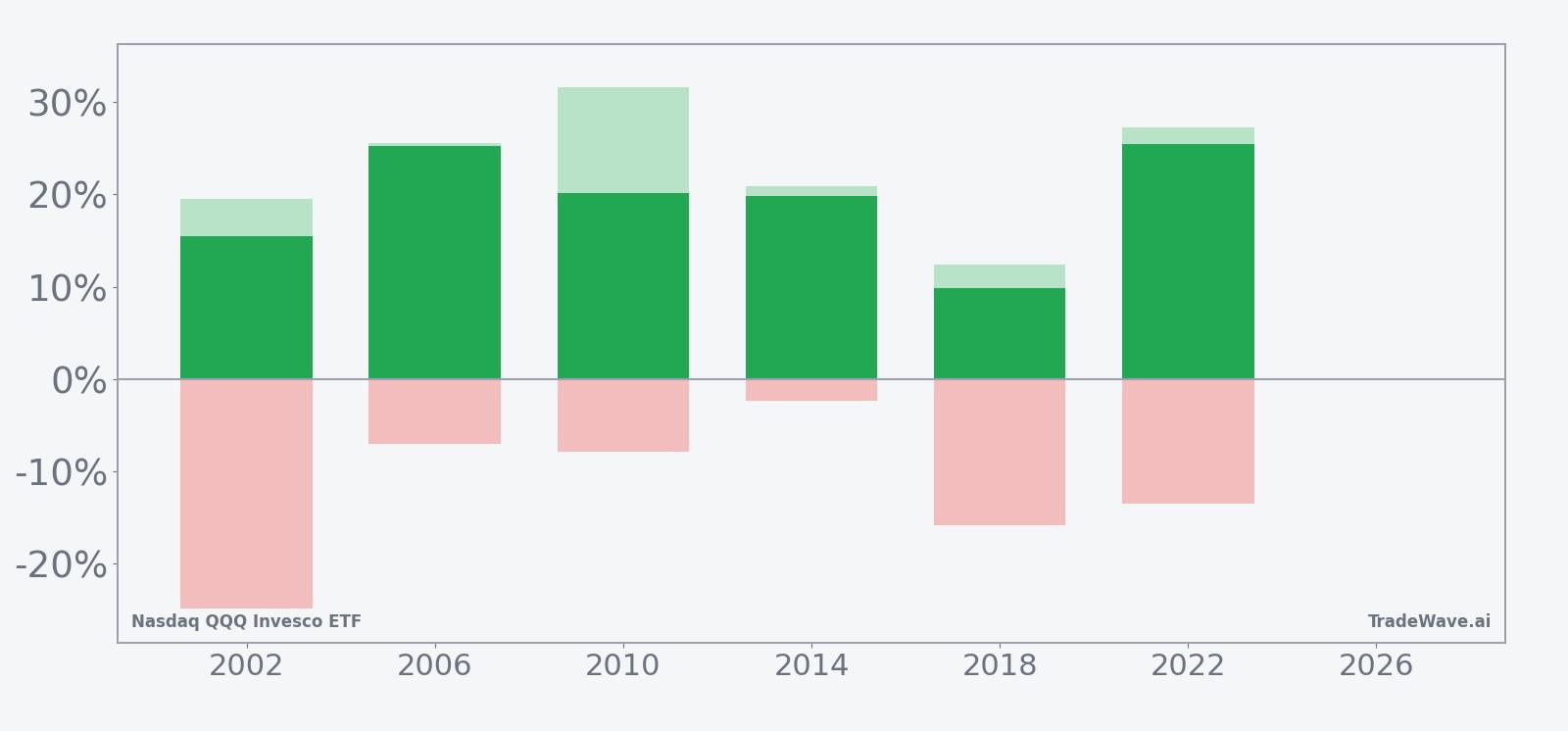
A second view layers net results with the best and worst intraperiod swings to show how far QQQ has tended to travel inside the window.
Across the six historical samples, average winners gained 19.35%, with a median outcome of 20.0%, and no losing years in the set. Individual windows ranged from a 9.89% gain in 2018 to a 25.43% gain in 2022, so the pattern has been consistently positive but not uniform in strength.
The intraperiod swings have been meaningful. Maximum favorable moves ranged from 12.37% in 2018 to 31.6% in 2010, showing that in strong years QQQ has often pushed well beyond the final net gain at some point during the window. On the downside, maximum adverse excursions have stretched as far as a 24.95% drawdown in 2002, with other years seeing pullbacks between roughly 2% and 16%, underscoring that even winning midterm-year windows have included sharp setbacks.
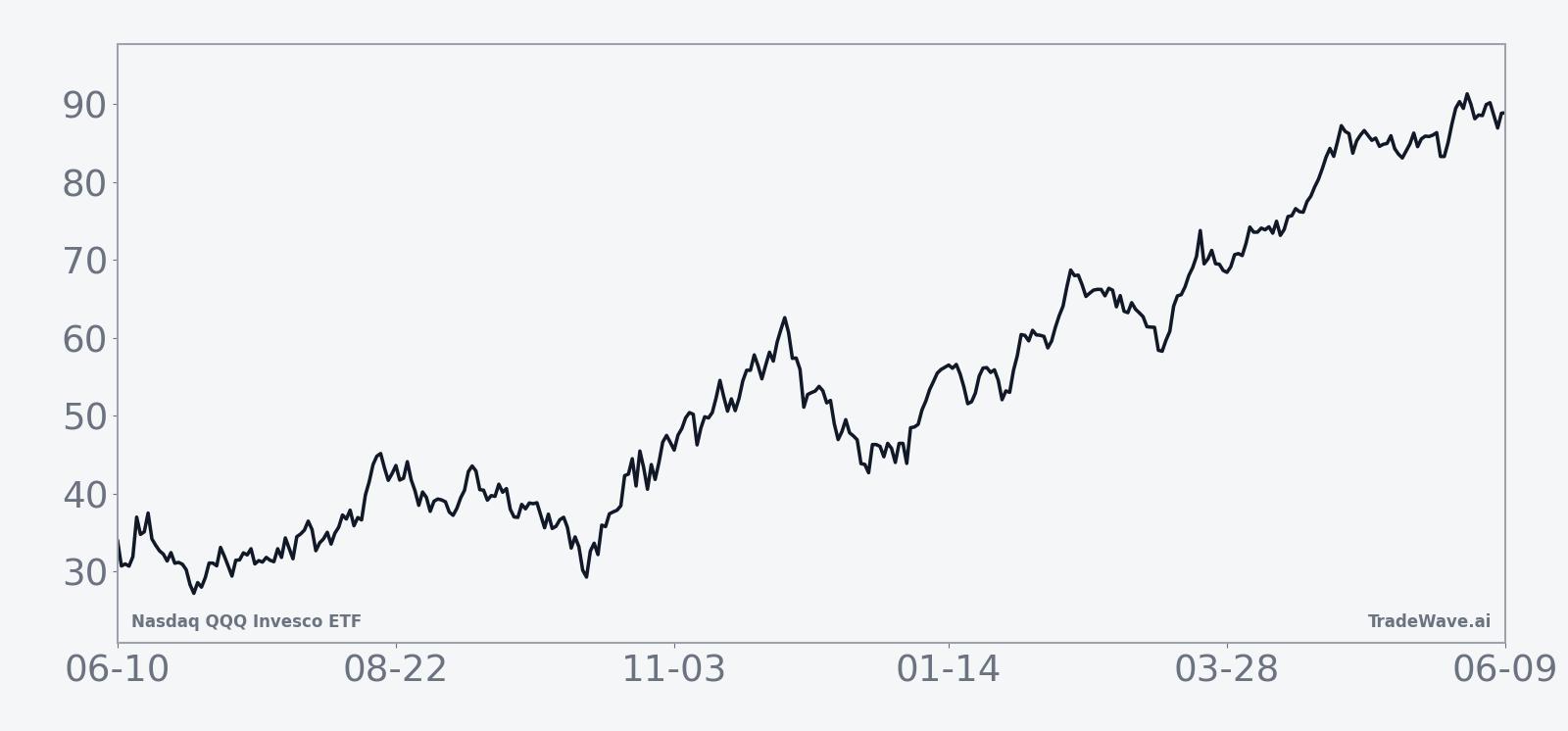
The historical seasonal trend line slopes higher for most of the 361-day span, with relatively steady progress rather than a single explosive burst. That profile suggests gains have tended to accrue over many months, with the late midterm year and early pre-election year both contributing to the overall move.
Add it up: six for six with double-digit average gains and a Sharpe ratio of 2.59 is an unusually strong seasonal record for a broad tech-heavy ETF like QQQ in this specific election-cycle slice.
Why does Nasdaq QQQ Invesco ETF (QQQ) follow this seasonal pattern?
One likely driver is the way the policy calendar and earnings cycle line up between the back half of the midterm year and the year before the presidential election, a phase that has often featured reduced political uncertainty and more supportive liquidity conditions. Analysts also point to institutional portfolio repositioning after midterm votes, which can favor large-cap growth and technology allocations that dominate QQQ. This pattern may also reflect the clustering of major product cycles and capital spending plans in the tech sector, which tend to show up in earnings and guidance during this stretch.
History does not guarantee future results; adverse excursions can be large even in winning windows, and past midterm-year drawdowns in QQQ have at times exceeded 20% inside this otherwise bullish pattern.
What is driving Nasdaq QQQ Invesco ETF (QQQ) today?
Nasdaq QQQ Invesco ETF finished May 25 at 717.545, up 0.42% on the day, after trading between 715.95 and 722.12 on volume of about 26.9 million shares.[1] The ETF is hovering about 0.6% below its 52-week high of 722.12, with a one-month gain of 8.08% that keeps it firmly above its 50-day moving average near 641.93 and supported by 20-day average volume around 38.1 million shares.[1]
The chart below shows QQQ’s recent advance alongside a 60-day seasonal projection for context.
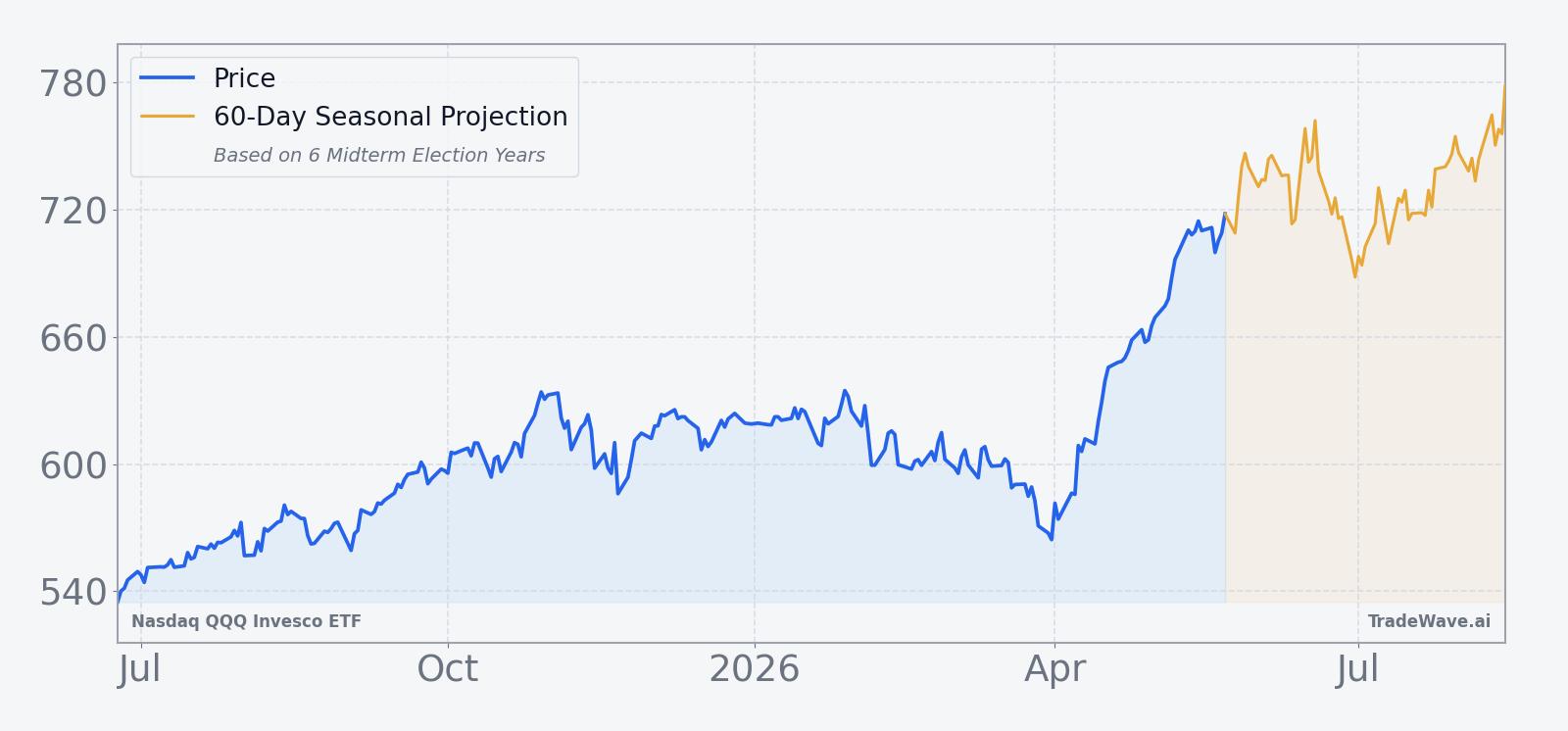
With no single earnings report or macro headline dominating flows, the move reflects broad strength in the Nasdaq complex and continued demand for large-cap growth exposure through liquid index vehicles. For traders, the key tension is that QQQ is already near its highs heading into a window that has historically rewarded long exposure, which raises the stakes for how any pullbacks or consolidations unfold as the midterm-year seasonal regime kicks in.
What should traders watch as this QQQ seasonal window approaches?
First, the calendar: the next iteration of this 361-day window begins on Jun 24, 2026, so price action in the weeks leading up to that date will shape how extended or consolidated QQQ looks as it enters a historically strong stretch. Second, levels: the recent 52-week high around 722 and the 50-day moving average near 642 are the key reference points for whether any dip remains a routine pullback or something deeper.[1]
Third, volatility inside the window will matter as much as direction. Past cycles show that even winning years have included double-digit drawdowns, so traders will be watching whether early weakness stays within the historical adverse excursion range or breaks below it. Finally, behavior relative to the seasonal template will be a tell: if QQQ can hold above major support and continue to grind higher through the late midterm year into the pre-election year, it would be consistent with the six-for-six record. A sharp and persistent break from that pattern would signal that this cycle is diverging from the usual midterm-year playbook.
Sources
About this seasonal analysis
Seasonal pattern data is sourced from TradeWave.ai, which analyzes historical price behavior across annual calendar windows going back up to 30 years. Read the full data methodology or the book The 100-Year Pattern by Afshin Moshrefi (2026 edition). Past performance of seasonal patterns does not guarantee future results. This article is for informational purposes only and does not constitute investment advice.