6-for-6 Midterm Streak: S&P 500 Technology Sector SPDR (XLK) Averages 21.08% Gains
S&P 500 Technology Sector SPDR is heading toward a midterm-year seasonal window that has never lost in the last six cycles, even as the ETF trades below its 52-week high.

What is the seasonal pattern for S&P 500 Technology Sector SPDR (XLK)?
S&P 500 Technology Sector SPDR has risen in 6 of 6 midterm-year windows starting around early July, with an average gain of 21.08% in winning years.
- 6 for 6 in this midterm-year window, with average winner gains of 21.08% across the last six cycles.
- Percent Profitable is 100%, with 6 winners and 0 losers in this 356-day S&P 500 Technology Sector SPDR trading window.
- The window begins on Jul 2 and runs for 356 trading days, spanning late midterm year into the following pre-election year.
- Annualized return across the pattern is 20.86%, with a Sharpe ratio of 2.13 that signals unusually strong risk-adjusted performance.
- The TradeWave Ratio of 2.19 indicates that price has typically traveled meaningfully in the long direction within the window, not just at the close.
- Individual years have still seen sizable drawdowns inside the window, with adverse moves as deep as roughly 22% before finishing higher.
According to historical data from TradeWave.ai, this upcoming stretch for XLK behaves very differently from an average year, with a distinct midterm-to-pre-election profile that traders rarely see laid out in one place.
How strong is the upcoming seasonal window for S&P 500 Technology Sector SPDR (XLK)?
S&P 500 Technology Sector SPDR has posted gains in every one of the last six midterm-year windows that start in early July, averaging 21.08% per cycle for long positions. Today XLK closed at 177.38, down 1.9% on the session and about 10.8% below its 52-week high of 198.73, after a modest 0.82% gain over the past month. This combination of a clean historical win streak and a pullback from the highs sets up a rare test of whether the midterm-to-pre-election seasonal tailwind can reassert itself into 2027.
The pattern is built around the presidential election cycle, focusing on the last six midterm election years rather than consecutive calendar years. That matters because policy, regulation and fiscal stance often shift in recognizable ways between the midterm year and the year before the presidential election, and large-cap technology has tended to respond in a consistent, pro-risk fashion during this specific handoff.
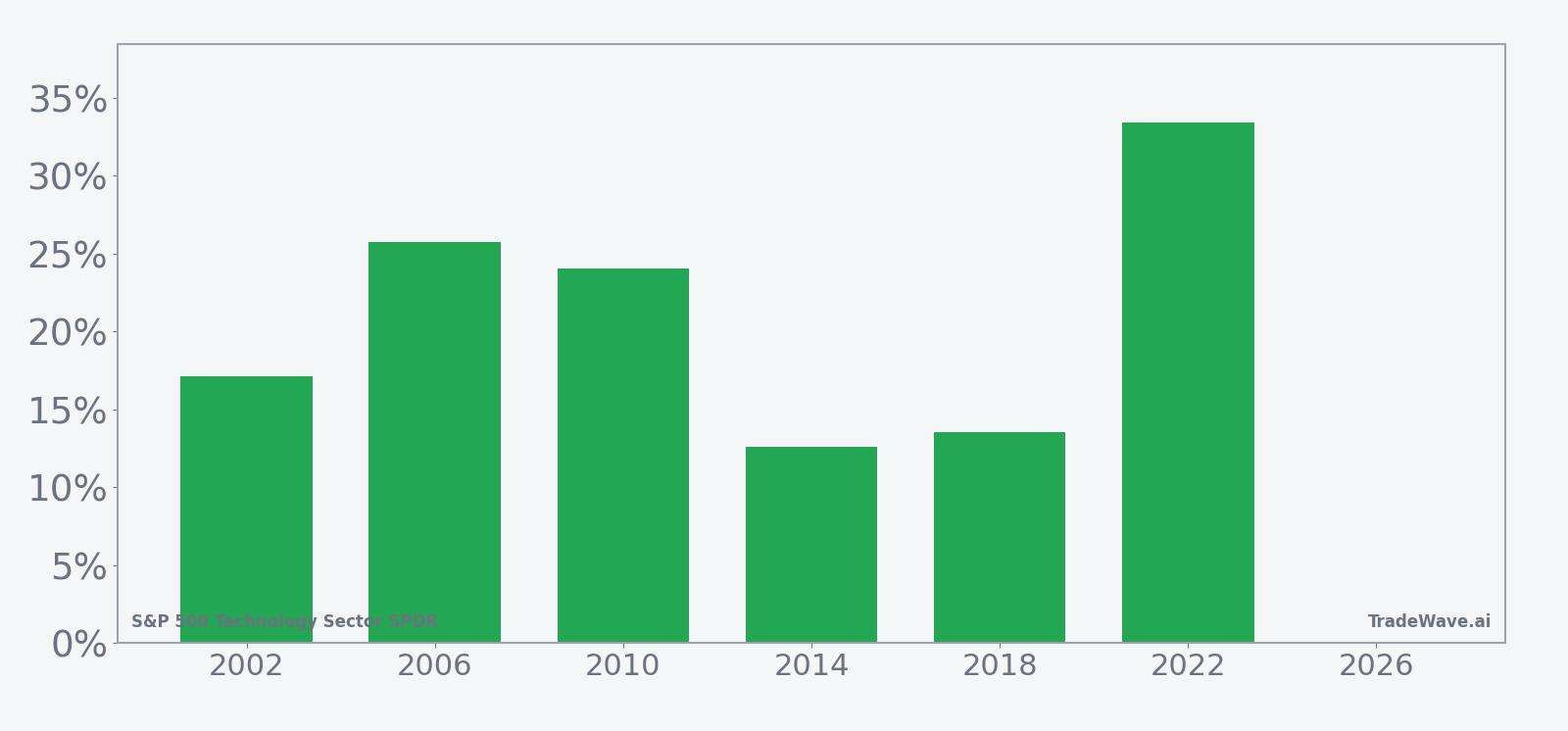
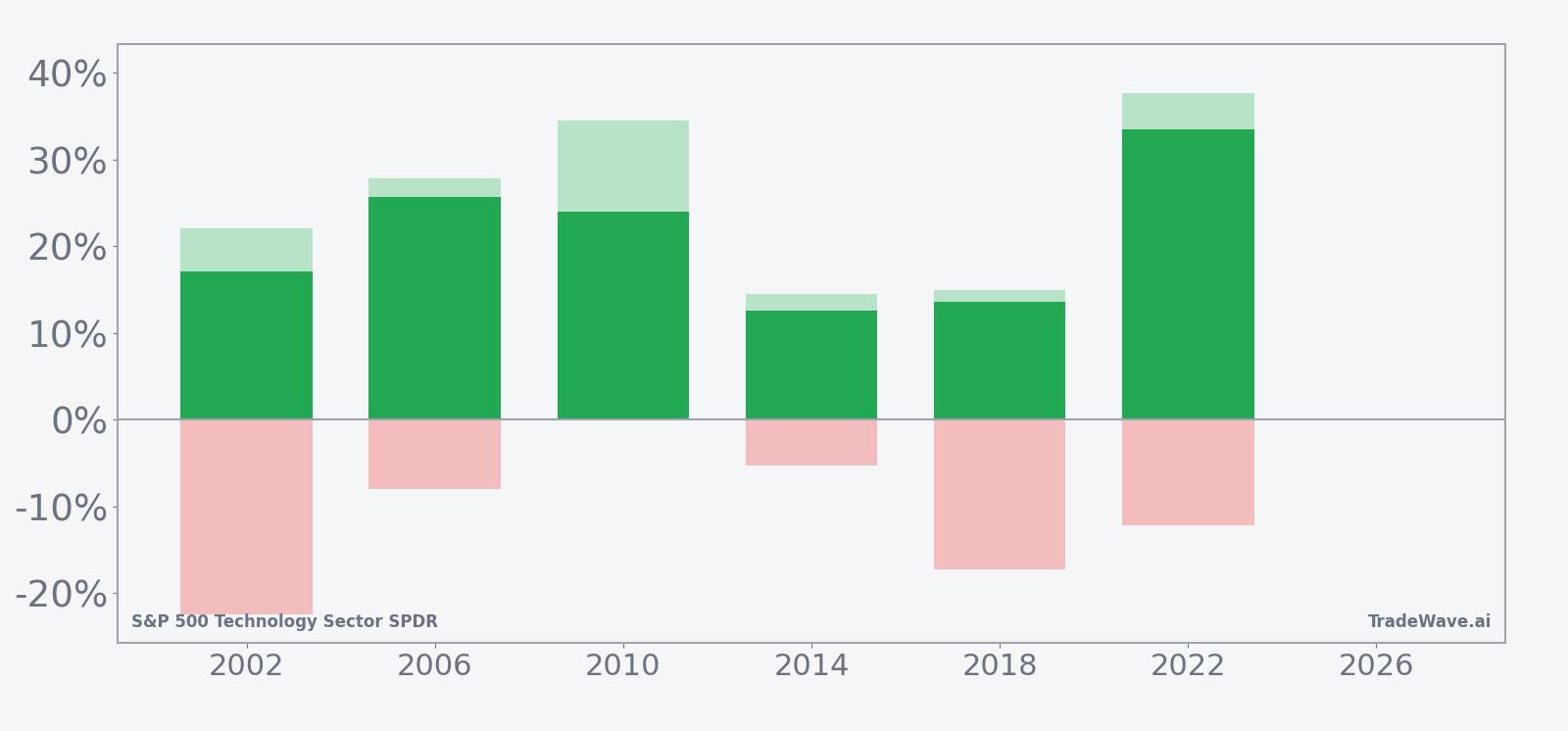
Year-by-year net returns and intraperiod swings show how upside and drawdowns have coexisted inside this window.
Trade direction for this pattern is explicitly long, and every one of the six historical windows finished positive. Average profit of 21.08% lines up with a 211% cumulative return and a 20.86% annualized pace, which is high even by technology’s standards. The Sharpe ratio of 2.13 suggests that, on an end-of-window basis, returns have been strong relative to volatility.
Inside the window, though, the ride has not been smooth. Maximum favorable moves have reached into the mid-30% range in stronger years such as 2010 and 2022, while maximum adverse moves have at times pushed near or beyond 20% in years like 2002 and 2018. That MFE/MAE profile points to a high-energy environment where XLK has tended to trend higher over the full stretch but with meaningful air pockets along the way.
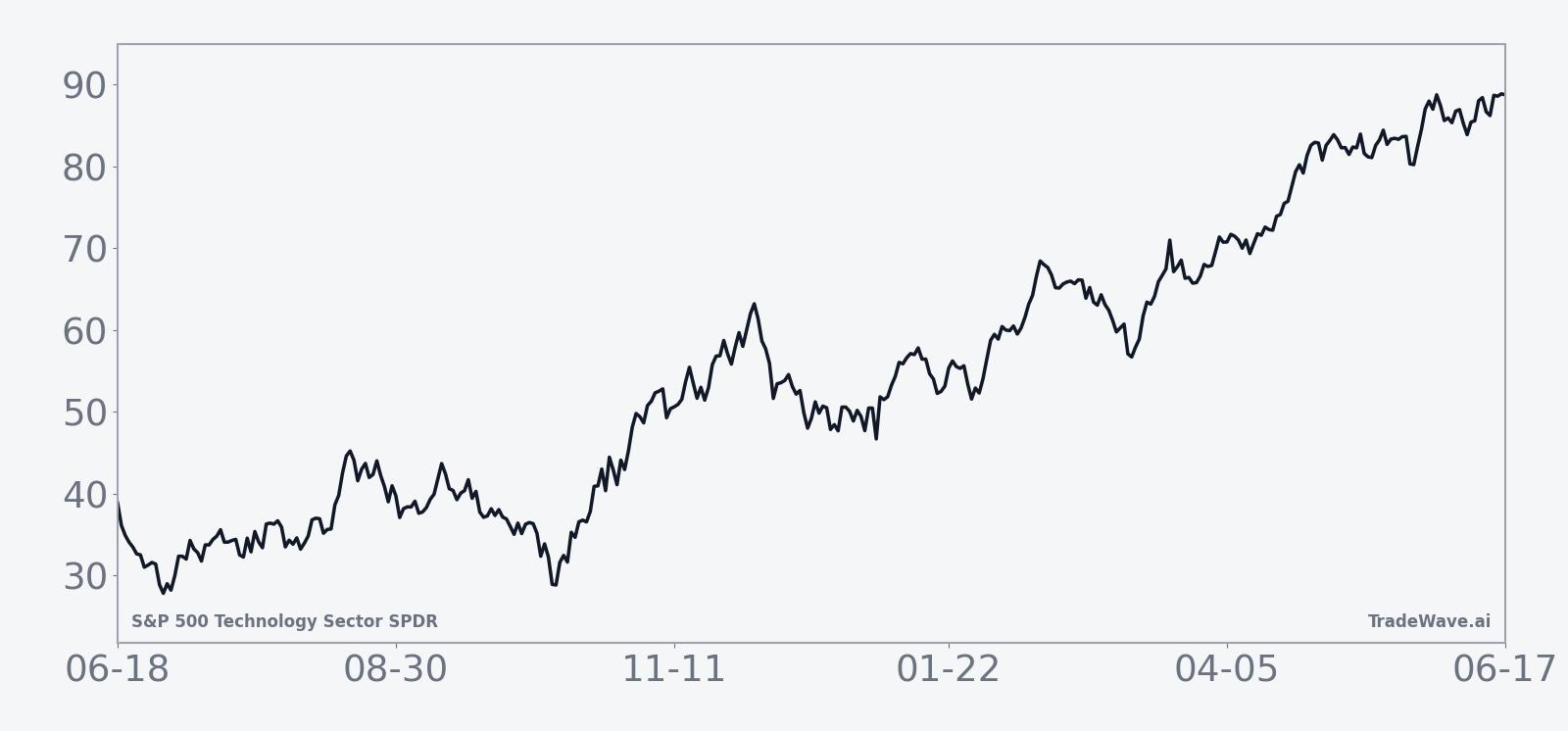
The per-year table shows the weakest net outcome was still a 12.61% gain in 2014, while the strongest was a 33.44% gain in 2022. In several cycles, including 2002 and 2018, the ETF suffered double-digit drawdowns before recovering to finish the window higher, which fits the idea of midterm-year volatility giving way to pre-election strength. The historical seasonal trend chart reinforces that the bulk of the average advance has tended to accrue gradually rather than in a single burst.
Put together, the pattern is straightforward: six for six, with double-digit gains and sizable swings inside the window. History does not guarantee a repeat, but the consistency across midterm cycles makes this one of the cleaner long-biased seasonal regimes on XLK’s calendar.
Why does S&P 500 Technology Sector SPDR (XLK) follow this seasonal pattern?
One likely driver is the way the earnings calendar and policy cycle line up between the midterm election year and the year before the presidential election. Large technology companies often guide more confidently once midterm political uncertainty clears, and institutional investors tend to rotate back into growth and innovation themes as fiscal and regulatory paths look more stable. This window may also reflect portfolio rebalancing and benchmark-chasing behavior as tech leadership reasserts itself into the historically strong pre-election phase.
History does not guarantee future results; adverse excursions (MAE) can be large even in winning windows.
What is driving S&P 500 Technology Sector SPDR (XLK) today?
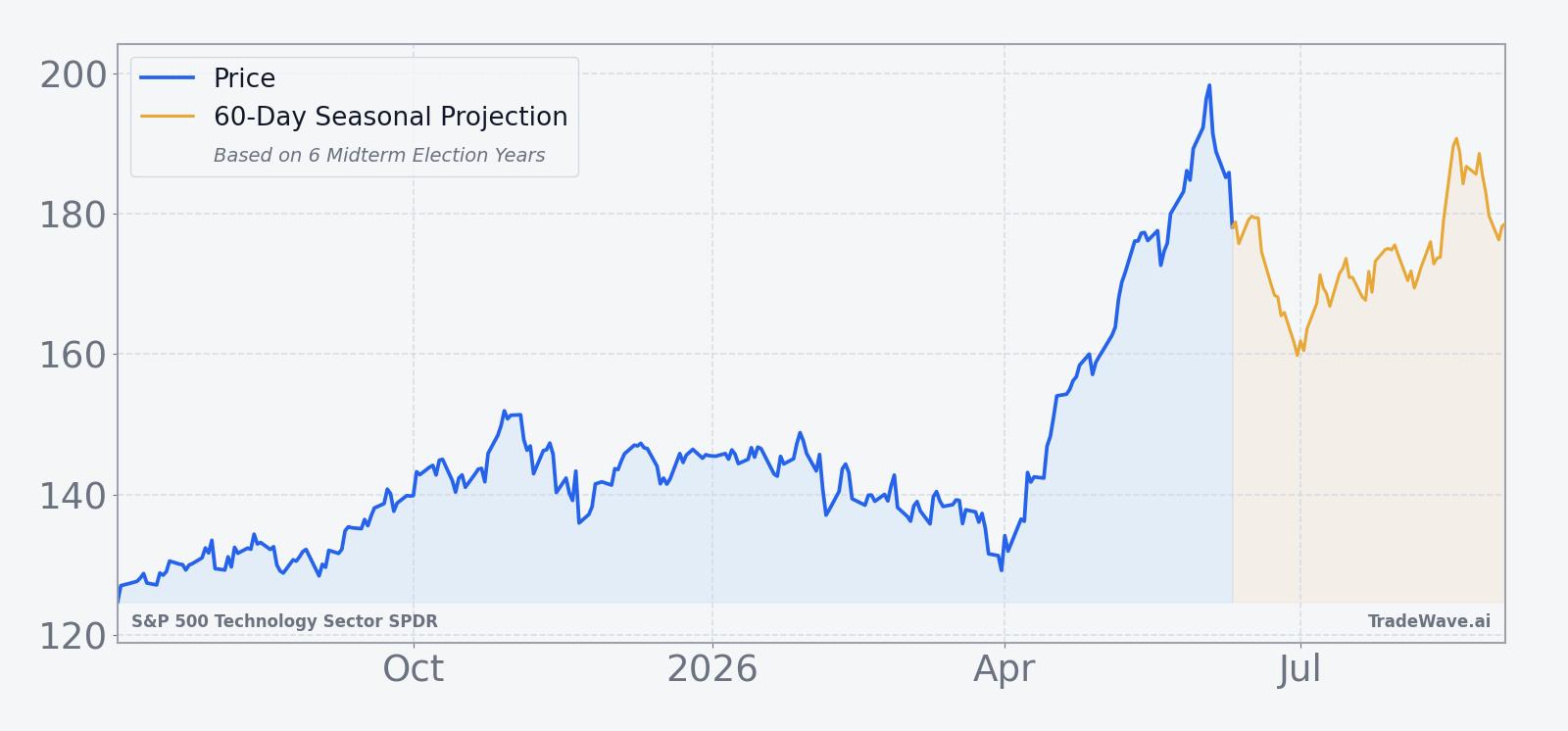
S&P 500 Technology Sector SPDR slipped 1.9% to 177.38 on Jun 11, with intraday trading between 176.15 and 182.41 on volume of about 17.6 million shares, modestly above its 20-day average of roughly 15.0 million.[1] The ETF remains above its 50-day moving average of 166.04, but it is about 10.8% below its 52-week high of 198.73, leaving a visible gap between recent price and the top of the range.[1] A 0.82% one-month gain suggests consolidation rather than a clear breakout or breakdown as investors weigh stretched valuations in mega-cap tech against ongoing demand for AI, cloud and software exposure.
The chart below situates the latest move in its recent multi-month context alongside a short-term seasonal projection.
What should traders watch as this XLK seasonal window approaches?
First, the calendar: the 356-day window tied to the last six midterm election years begins on Jul 2, so any sharp move in XLK around that date will quickly test whether the historical pattern is still in play. Second, levels: traders will be watching whether the ETF can reclaim the 190 to 200 zone that capped it near the 52-week high, or whether repeated failures there turn the recent pullback into something deeper.[1] Third, volatility inside the window: prior cycles show that even winning years have seen drawdowns of 10% to 20%, so how XLK behaves on the first sizable dip will be an important tell on whether buyers are still willing to lean into the midterm-to-pre-election seasonal tailwind.
If the ETF grinds higher with contained drawdowns, it would rhyme with the historical pattern of steady, long-biased gains across this regime. A choppier tape with repeated deep air pockets would not break the seasonal record by itself, but it would remind traders that the path to those historical returns has rarely been a straight line.
Sources
About this seasonal analysis
Seasonal pattern data is sourced from TradeWave.ai, which analyzes historical price behavior across annual calendar windows going back up to 30 years. Read the full data methodology or the book The 100-Year Pattern by Afshin Moshrefi (2026 edition). Past performance of seasonal patterns does not guarantee future results. This article is for informational purposes only and does not constitute investment advice.