International Paper (IP) Enters 13-Day April Window With 6-of-7 Midterm Wins Since 1994
International Paper is approaching a historically bullish 13-day April window just as its share price trades well below its recent average and investors weigh a complex breakup and turnaround story.

What is the seasonal pattern for International Paper (IP)?
International Paper has risen in 6 of 7 midterm-year April windows starting around Apr 6, with an average gain of 4.64% in winning years.
- 6 wins and 1 loss in this 13-day window across the last 7 midterm election years, with winners averaging 4.64% gains.
- Percent Profitable is 86%, with 6 winners and 1 loser in the historical sample for this IP seasonal trend.
- Including every year, Avg Profit - All is 4%, showing that the lone losing year was shallow compared with the gains.
- The strongest year in this International Paper trading window delivered an 8.8% net return, while the weakest slipped just 0.17%.
- Trade Direction is long, with a TradeWave Ratio of 1.46 and a Sharpe ratio of 1.25, pointing to a historically favorable risk-reward profile.
- Maximum adverse moves have still reached more than 3% in some years, so intraperiod drawdowns can be meaningful even when the window finishes higher.
According to historical data from TradeWave.ai, this upcoming stretch for International Paper has behaved differently from a typical April in past midterm election years, and the next iteration is only days away.
How has International Paper (IP) traded in this midterm-year April window?
Grouping by the presidential election cycle matters here because this pattern looks only at the last seven midterm election years, a phase that often brings policy noise and shifting expectations for industrial demand. International Paper has risen in 6 of 7 of those midterm-year windows starting on Apr 6 and lasting 13 trading days, averaging 4.64% gains in the winning years while the single losing year was a modest 0.17% decline. The next window begins on Apr 6, 2026, and it lands as the broader cycle transitions from the midterm election year into the year before the presidential election, a phase that has often coincided with improving risk appetite in prior cycles.
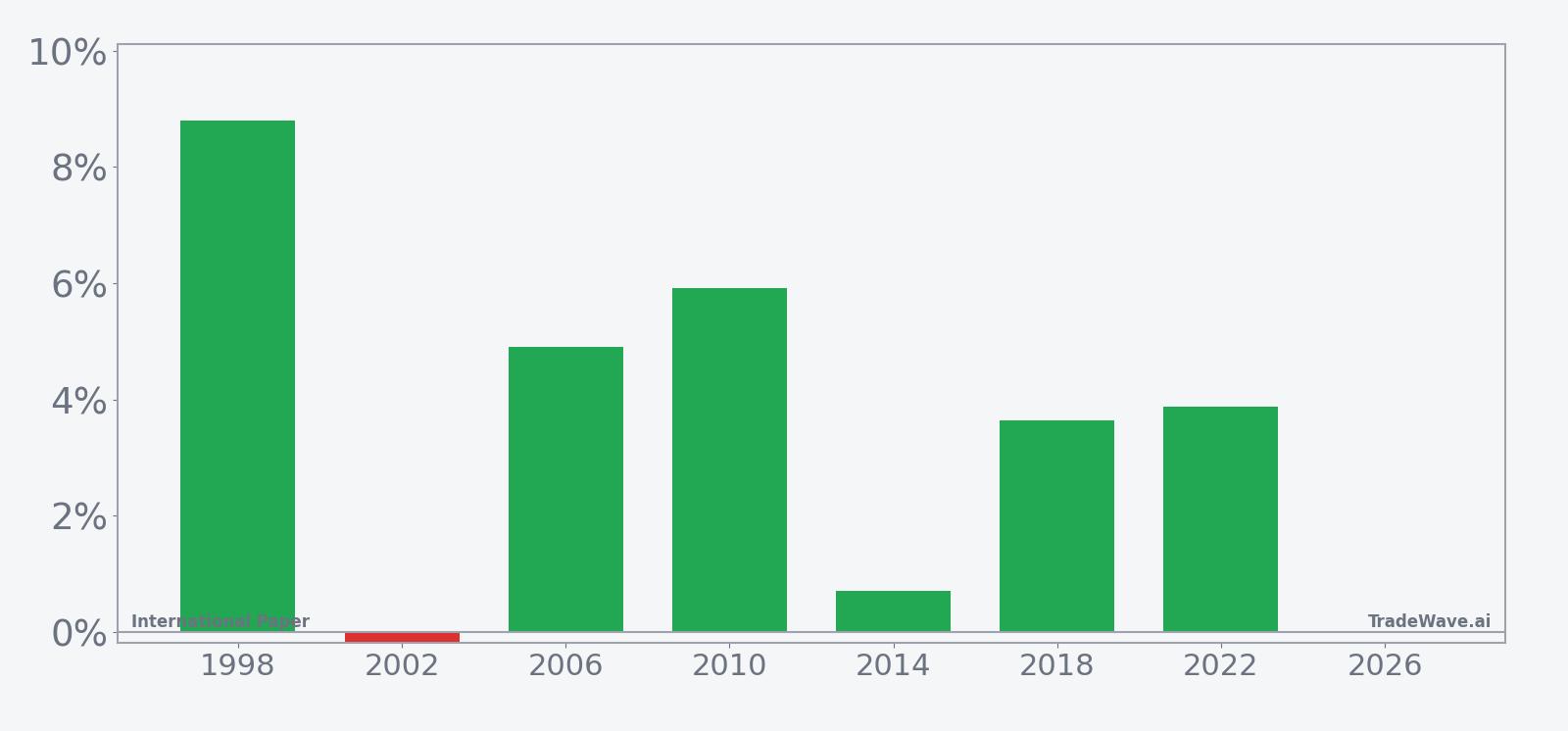
The trade direction for this setup is long, which means the historical pattern has favored upside exposure during this slice of the calendar. Percent Profitable sits at 86%, with six winning years and one losing year, and the all-years average return of 4% is only slightly below the 4.64% average for winners, a sign that the lone down year did not meaningfully drag the profile. The median profit of 3.87% is close to the average, suggesting that gains have not been driven by a single outlier but by a cluster of mid-single-digit advances.
Looking at individual years, 1998 stands out as the strongest example, with an 8.8% net return over the 13-day window and a maximum favorable move of 12.24% from entry before giving back some ground. At the other end of the spectrum, 2002 was the only losing year, slipping 0.17% even though the stock still managed a 2.49% peak run-up during the period before reversing. That mix of intraperiod rallies and occasional reversals is typical of a cyclical industrial name, but the shallow loss in the worst year is notable compared with the upside in the best years.
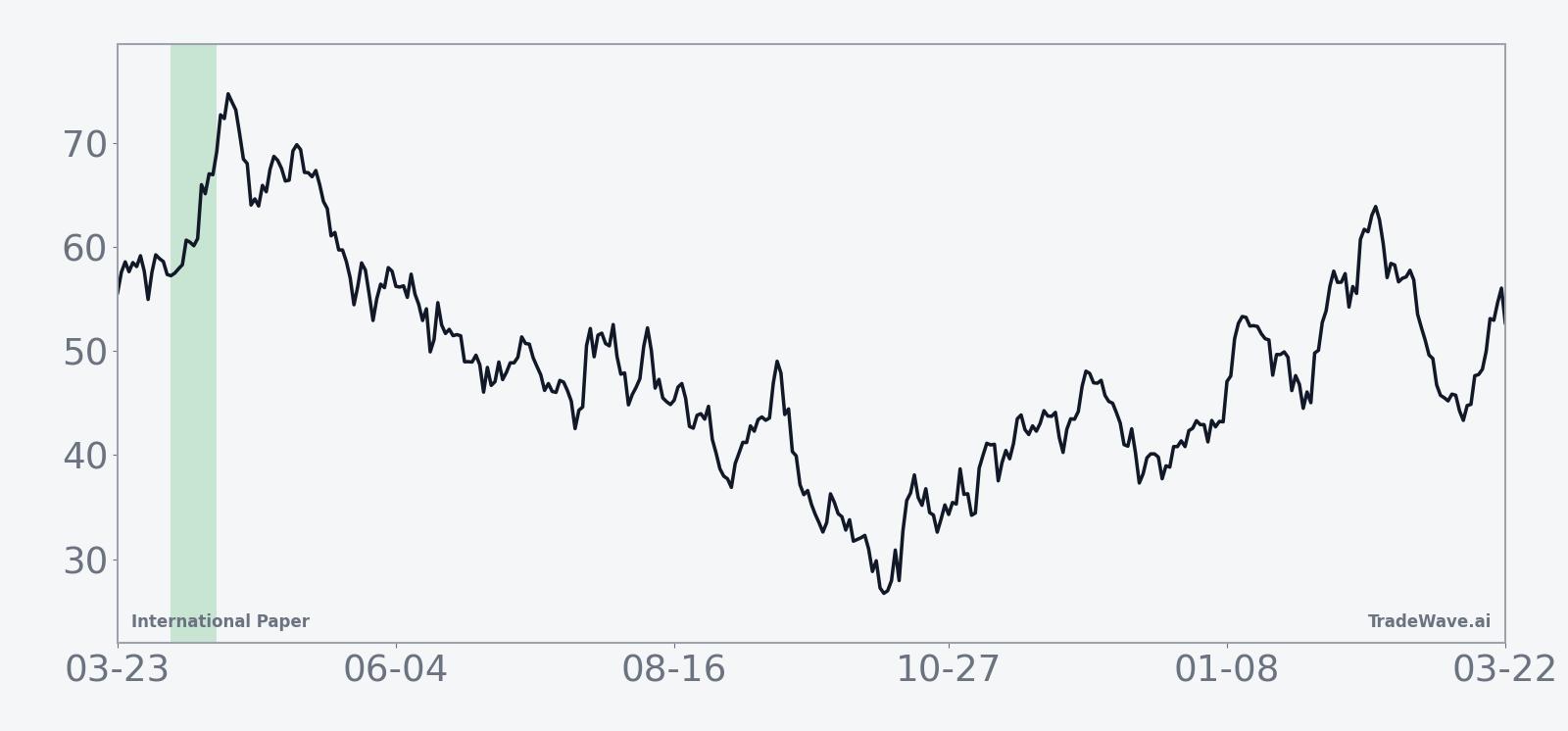
The historical seasonal average trend for this window tilts higher, with gains tending to build steadily rather than in a single spike. In several years, the maximum favorable move arrived before the final day, which means traders who were long during the window often saw peak gains earlier than the closing result. That behavior fits with a pattern where buyers step in early in the window, perhaps around earnings or macro headlines, and then activity cools as the calendar rolls forward.
Year-by-year bars that combine net results with peak rallies and worst drawdowns show how much room International Paper has historically had to run, and how deep it has occasionally dipped, inside this window.
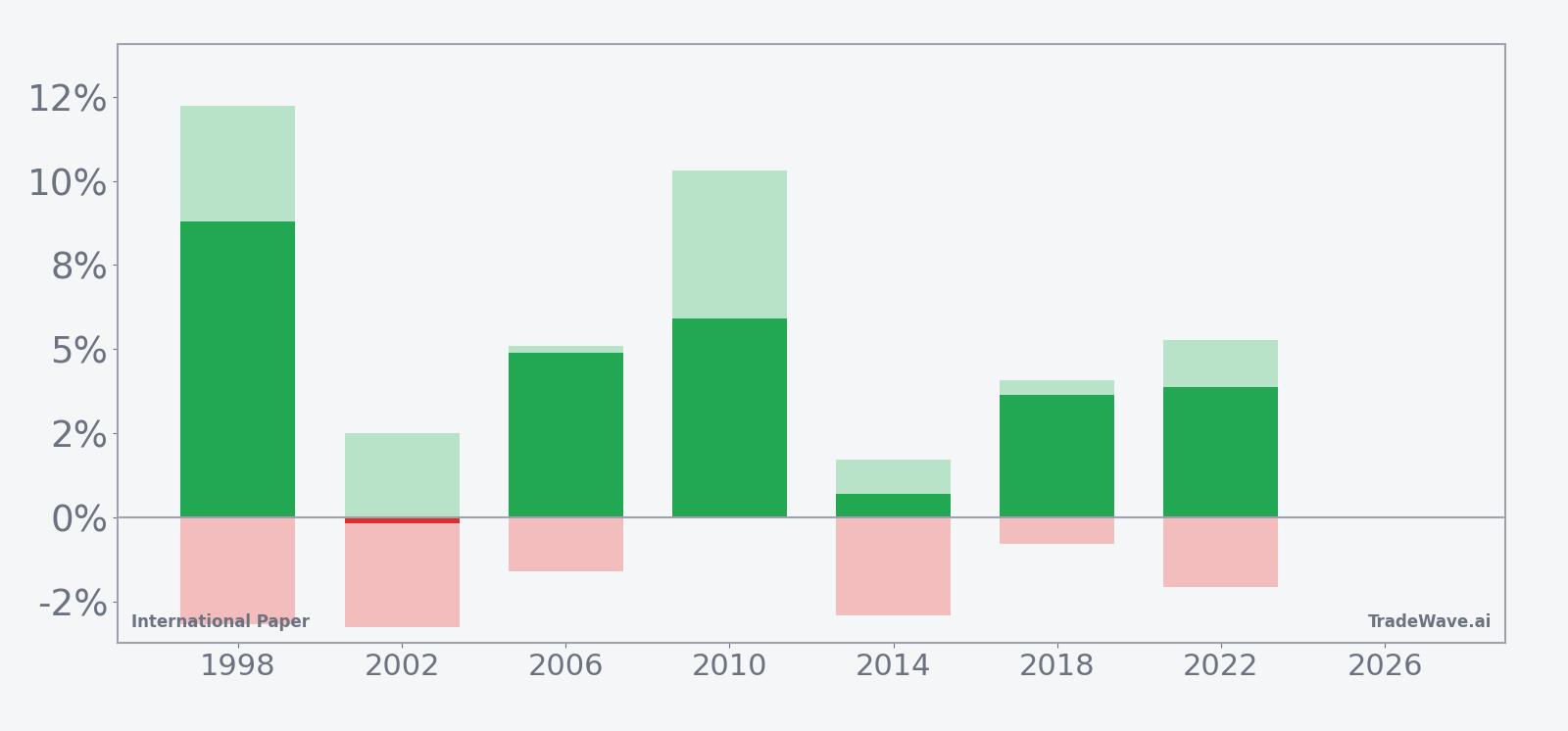
The combined net, maximum favorable excursion and maximum adverse excursion bars show that upside swings have often been larger than the final net gains, while downside excursions have typically stayed in the low single digits. In 2010, for example, the stock posted a 5.91% net gain but at one point was up 10.31% from entry, while the worst drawdown during that window was a mild 0.54% dip. In contrast, 2002 and 2014 saw adverse moves of roughly 3% from entry before stabilizing, a reminder that even historically friendly windows can involve uncomfortable pullbacks along the way.
The cumulative return profile across all seven midterm-year samples adds up to a 30% gain for this specific 13-day slice of the calendar. With an annualized return of 3.91% and a Sharpe ratio of 1.25, the risk-adjusted performance of this window has been stronger than a random two-week stretch for a typical cyclical stock. The key takeaway is simple: six for seven with mid-single-digit gains and contained drawdowns is a cleaner record than many investors might expect from a packaging name tied to the economic cycle.
History does not guarantee future results; adverse excursions (MAE) can be large even in winning windows.
Why does International Paper (IP) follow this seasonal pattern?
One likely driver is the clustering of earnings updates and guidance resets for industrial and packaging companies around early spring, which can trigger short bursts of repositioning in names like International Paper. Analysts have also pointed to midterm-year policy debates on trade and tariffs, which can shift expectations for box demand and input costs in a tight window. This pattern may reflect a mix of portfolio managers adjusting exposure after seeing first-half order books and macro data, and traders leaning into or fading those moves as the presidential cycle advances toward the year before the election.
What is driving International Paper (IP) today?
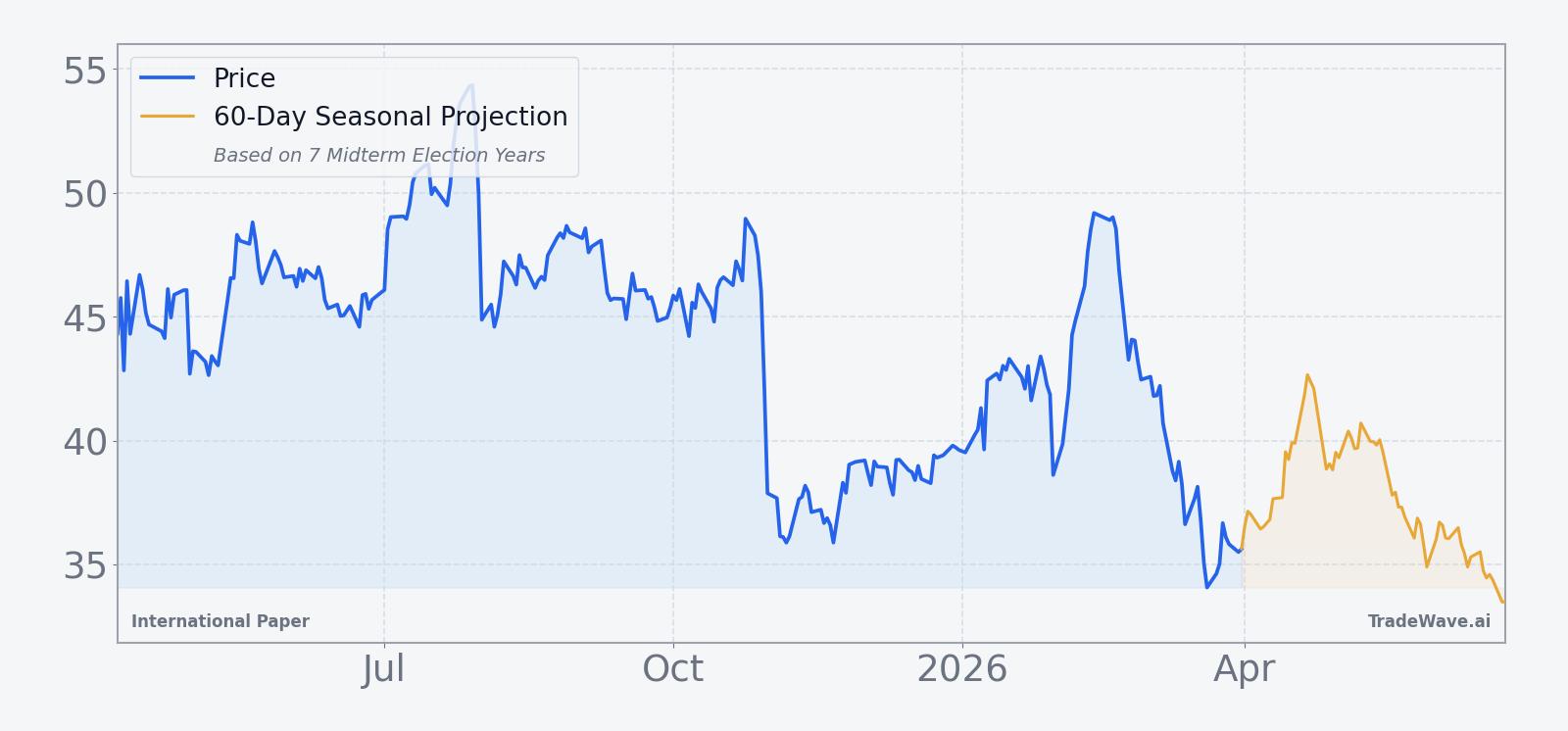
International Paper shares closed at 35.66 on Apr 2, down 0.1% on the day and roughly 33.7% below their 52-week high of about 53.73, while sitting above the 52-week low of 33.57 and well under the 50-day moving average of 41.46.[2] That leaves the stock trading at a discount to its recent trend just as investors digest a wider fourth-quarter loss tied to higher costs and an impairment charge, alongside a plan to split the company into separate North American and EMEA businesses that was announced on Jan 29, 2026.[2] In Aug 2025, International Paper also agreed to sell its Global Cellulose Fibers unit for $1.5 billion, a move aimed at sharpening the portfolio and freeing capital for its core containerboard and packaging operations.[3] Earlier analysis in Jun 2025 argued that ongoing self-help measures, including efficiency gains and margin work, were not fully reflected in the share price, a view that still frames how some investors see the stock heading into 2026.[4]
Those corporate actions sit on top of a macro backdrop that has been relatively supportive for a cyclical packaging name. An accommodative Federal Reserve stance and tariff deals in Asia have been cited as tailwinds for the broader economy, which in turn can support box demand and pricing power for a producer that controls roughly a quarter of the North American containerboard market.[4] Management has previously highlighted an 80/20 strategy and targeted EBITDA benefits of about $600 million in 2026, with consensus expectations for 2027 earnings per share north of $3, so the upcoming seasonal window will unfold as investors look for evidence that those targets are on track.[4]
The chart below situates the latest move in its recent multi-month context and overlays a 60-day seasonal projection.
What should traders watch in this International Paper (IP) window?
For this 13-day midterm-year April window, the first thing to watch is whether International Paper can reclaim the 50-day moving average zone near 41.46 or whether rallies stall while the stock remains in the mid-30s.[2] A move back toward the low-40s during the window would be consistent with the historical pattern of mid-single-digit gains and early strength, while a failure to bounce meaningfully would mark a clear break from the past seven cycles. Second, investors will be focused on any updates around the planned split of the company and the integration of the Global Cellulose Fibers sale proceeds, since clarity on capital allocation and margin targets could act as a catalyst inside the window.[2][3]
Third, macro headlines around tariffs, global growth and Federal Reserve policy will matter for a packaging name that is tightly linked to shipping volumes and industrial production.[4] If the stock rallies on constructive macro and company-specific news while intraperiod drawdowns stay contained in the low single digits, that would echo the historical MFE and MAE profile for this window. If instead International Paper remains heavy despite supportive headlines, or if drawdowns deepen beyond the roughly 3% adverse moves seen in prior years, traders will have a clear signal that this midterm-year seasonal edge is fading in the current cycle.
Sources
- The Wall Street Journal, "International Paper Splitting in Two; Wider Quarterly Loss Posted" (Jan 29, 2026)
- The Wall Street Journal, "American Industrial Partners to Buy International Paper Unit for $1.5 Billion" (Aug 21, 2025)
- Seeking Alpha, "International Paper Shares Are Not Reflecting Ongoing Self-Help Measures" (Jun 5, 2025)
About this seasonal analysis
Seasonal pattern data is sourced from TradeWave.ai, which analyzes historical price behavior across annual calendar windows going back up to 30 years. Read the full data methodology or the book The 100-Year Pattern by Afshin Moshrefi (2026 edition). Past performance of seasonal patterns does not guarantee future results. This article is for informational purposes only and does not constitute investment advice.