Incyte (INCY) Has Dropped in 6 of 7 Midterm April Windows, Averaging 4% Short-Side Profits
Incyte is trading in the middle of its 52-week range just days before a short midterm-election-year window that has historically leaned bearish for the stock.

What is the seasonal pattern for Incyte (INCY)?
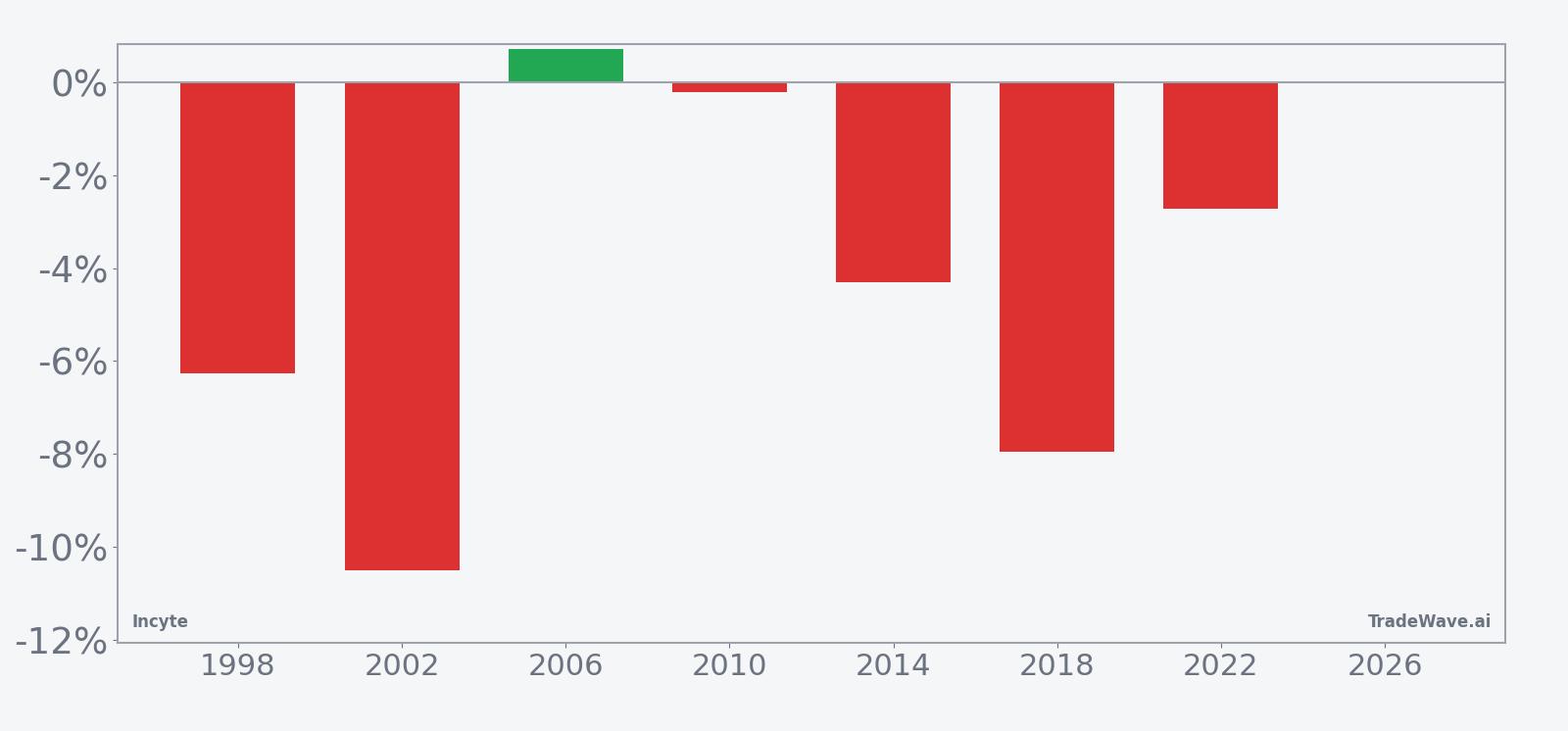
Incyte has fallen in 6 of 7 midterm-election-year April windows during this six-day stretch, with an average 5.33% gain in winning short years.
- 6 wins and 1 loss for the short side in this window, with winning years averaging 5.33% moves in the trade direction.
- The upcoming seasonal window runs from Apr 20 through Apr 27, covering six trading days in midterm election years.
- Percent Profitable is 86%, with 6 winners and 1 loser for the short setup across the last seven midterm-election-year samples.
- Avg Profit in winning years is 5.33%, while Avg Profit - All, which includes the lone losing year, is 4%.
- Maximum favorable moves have often been sizable, but adverse excursions inside the window have at times approached double-digit losses for shorts.
- Add it up: a 35% cumulative gain for the short side across these seven midterm-election-year windows.
According to historical data from TradeWave.ai, this specific six-session slice of the midterm-election-year calendar has behaved very differently from an average April week for Incyte. The next section walks through how that pattern has played out in prior cycles and what it means as the 2026 window approaches.
How has Incyte (INCY) traded in this midterm-year April window?
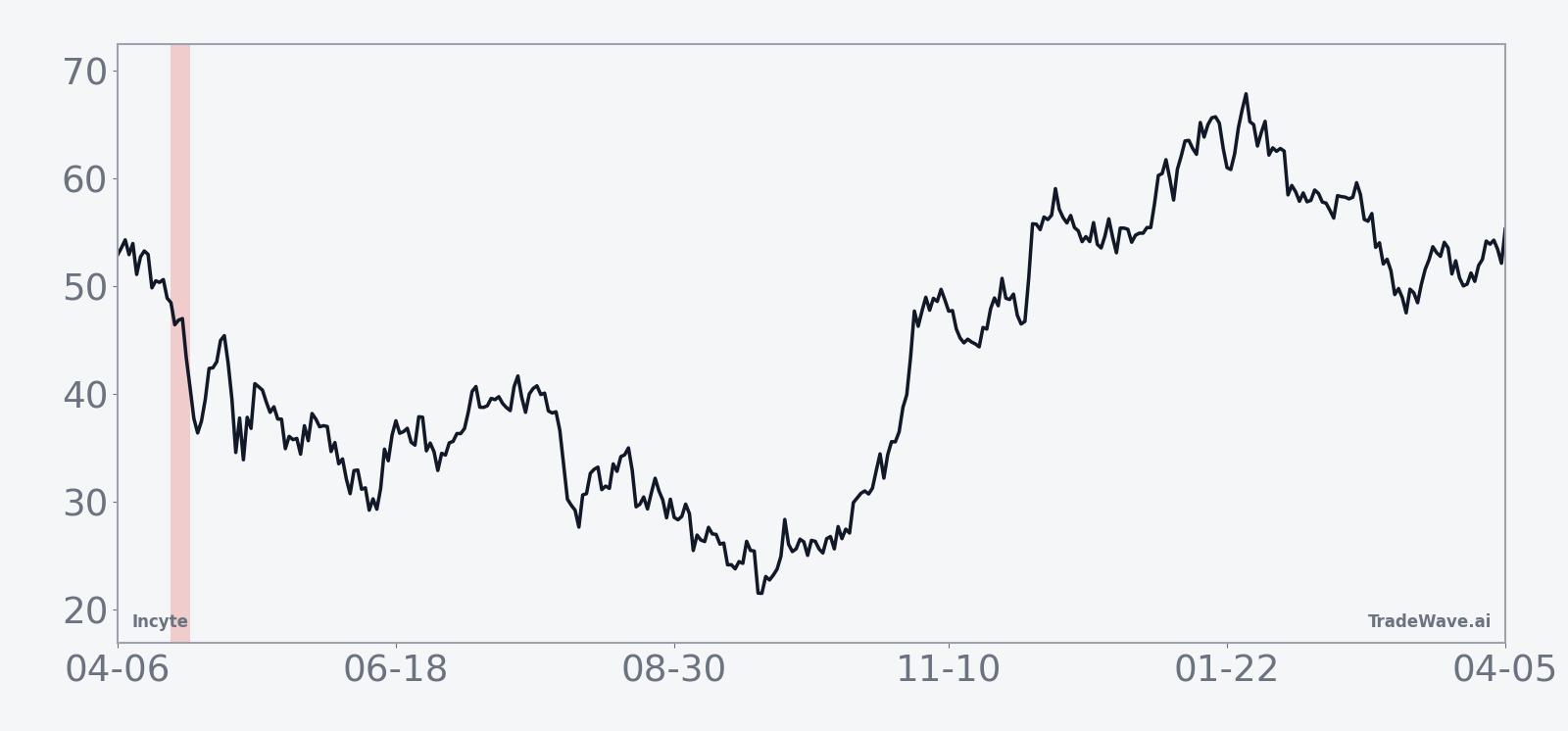
Incyte has fallen in 6 of the last 7 midterm-election-year runs through this six-day April window, delivering a 35% cumulative gain for the short side. Shares finished Monday at 95.55, leaving the stock about 14.9% below its 52-week high of 112.29 and roughly 77.7% above the 52-week low of 53.79. That combination of a historically bearish Incyte trading window and a stock sitting mid-range on the chart gives this year’s setup extra bite for traders watching the INCY seasonal trend.
Because this pattern is grouped by the presidential election cycle, it only looks at the last seven midterm election years rather than consecutive calendar years. That matters for a biotech name like Incyte, where policy risk, drug pricing debates and regulatory calendars often cluster around the mid-cycle phase of a presidency.
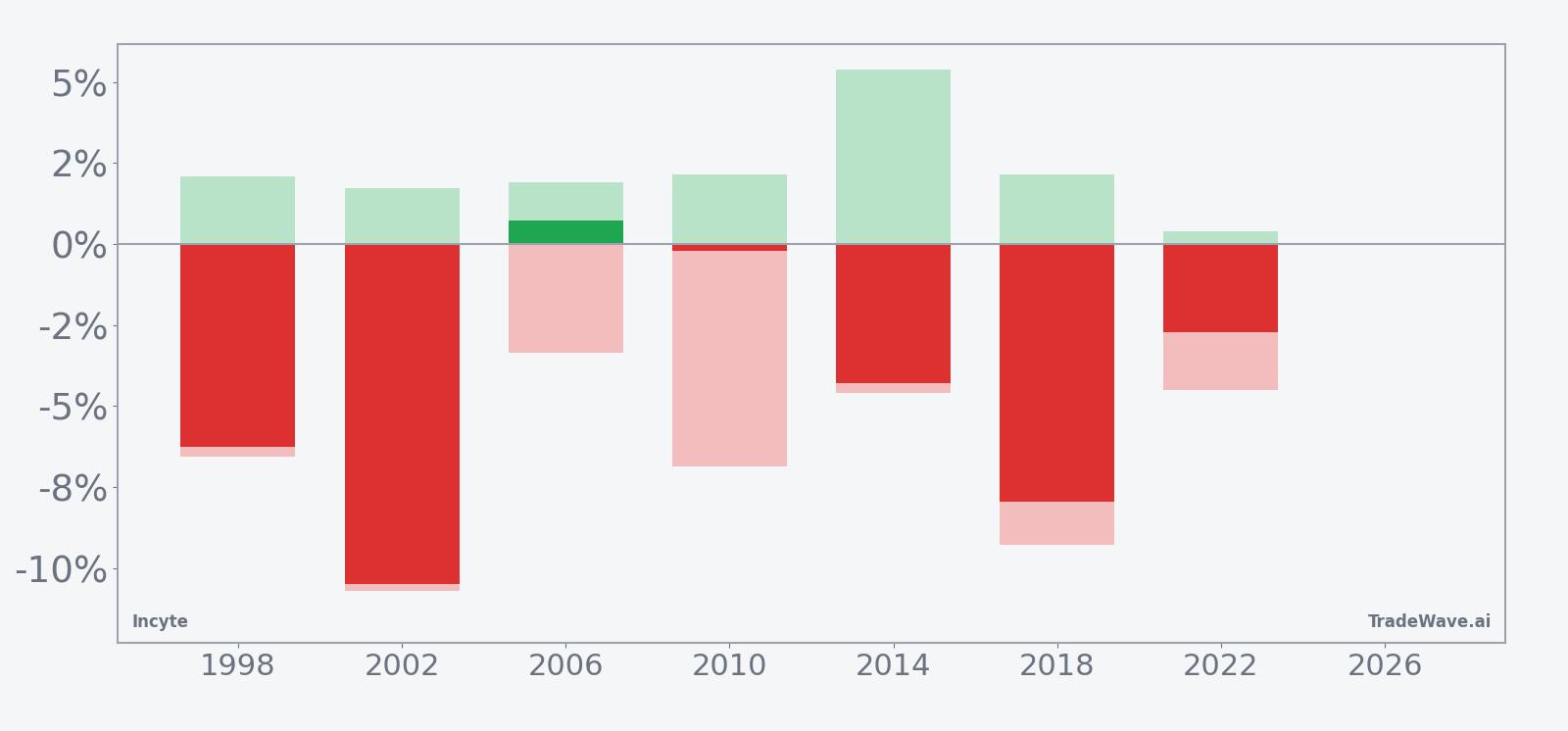
A stacked view of net results alongside best and worst intraperiod swings shows how far Incyte has typically moved inside the window.
The trade direction for this pattern is short, so negative net returns are the “good” years for the setup. Across the seven midterm-election-year samples, six years delivered profits for shorts, with an average 5.33% gain in those winning years and a 4% average when the lone losing year is included. The strongest short year was 2002, when Incyte dropped 10.5% over the window, while 2006 was the outlier that slightly favored longs with a 0.72% gain.
The maximum favorable move, or best intraperiod run in the trade direction, has often been meaningful. In 2014, for example, the stock’s best point-to-trough move for shorts reached 5.37% even though the final net return was a 4.3% gain for the short side. On the flip side, maximum adverse moves, which capture the worst drawdown from entry, have at times been sharp, with years like 2010 and 2018 showing intraperiod rallies against shorts of 6.86% and 9.29% respectively before the window closed back in favor of the pattern.
The cumulative return line for this Incyte trading window slopes steadily in favor of the short side rather than chopping sideways. That suggests the historical seasonality has not been driven by one or two outlier years but by a consistent bias across most midterm-election-year samples. The TradeWave Ratio of 2.42 reinforces that price has typically traveled a fair distance in the trade direction inside the window, even when the final close did not capture the full swing.
History does not guarantee future results; adverse excursions can be large even in winning windows, and shorts in particular need to respect how quickly a biotech stock can move against them.
Why does Incyte (INCY) follow this seasonal pattern?
This pattern may reflect how biotech risk is repriced in the early part of midterm election years, when drug pricing rhetoric and regulatory noise often pick up. One likely driver is institutional portfolio repositioning around policy risk, with managers trimming exposure to names like Incyte ahead of potential headlines. Analysts have also pointed to the way earnings calendars and clinical updates cluster in the spring, which can amplify short-term volatility in this kind of six-day Incyte trading window.
What is driving Incyte (INCY) today?
Incyte slipped 0.5% Monday to close at 95.55, leaving the stock about 14.9% below its 52-week high of 112.29 and well above its 52-week low of 53.79. The move comes after a strong run over the past month, with INCY up 3.25% in that span on average daily volume of roughly 1.5 million shares, slightly below the recent 20-day average of 1,501,920 shares. The stock is trading just under its 50-day moving average of 97.34, a level that has acted as a near-term pivot for the Incyte seasonal trend.
Fundamentally, investors are still digesting Incyte’s February guidance for 2026 revenue of $4.77 billion to $4.94 billion and Jakafi sales of $3.22 billion to $3.27 billion, which some viewed as cautious given looming patent expiry in 2028.[1] In Q4 2025, revenue of $1.51 billion topped estimates, but adjusted EPS of $1.80 missed consensus, keeping the focus on margin pressure and the need for newer products like Opzelura to scale.[1] A regulatory decision on Opzelura’s ex-U.S. launch in moderate atopic dermatitis is expected on Jul 1, 2026, a potential catalyst that could reshape the company’s medium-term growth profile if approval comes through.[1]
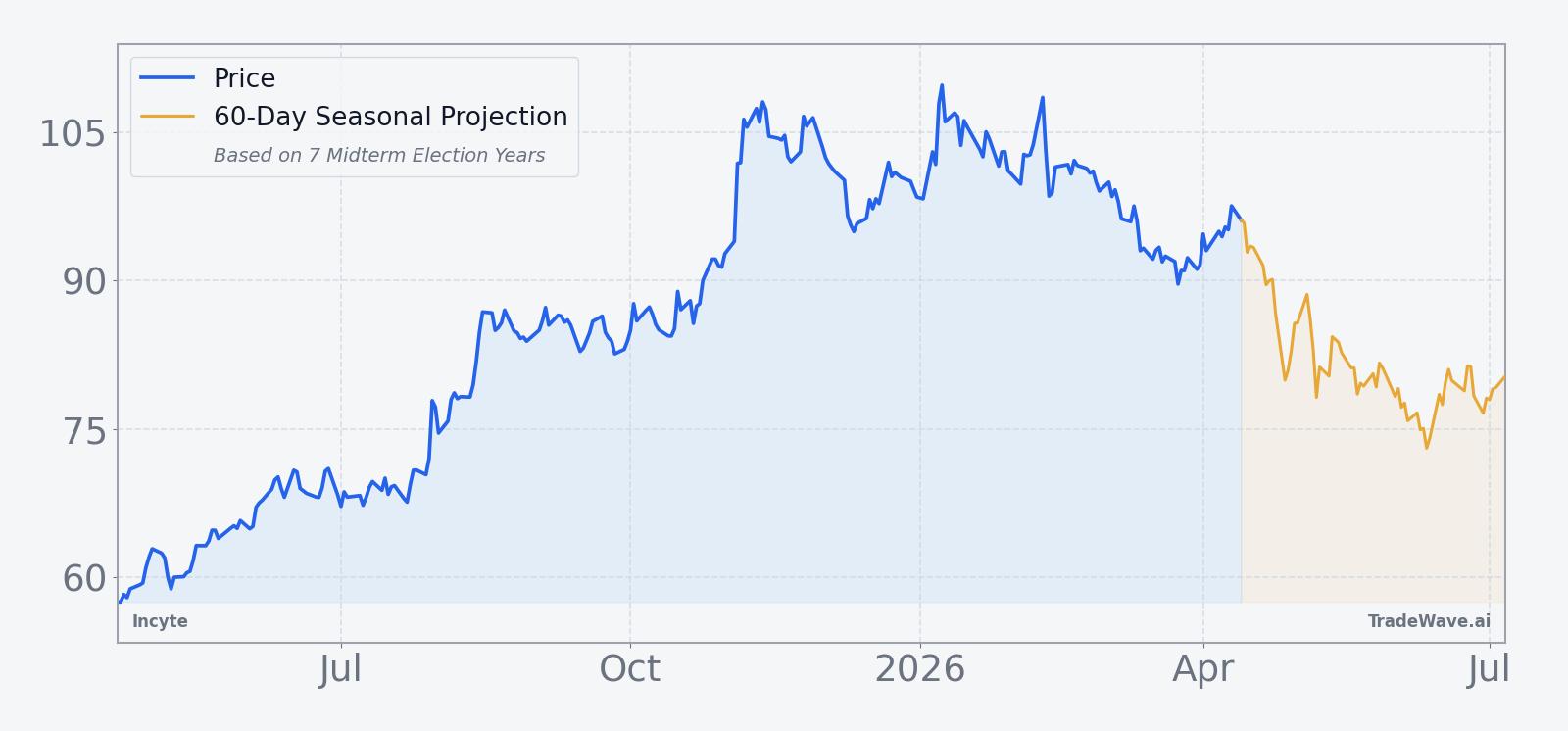
The chart below situates the latest move in its recent multi-month context and overlays a 60-day seasonal projection.
What should traders watch as this Incyte seasonal window opens?
First, the calendar: the six-day window begins on Apr 20 and runs through Apr 27, so price action in that band will be the real test of whether the historical Incyte seasonal pattern shows up again. Traders will be watching how INCY behaves around the 50-day moving average near 97 and the recent swing high zone closer to 112; a decisive break above those levels during the window would contradict the historical short bias, while a drift back toward the low 90s would be more in line with prior midterm-election-year behavior.
Second, the policy and regulatory backdrop matters. Any new commentary around U.S. drug pricing, reimbursement or oncology reimbursement frameworks could hit sentiment for the biotech sector and for Incyte specifically, especially with the Opzelura decision on the horizon.[1] Finally, intraday volatility inside the window will be important: if maximum adverse moves against shorts stay contained compared with past cycles, it would suggest a calmer regime than the sharp squeezes seen in years like 2018, whereas another deep intraperiod rally would signal that the risk side of this pattern is still very much alive.
Sources
About this seasonal analysis
Seasonal pattern data is sourced from TradeWave.ai, which analyzes historical price behavior across annual calendar windows going back up to 30 years. Read the full data methodology or the book The 100-Year Pattern by Afshin Moshrefi (2026 edition). Past performance of seasonal patterns does not guarantee future results. This article is for informational purposes only and does not constitute investment advice.