FMC Corporation (FMC) Strategic Review Comes as 110-Day Midterm Stretch Turns Weak
FMC Corporation is heading toward a historically weak 110-day midterm-election-year stretch just as the stock trades near the bottom of its recent range and management weighs strategic options.

Key takeaways
- FMC Corporation’s midterm-election-year window that begins on Apr 23 and runs 110 days has historically favored downside moves for short positions.
- Across the last 7 midterm-election-year samples, the pattern shows 86% profitable short trades, with 6 winners and 1 loser.
- Average gain in winning years is 16.18% for shorts, while including all years the average outcome is a 13% move in the trade direction.
- The window sits in the early part of the midterm election year, a phase that often brings policy uncertainty and choppy trading for cyclical names like agricultural chemicals.
- Intraperiod swings have been meaningful, with some years showing deep adverse moves before the short ultimately worked, underscoring the need to respect drawdown risk.
- Today FMC trades at 15.66, up 1.4% on the day but still far below its 52-week high, as investors digest weak earnings and ongoing strategic reviews.[1]
According to historical data from TradeWave.ai, this specific midterm-election-year stretch in FMC has behaved very differently from an average quarter, with a clear directional bias that most investors do not track day to day.
Seasonal window
FMC Corporation has delivered profitable short trades in 6 of the last 7 midterm-election-year windows that start in late April and run for 110 trading days, with winning years averaging 16.18% in the trade direction. Today the stock closed at 15.66, up 1.4% on the session, leaving it well below its 52-week high of about 42.65 and roughly 30.3% above its 52-week low near 12.03.[1]
The presidential election cycle matters here because this pattern only looks at the last seven midterm election years, a phase that often brings tighter financial conditions, policy debates over spending and regulation, and more volatile trading in cyclical sectors. For an agricultural and materials name like FMC, that backdrop can intersect with tariff headlines, subsidy debates and environmental rules in ways that do not show up in a simple calendar-month study.
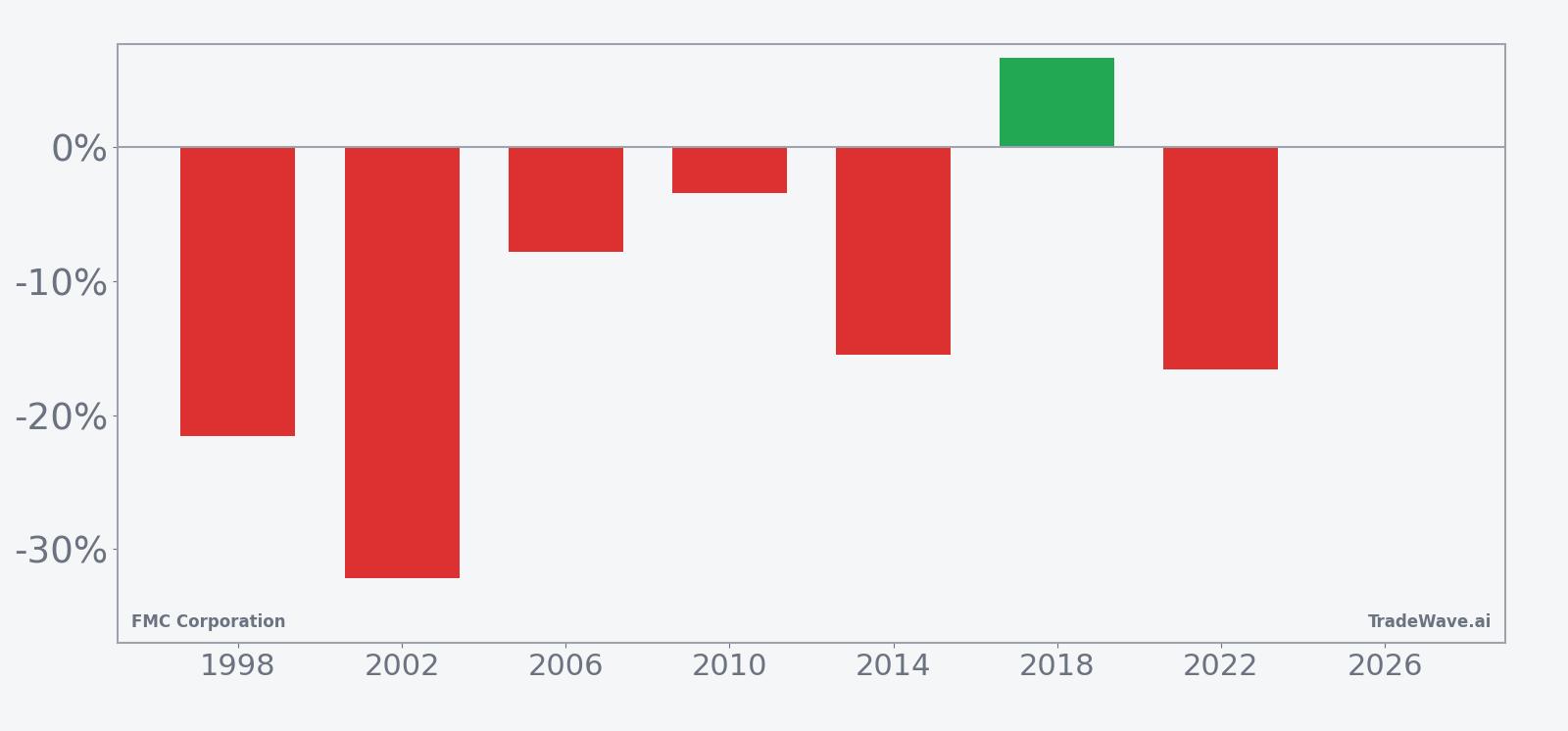
This seasonal window begins on Apr 23 and spans 110 trading days. Historically, during this period, FMC Corporation has shown a clear downside tendency that aligns with a short trade direction. Across those seven midterm-election-year samples, 6 were profitable for shorts and only 1 produced a loss, giving the pattern an 86% hit rate. Average gains in the winning short years came in at 16.18%, while including the lone losing year still leaves an average move of 13% in favor of the short side.
The per-year breakdown shows how that plays out in practice. In 2002, a short entered at 6.02 and exited 110 trading days later at 4.08, a net return of about 32.19% in the trade direction. In 2014, the pattern captured a drop from 51.92 to 43.89, a 15.46% move for shorts. The one clear miss was 2018, when FMC rallied from 58.30 to 62.21 during the window, handing shorts a 6.7% loss even though the maximum favorable move inside that year briefly reached 12.8% before reversing.
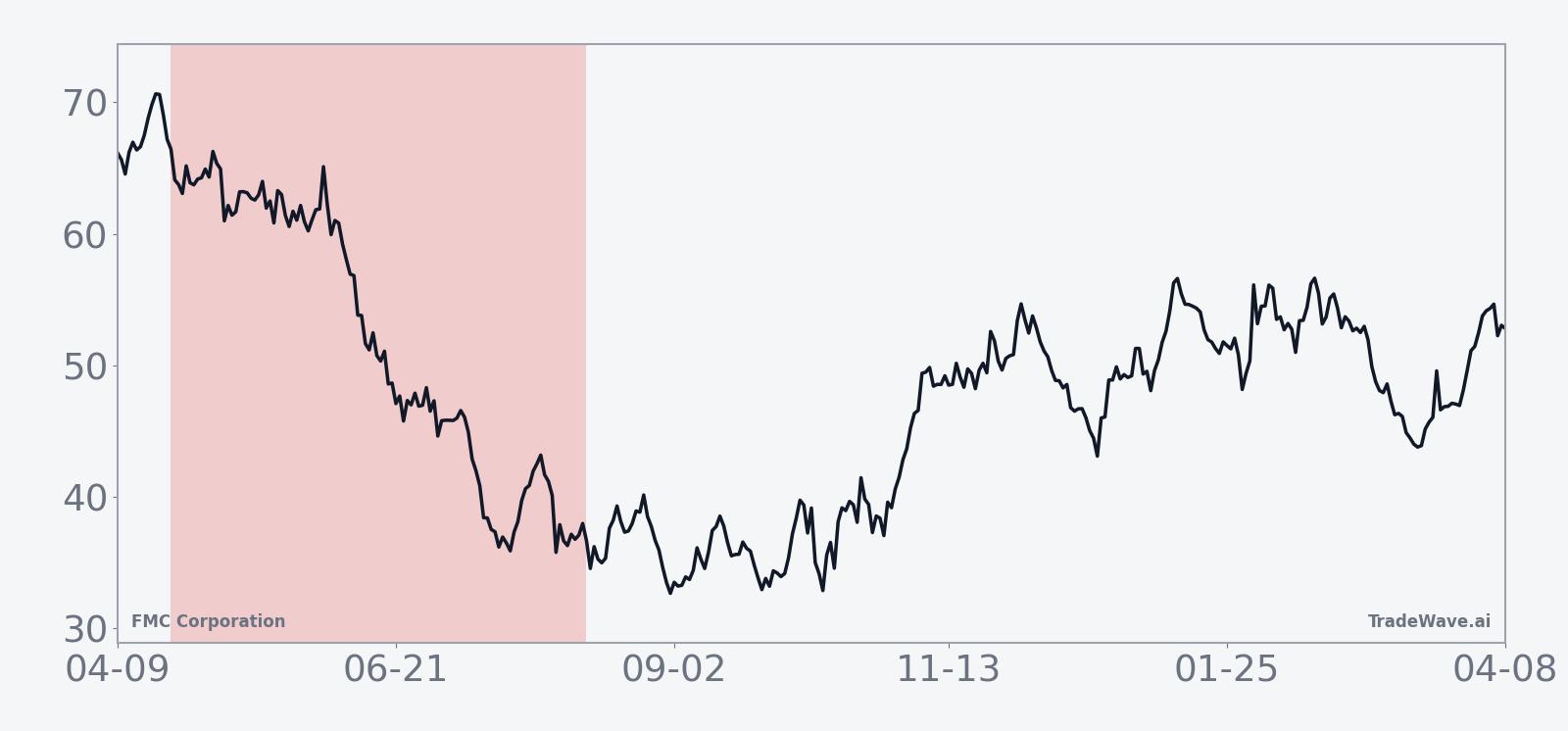
The historical seasonal average trend suggests that, in many midterm years, the bulk of the downside for FMC has tended to build gradually rather than in a single air pocket. The curve slopes lower across much of the 110-day span, with only modest countertrend rallies, which is consistent with a grind-down pattern rather than a crash-and-snapback profile.
A second view that stacks net results with peak run-ups and worst drawdowns shows how far FMC has typically moved inside the window before settling at the final outcome.
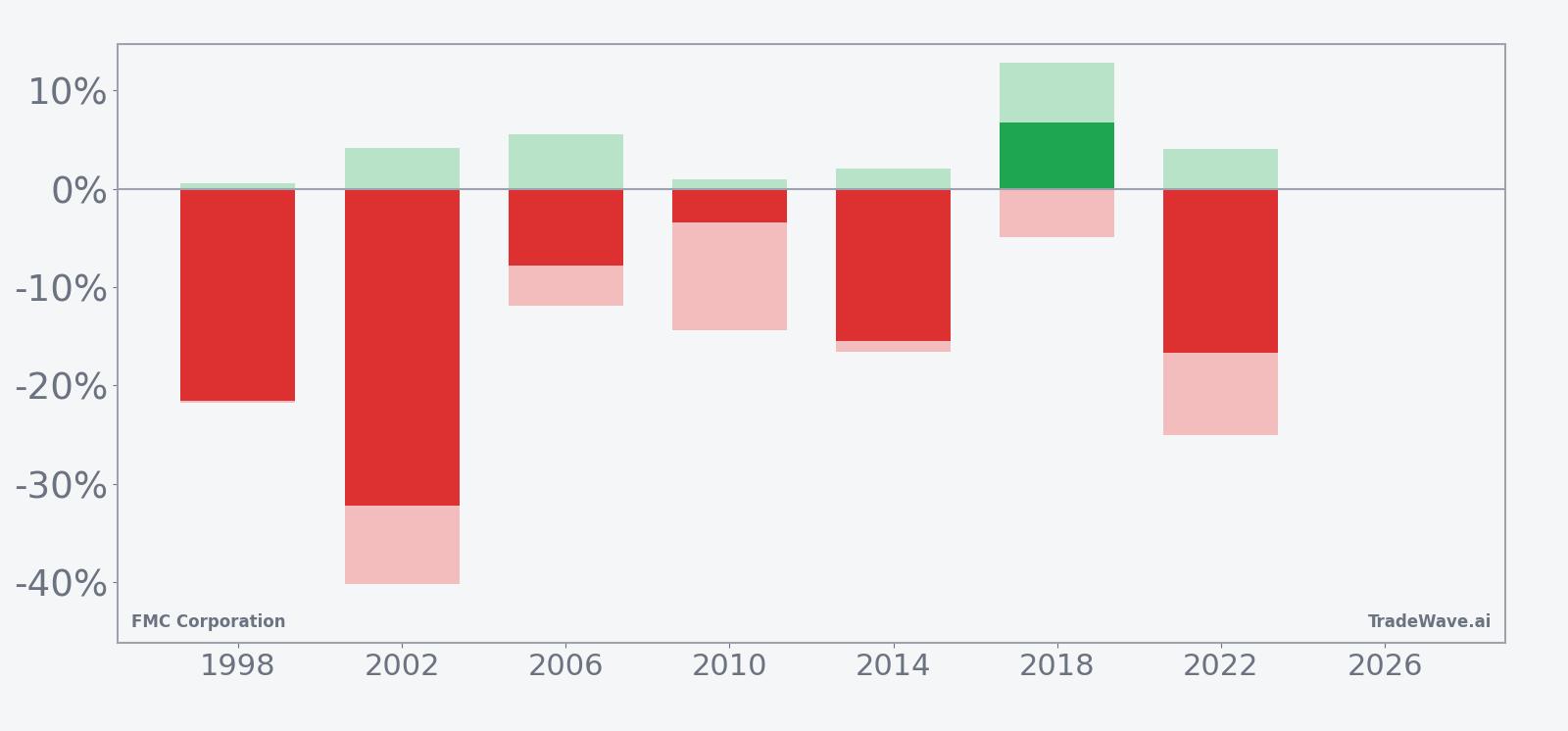
The stacked net/MFE/MAE profile shows that even in strong short years, FMC often experienced meaningful countertrend rallies before the downside reasserted itself. For example, 2006 delivered a 7.84% gain for shorts by the end of the window, but the worst intraperiod drawdown from entry reached about 11.9% against the trade before the stock rolled over. In 2022, the short finished up 16.62%, yet the maximum adverse move inside the window was roughly 25.01% before the trend turned. Add it up: this has been a historically favorable window for shorts, but one that has not rewarded complacency about interim volatility.
History does not guarantee future results; adverse excursions can be large even in winning windows, and past midterm-election-year behavior may not repeat.
Price and near-term drivers
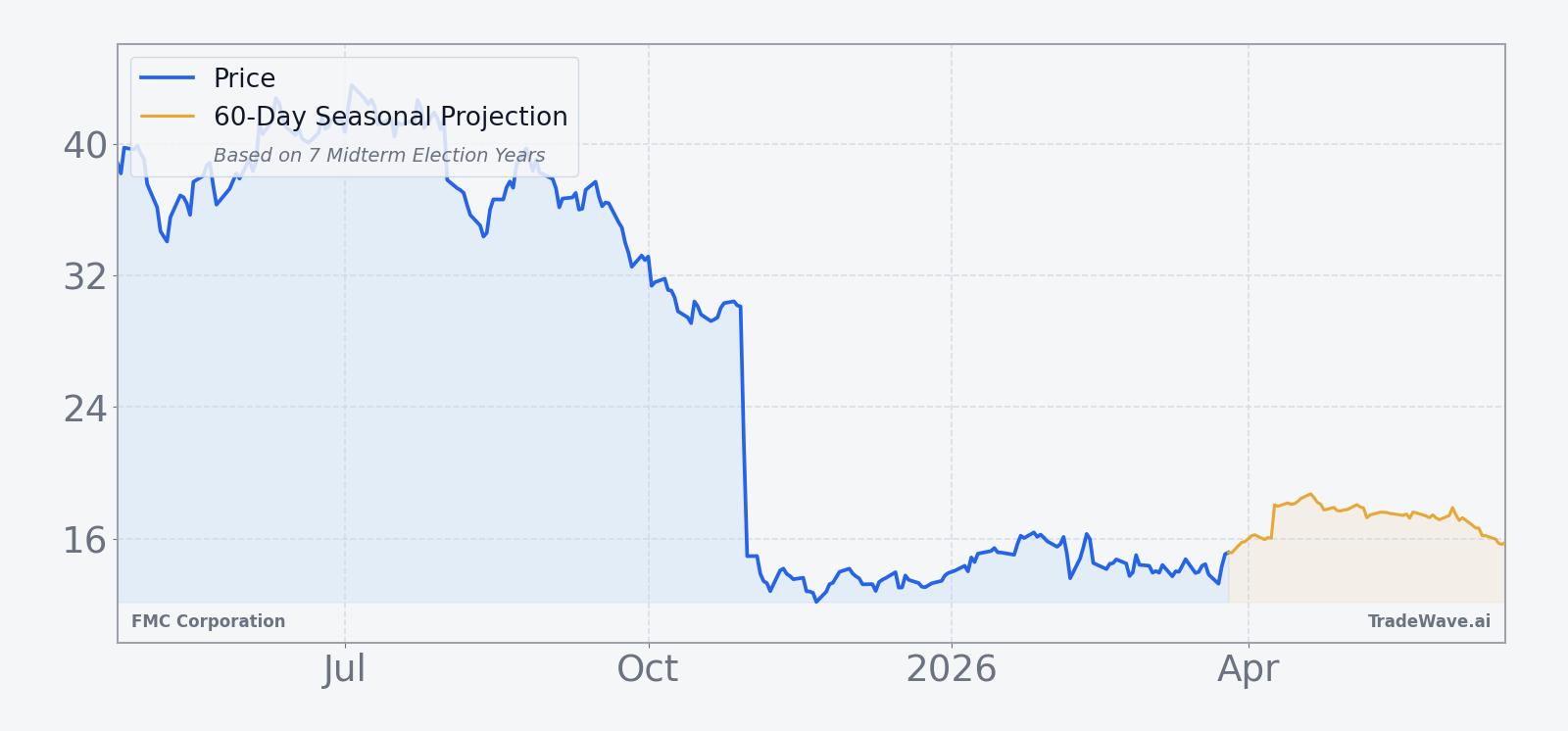
FMC shares closed Friday at 15.66, up 0.22 on the day, a 1.4% gain that extends a roughly 7.26% advance over the past month as the stock bounces off its 52-week low near 12.03 but remains far below the 42.65 high set earlier in the year.[1] Trading volume of about 3.53 million shares was slightly below the recent 20-day average of roughly 3.60 million, suggesting the move was more of a grind than a surge in conviction.[1]
That price action comes after a difficult fundamental stretch. FMC recently missed fourth-quarter earnings and revenue estimates, with sales declining as tariff headwinds and pricing pressure weighed on results.[1] Management responded by launching a review of strategic options, including a potential sale of the company, and by laying out 2026 priorities that acknowledge a tougher operating backdrop for crop-protection chemicals.[1] The stock’s slide from the low 40s to the mid-teens reflects that reset in expectations, as investors reassess both the earnings power of the franchise and the odds that a strategic transaction can unlock value.
Sector context has not helped. Agricultural and materials names have been wrestling with softer global demand, shifting trade policies and input-cost volatility, all of which compress pricing power for companies like FMC that sit between upstream commodity producers and downstream farmers.[1] The upcoming appearance of CEO Pierre Brondeau and CFO Andrew Sandifer at the Bank of America Global Agriculture and Materials Conference on Feb 25 was flagged as a venue where management could elaborate on strategy, capital allocation and the status of the strategic review, and investors will be parsing any follow-up commentary for clues on timing and scope.[1]
Legal overhangs add another layer. In April 2025, a securities class action was filed alleging that insiders at FMC made misrepresentations about company operations, and in May 2025 another law firm publicly encouraged investors to contact it regarding potential claims.[2][3] Those cases sit in the background rather than driving day-to-day trading, but they contribute to a perception of elevated governance and disclosure risk that can matter when a company is exploring strategic alternatives.
The chart below situates the latest bounce against FMC’s steep multi-month decline and overlays a short-term seasonal projection.
Election-cycle backdrop and macro lens
The current pattern phase is the midterm election year, and the calendar is in the early part of that year. Historically, midterm years have been split personalities for equities: choppy and often weak in the first half as Washington debates spending, regulation and trade, then stronger into the following pre-election year once policy paths are clearer. For a company like FMC that is exposed to tariffs, environmental rules and agricultural subsidies, that early-year uncertainty can translate into cautious customer ordering and more volatile earnings revisions.
Macro themes around strategic options also intersect with this cycle. FMC’s decision to explore a potential sale or other strategic moves comes at a time when regulators are scrutinizing consolidation in chemicals and agriculture, and when higher interest rates make leveraged buyouts more complex.[1] Any bidder would need to underwrite not just FMC’s earnings power but also the policy risk around crop-protection products, including potential restrictions on certain active ingredients. That mix of regulatory and financing uncertainty is typical of midterm years, when legislative agendas and committee leadership can shift in ways that matter for sector structure.
From a trading perspective, the combination of a deeply discounted stock, a strategic review and a historically weak seasonal window for longs creates a nuanced setup. On one hand, the valuation reset and potential corporate actions could support sharp countertrend rallies, as 2018’s losing short year showed. On the other, the midterm-year pattern suggests that rallies inside this April-to-summer stretch have often been opportunities for the short side rather than the start of durable uptrends.
What to watch as the window opens
The seasonal window for FMC begins on Apr 23 and runs for 110 trading days, carrying through much of the midterm-year summer. Traders watching this name into that period will be focused on a few concrete markers. First, price behavior around the 50-day moving average near 14.88 will matter; in prior midterm years, failed rallies into intermediate-term resistance have often preceded the deeper declines that made the short pattern work.[1] A sustained break back above that band with rising volume would look more like 2018’s squeeze than the grind-down years.
Second, any updates on the strategic review, whether through conference commentary, formal announcements or credible media reports, could override the seasonal script. A credible buyer emerging at a premium would obviously be a problem for shorts, while a drawn-out or inconclusive process could reinforce the historical pattern of midterm-year drift lower.[1] Third, sector and policy headlines around tariffs, crop prices and environmental regulation will shape how investors handicap FMC’s medium-term earnings power, which in turn influences how much patience they have for a turnaround story in a tough macro phase.
Finally, traders will be monitoring how legal and governance issues evolve. If the securities class action filed in April 2025 and the related investor-outreach efforts from May 2025 move toward resolution, that could remove one overhang; if they escalate, they could add to the discount investors demand for owning the stock through a strategic process.[2][3] The key tell inside the window will be whether FMC behaves like its historical midterm-year pattern, with rallies fading and new lows being tested, or whether a combination of corporate actions and macro shifts breaks that script. Either way, the calendar says this is not just another quarter for this stock.
Sources
- [1] Finviz, "FMC Corporation CEO Pierre Brondeau and CFO Andrew Sandifer to speak at Bank of America Global Agriculture and Materials Conference" (Feb 11, 2026)
- [2] Morningstar, "The Gross Law Firm Announces the Filing of a Securities Class Action on Behalf of FMC Corporation(FMC) Shareholders" (Apr 7, 2025)
- [3] Morningstar, "Kuehn Law Encourages Investors of FMC Corporation to Contact Law Firm" (May 28, 2025)