Seven Straight Midterm Windows Have Ended Lower for Match Group (MTCH) Shorts Averaging 8.59%
Match Group is stepping into a historically weak 27-day midterm-election-year window just as the stock trades near its 52-week high, setting up a sharp test of its recent rebound.

What is the seasonal pattern for Match Group (MTCH)?
Match Group has fallen in 7 of 7 midterm-election-year windows starting Apr 24, with an average gain of 8.59% for short positions in winning years.
- 7 for 7 in this window for shorts, with average winning-year profits of 8.59% over 27 trading days.
- The pattern runs from Apr 24 for 27 days in midterm election years and has historically favored downside moves in MTCH.
- Percent Profitable is 100%, with 7 winners and 0 losers across the last seven midterm-election-year samples.
- The TradeWave Ratio of 2.35 suggests MTCH typically travels meaningfully in the trade direction within the window, not just at the close.
- Individual years have seen adverse moves against the short before working, with some drawdowns exceeding 10% inside the window.
- Add it up: a 77% cumulative return for the short strategy across these seven midterm-election-year windows.
According to historical data from TradeWave.ai, this specific late-April stretch in midterm election years has behaved very differently from an average month for Match Group. The next section walks through how that pattern has played out and what it means for the current setup.
How has Match Group (MTCH) traded in this midterm-year window?
Match Group has delivered profitable short-side trades in every single midterm-election-year window starting Apr 24 across the last seven cycles, averaging 8.59% gains for bears over 27 trading days. Shares closed Friday at 35.66, down 2.4% on the day and about 6.9% below their 52-week high of 38.32, after a strong run over the past month. That combination of a clean 7-for-7 historical record for shorts and a stock pressing up toward the top of its one-year range gives this window more bite than a typical calendar quirk.
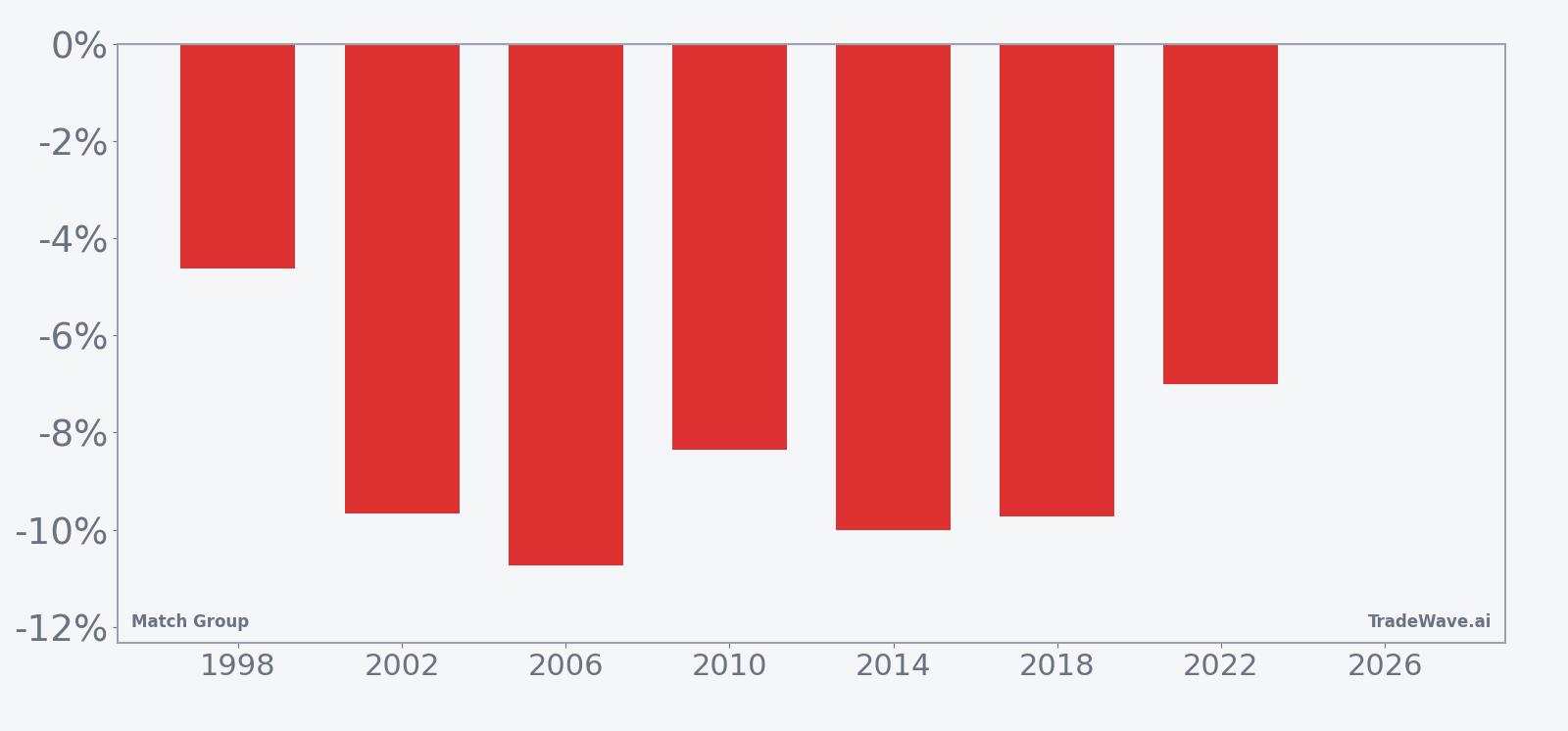
Because this pattern is grouped by the presidential election cycle, it only looks at midterm election years, which tend to feature more policy uncertainty and choppy risk appetite than other phases. For a consumer-internet name like Match Group, that has often coincided with investors re-rating growth expectations and trimming exposure to higher-beta platforms during this early-year stretch.
A second view layers in both the best and worst intraperiod swings for each year.
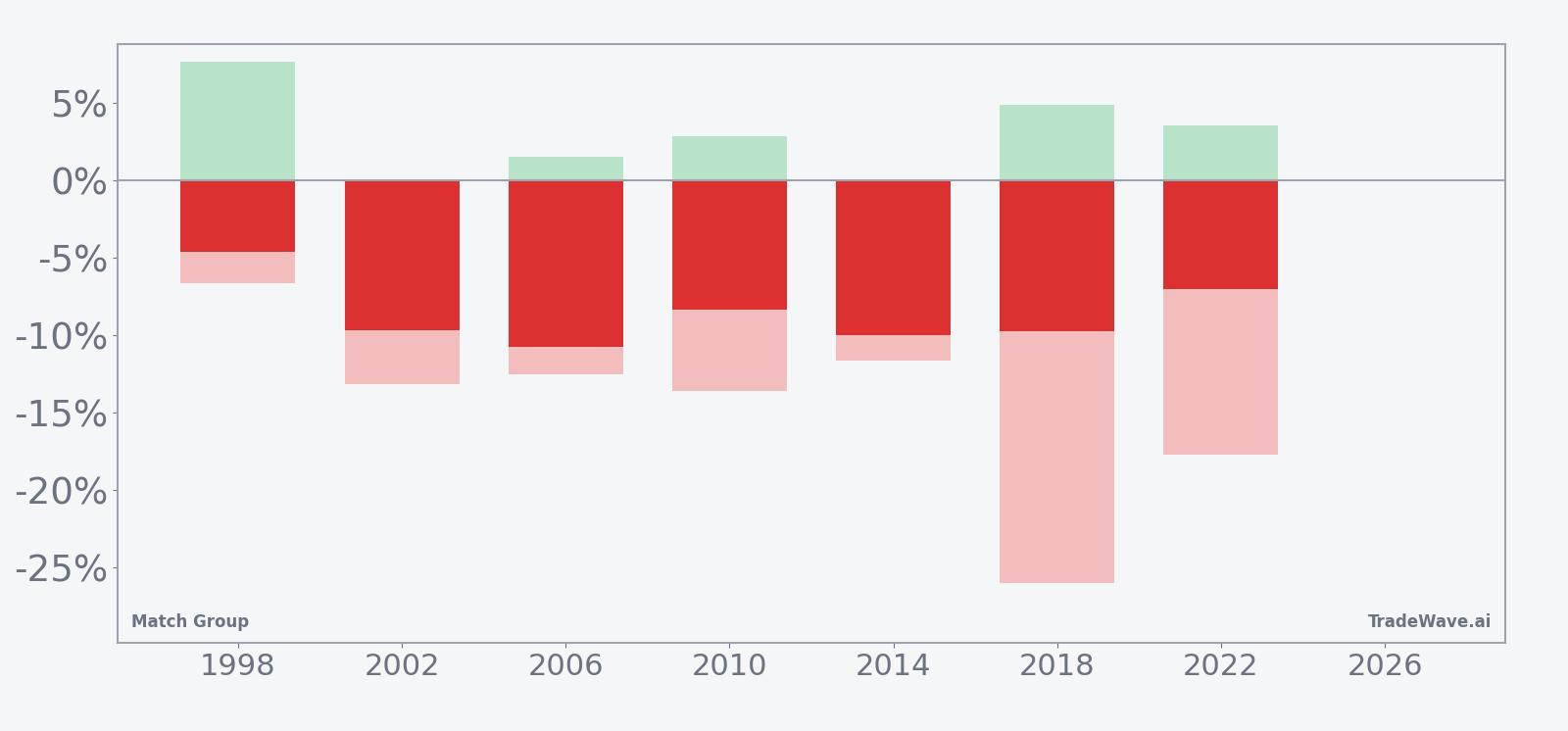
Across the seven midterm-election-year samples, every window ended with MTCH lower, which is favorable for the short trade direction. Average profit of 8.59% lines up with a 77% cumulative return for the strategy, while the Sharpe ratio of 3.89 points to unusually consistent outcomes for such a short, 27-day span. The TradeWave Ratio of 2.35 indicates that price has typically moved meaningfully in the trade direction inside the window, not just drifted to a small net change.
The per-year breakdown shows how that has played out in practice. In 2006, for example, the stock fell 10.73% from entry to exit, with a best intraperiod move of 1.54% in favor of the short and a worst drawdown of 12.51% against it. In 2018, the net decline of 9.72% came with a maximum favorable move of 4.88% but also a sharp 26.03% adverse swing at one point, underscoring how violent countertrend rallies can be even in ultimately profitable short windows.
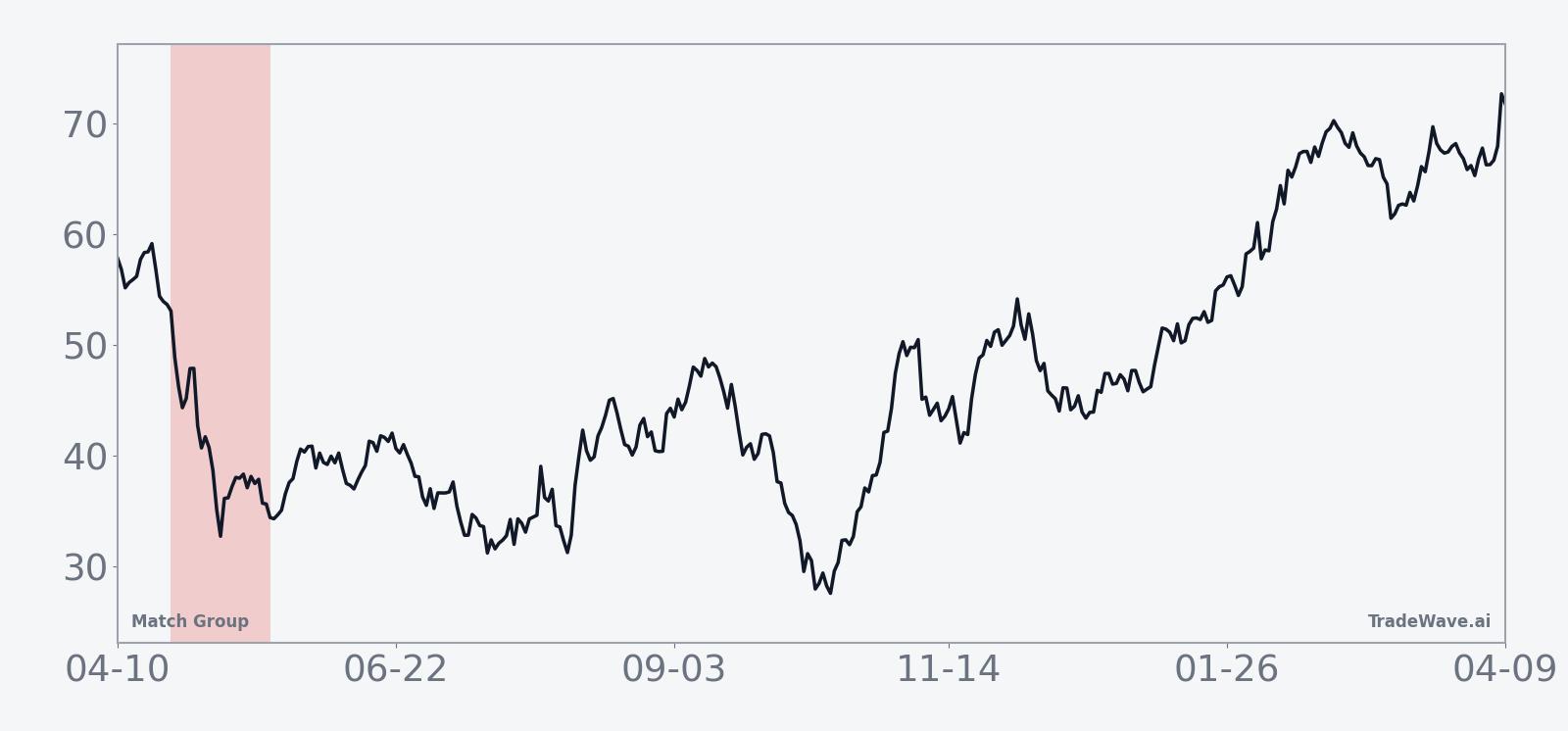
The historical seasonal trend chart suggests that weakness has tended to build after the first week, with the middle of the window doing most of the work for shorts. Early days have sometimes seen small rallies that later faded, which matches the MAE profile where several years show double-digit adverse excursions before the trade moved back in the intended direction. The 1998 and 2014 windows, with net returns of -4.62% and -10.02% respectively, fit that pattern of choppy starts followed by more decisive downside.
Put together, the message from this MTCH seasonal trend is straightforward: in the last seven midterm election years, this late-April to late-May stretch has been a reliable headwind for the stock, with every sample ending lower and several featuring sizable intraperiod whipsaws.
History does not guarantee future results; adverse excursions can be large even in winning windows, and traders using this pattern still face the risk of sharp moves against their position.
Why does Match Group (MTCH) follow this seasonal pattern?
One likely driver is the way Match Group’s earnings and guidance cadence lines up with the midterm-year policy calendar, with early-year reports often prompting investors to reassess growth and spending plans. Analysts have also pointed to broader risk-off rotations in midterm springs, when higher-beta internet and app names can see profit-taking as macro uncertainty rises. This pattern may reflect that combination of company-specific guidance resets and election-cycle volatility compressing valuations in the weeks after late-April.
What is driving Match Group (MTCH) today?
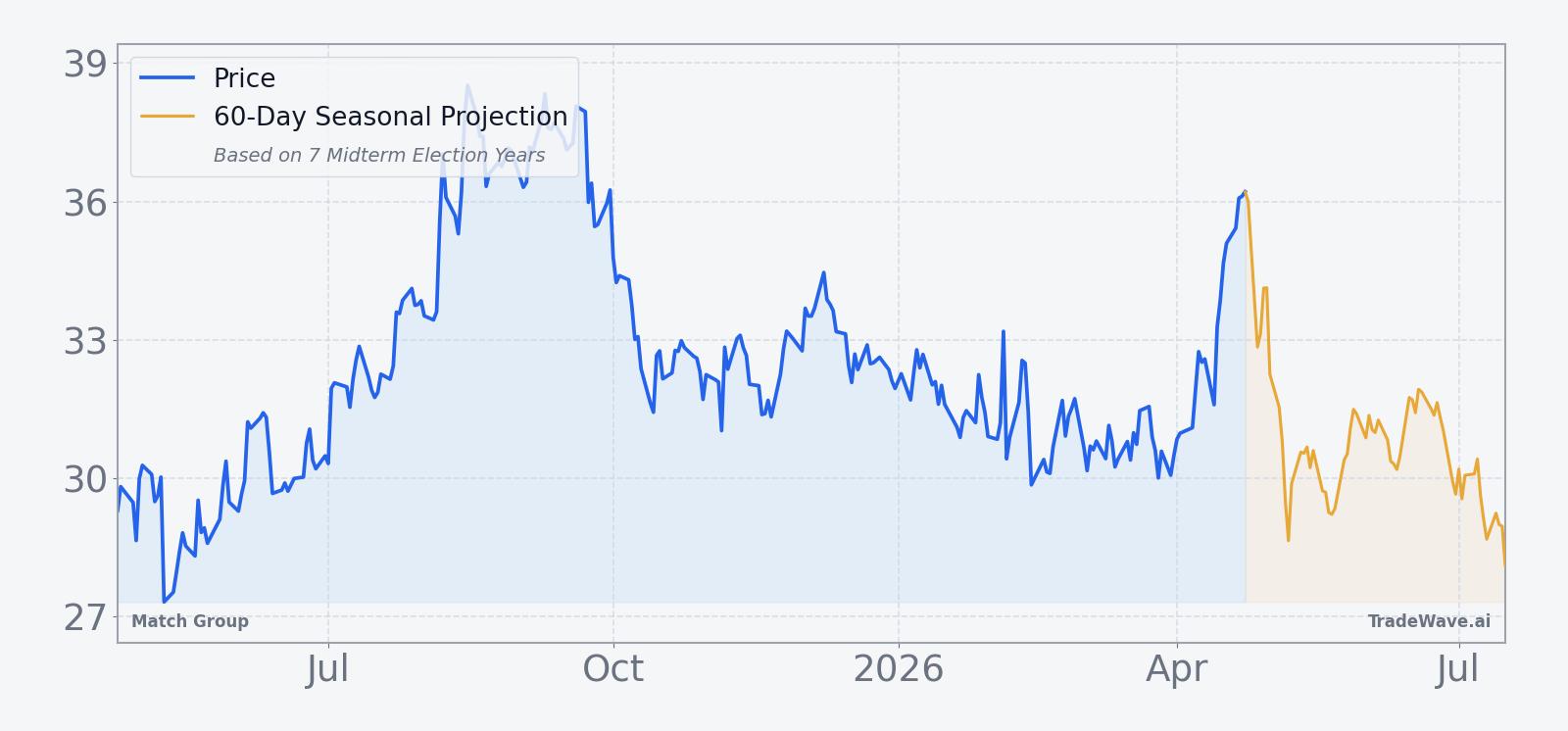
Match Group slipped 2.4% on Friday to 35.66, backing off recent highs but still sitting comfortably above its 50-day moving average of 31.74 and up 17.53% over the past month. The stock is trading about 6.9% below its 52-week high of 38.32 and roughly 37.7% above its 52-week low near 25.89, a rebound that has come with average 20-day volume of about 3.25 million shares.
That recovery leg was sparked in early February when the company reported Q4 2025 revenue of $878 million, topping estimates of $871.3 million, and forecast Q1 2026 revenue between $850 million and $860 million, above analyst expectations of $853.3 million.[1] In extended trading after those results, shares jumped roughly 12%, signaling a surge in demand and likely volume as investors recalibrated expectations for the turnaround in Tinder and Hinge.[1] At the same time, management flagged heavier AI-related investment and some near-term pressure on Tinder monetization, a nuance that left the fundamental story more balanced than the initial price spike suggested.[2]
Since then, MTCH has been grinding higher rather than exploding, a pattern consistent with investors digesting both the upbeat revenue outlook and the cost of new product initiatives. With no near-term earnings date on the calendar, the next few weeks are more about how the stock trades around technical levels and this historical seasonal window than about fresh fundamental catalysts.
The chart below situates the latest pullback and the 52-week range against a 60-day seasonal projection overlay.
What should traders watch in this MTCH seasonal window?
For this 27-day stretch, the first watchpoint is how MTCH behaves around the 35 to 38 zone that has defined its recent range. A decisive break above the 52-week high with strong volume would run counter to the historical midterm-year pattern, while a failure to hold the 50-day moving average near 31.74 would look more in line with prior downside windows.
Second, traders will be watching for any follow-through or reversal of the February post-earnings enthusiasm. If the 12% after-hours surge that followed Q4 results marked a lasting shift in sentiment, pullbacks during this window may be shallower than in past midterm years; if enthusiasm fades and volume dries up, the stock could revert more closely to its historical seasonal script.[1]
Finally, the broader policy and macro backdrop typical of midterm election years matters. Any signs of tightening consumer budgets, regulatory noise around app stores or subscription pricing, or a broader risk-off move in internet and growth stocks could amplify the downside bias that has shown up in this MTCH trading window before. The pattern does not dictate outcomes, but it sets a clear bar: history says this is when the stock has most often struggled, and price action over the next month will show whether 2026 breaks or extends that streak.
Sources
About this seasonal analysis
Seasonal pattern data is sourced from TradeWave.ai, which analyzes historical price behavior across annual calendar windows going back up to 30 years. Read the full data methodology or the book The 100-Year Pattern by Afshin Moshrefi (2026 edition). Past performance of seasonal patterns does not guarantee future results. This article is for informational purposes only and does not constitute investment advice.