AngloGold Ashanti (AU) Has Dropped in 7 of 9 Midterm Windows as Next 48-Day Stretch Opens
AngloGold Ashanti is pressing fresh highs just as it approaches a historically bearish 48-day midterm-election seasonal window that has often rewarded short sellers.
What is the seasonal pattern for AngloGold Ashanti (AU)?
AngloGold Ashanti has fallen in 7 of 9 midterm-election-year windows during this 48-day stretch, with an average 22.56% gain in winning short years.
- 7 wins and 2 losses for the short side in this window, with winning years averaging 22.56% moves in the trade direction.
- The upcoming 48-day AngloGold Ashanti trading window starts Apr 28 and targets the last 9 midterm election years.
- Percent Profitable sits at 78%, with 7 winners and 2 losers for the short setup across the historical sample.
- Average Profit across all years is 17%, showing that losing years have been smaller than the big short-side wins.
- Individual years have seen sharp swings, including a 60.0% best-case move and a 58.33% worst drawdown inside the window.
- The AU seasonal trend in this phase has tended to favor downside follow-through even as intraperiod rallies can be violent.
According to historical data from TradeWave.ai, this midterm-election slice of the calendar has behaved very differently from an average month for AngloGold Ashanti. The next section walks through how that pattern has played out and what it could mean for the approaching window.
How has AngloGold Ashanti (AU) traded in this midterm-year window?
AngloGold Ashanti has fallen in 7 of the last 9 midterm-election-year windows starting around Apr 28, with short trades averaging 22.56% gains when they work. Shares finished Monday at 90.56, up 1.6% on the day and about 42.1% below the 52-week high of 129.14, after a powerful run that has left the stock well above its 50-day moving average of 104.46.[1] In November 2025, options traders piled into AU calls, with 68,797 contracts changing hands in a single session, a 1,505% jump in volume that flagged aggressive bullish positioning into year-end.[5] That mix of a historically bearish seasonal window, a stretched price backdrop and prior crowded upside bets sets up a tension point for the next leg of the AngloGold Ashanti story.
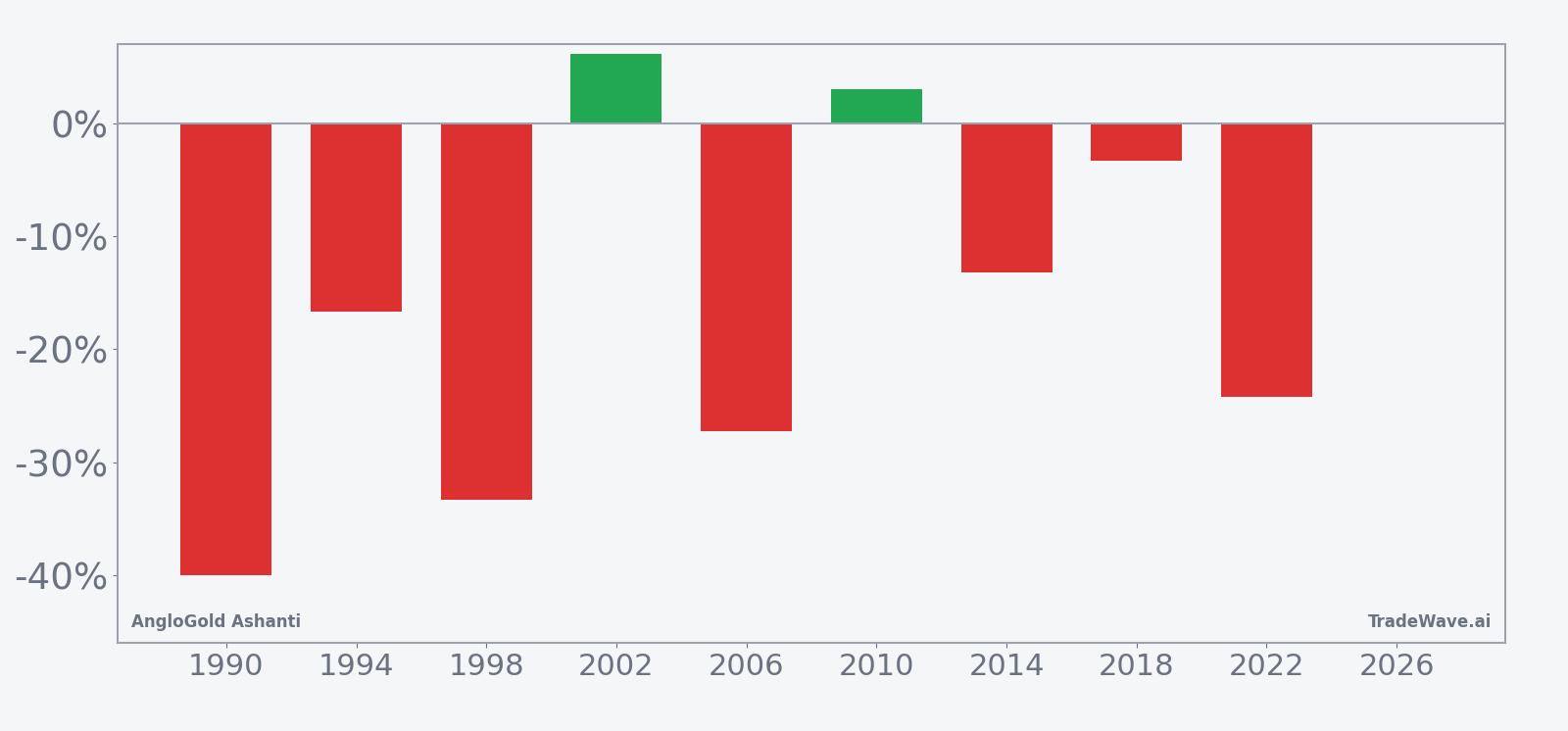
Grouping the AU seasonal pattern by the presidential election cycle matters here because this window is built from the last 9 midterm election years, while the calendar is currently in the year after the presidential election. Historically, midterm years have seen more policy uncertainty and sector rotation in cyclicals and miners, which can amplify moves when gold prices and risk appetite shift together.
This seasonal window begins on Apr 28 and spans 48 trading days. Historically, during this period, AngloGold Ashanti has shown a clear bearish tendency for the stock, with the short side favored in most midterm-election years. Percent Profitable for the short setup is 78%, with 7 winning years and 2 losing years, so the pattern is strong but not flawless.
Average Profit in winning years is 22.56%, which means that when the short pattern has worked, it has often produced sizable downside moves. When every year is included, the Average Profit - All drops to 17%, reflecting the drag from the two losing years but still leaving a solid net edge for the short direction. The Median Profit of 16.67% shows that the typical outcome has been a meaningful but not extreme move in favor of shorts.
The per-year table shows how wide the range of outcomes has been. In 1990, the short pattern delivered a 40.0% gain with a best intraperiod move of 60.0% and a worst drawdown of 50.0% from entry, a textbook high-volatility year for AU. At the other end of the spectrum, 2010 was a mild winner for shorts, with a 2.97% net move, a 7.41% best run in the trade direction and a 7.31% worst adverse swing, underscoring that not every midterm window has been a home run.
The MAE/MFE profile across years points to a window where both sides of the tape can be violent. Maximum favorable excursions have reached as high as 60.0% in some years, while maximum adverse excursions have stretched to 58.33%, so even successful short windows have often forced traders to sit through deep rallies before the pattern reasserted itself. That mix of large MFE and large MAE is a hallmark of a high-variance AU seasonal trend rather than a smooth grind lower.
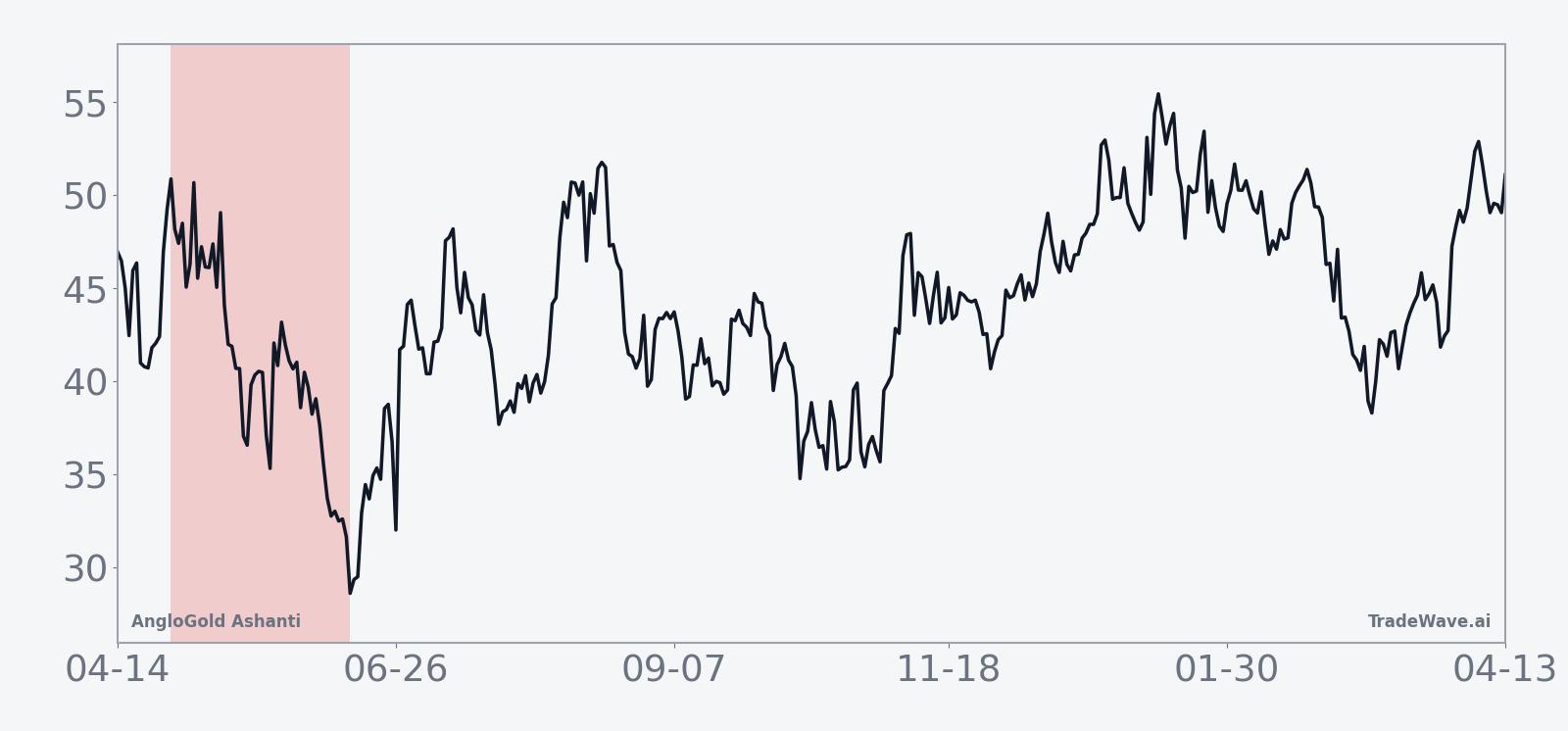
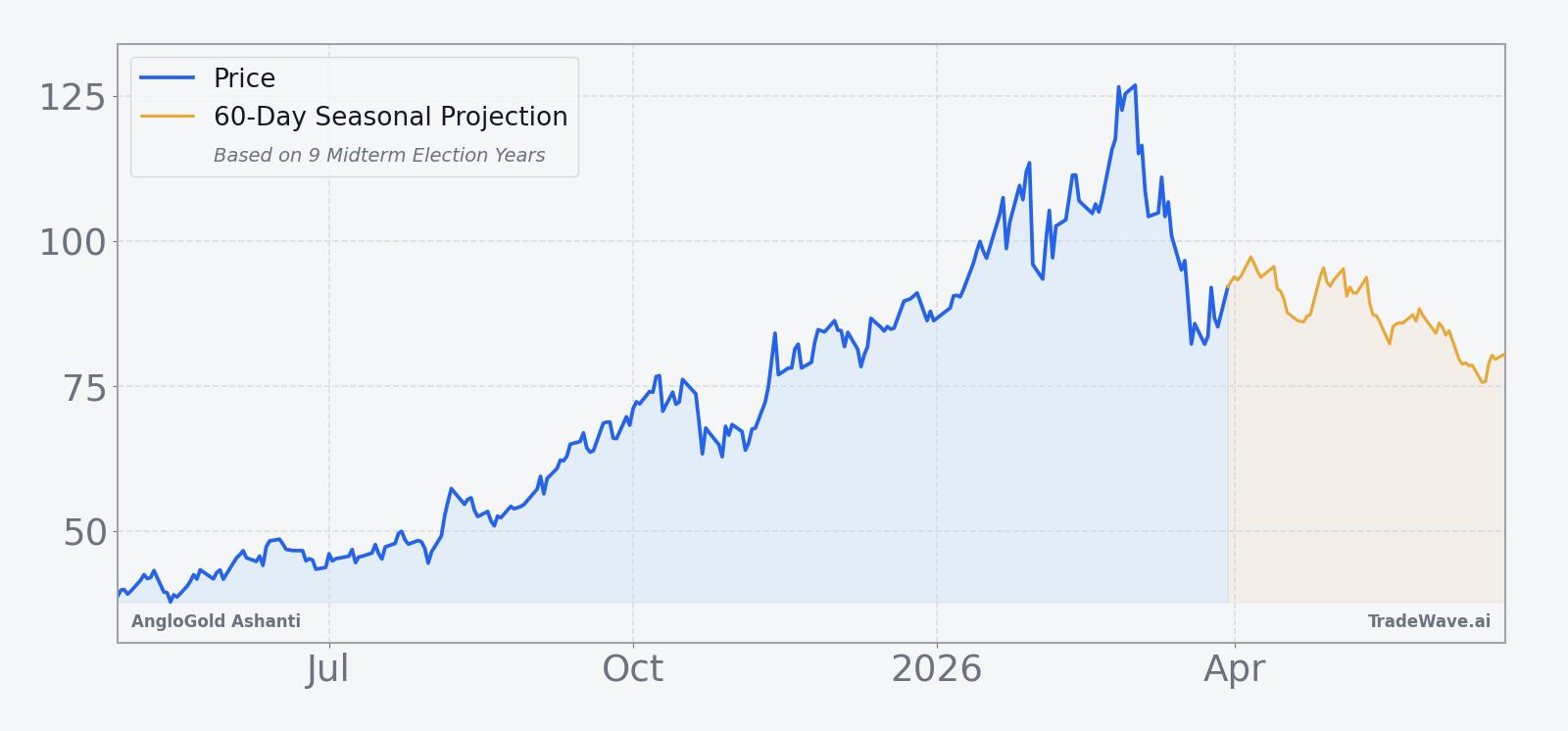
The historical seasonal average curve for this AU trading window tends to show pressure building as the window progresses rather than an immediate collapse. Early days often feature choppy price action with countertrend rallies, while the bulk of the short-side gains have typically accrued in the back half of the 48-day stretch. That timing nuance matters for traders who might otherwise expect an instant reaction when the calendar flips to late April.
The next chart combines net results with best and worst intraperiod swings to show how far AU has tended to travel in both directions during this window.
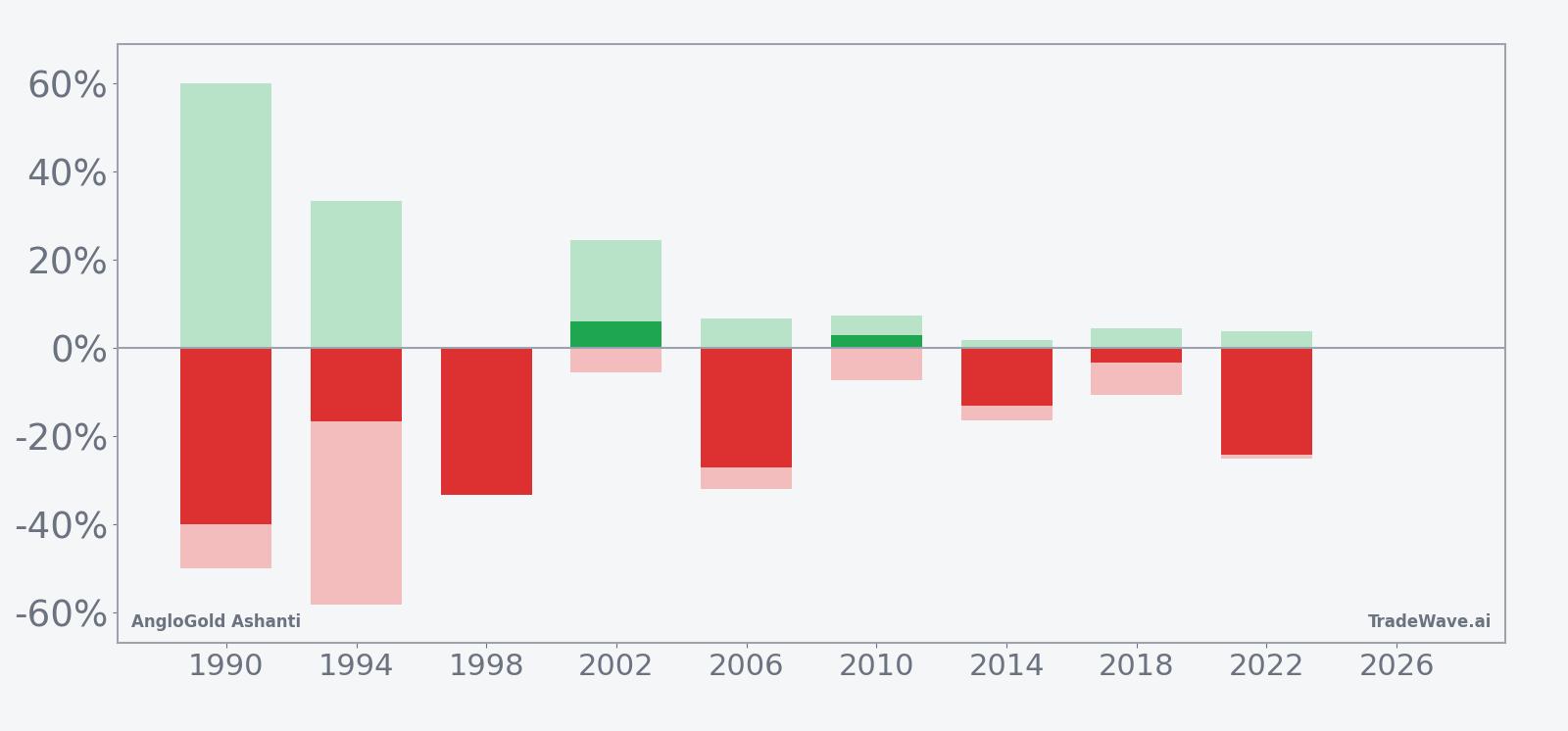
The stacked net/MFE/MAE bars make the pattern’s character clear: most years have delivered meaningful downside for AU, but almost every one has included a sizable countertrend move along the way. For short setups, the best years combined strong net declines with relatively contained adverse swings, while the weaker years saw shorts squeezed hard before the stock ultimately drifted or finished higher. Add it up: 7 for 9 with a 266% cumulative return in the trade direction is a strong record, but it has not been an easy ride.
History does not guarantee future results; adverse excursions (MAE) can be large even in winning windows.
Why does AngloGold Ashanti (AU) follow this seasonal pattern?
This AU seasonal pattern may reflect a mix of election-cycle policy risk, gold-price seasonality and institutional portfolio repositioning. Midterm years often bring fiscal and regulatory debates that can swing real-yield expectations and gold prices, which feed directly into gold miners’ earnings outlooks. At the same time, many asset managers rebalance commodity and basic-materials exposure around midyear, which can amplify selling pressure in names like AngloGold Ashanti when sentiment turns.
What is driving AngloGold Ashanti (AU) today?
AngloGold Ashanti closed Monday at 90.56, up 1.39 points or 1.6%, with roughly 3.49 million shares changing hands against a 20-day average volume of about 3.71 million.[1] The stock sits well above its 52-week low of 30.18 and about 42.1% below its 52-week high of 129.14, leaving it elevated in absolute terms but still off last year’s peak.[1] The 50-day moving average near 104.46 highlights how sharp the recent pullback has been after a powerful run that tracked record gold prices and renewed interest in miners.[1]
In November 2025, AngloGold Ashanti reported quarterly earnings with EPS of 1.32 versus a 1.34 consensus and revenue of 2.37 billion against expectations of 2.53 billion, a modest miss that did little to dent the broader bullish narrative around gold miners at the time.[1] Around the same period, analysts tracked by MarketBeat maintained a “Moderate Buy” stance on AU, with a consensus price target of 69.5 that now sits well below the current share price and reflects an earlier price regime.[1] The basic materials and mining sector backdrop remained constructive into late 2025, helped by strong margins and solid returns on equity for producers like AngloGold Ashanti.[1]
Options and flow data from late 2025 also showed how aggressively traders had leaned into the AU rally. In November 2025, call buyers snapped up 68,797 contracts in a single session, a 1,505% surge in volume that signaled speculative upside positioning.[5] Separate filings highlighted new institutional stakes and additions from firms such as Dynamic Technology Lab, Artisan Partners and Franklin Resources, underscoring how AU had become a favored way to play the gold-price breakout.[3][4][7] Those flows are now part of the backdrop as the stock heads toward a historically tricky seasonal stretch for longs.
The chart below situates the latest move in its recent multi-month context and overlays a 60-day seasonal projection.
What should traders watch as this AU seasonal window approaches?
The next AU seasonal window tied to midterm-election years opens on Apr 28, so the key question is how the stock behaves as that date approaches. Traders will be watching whether AU continues to rebound toward the 50-day moving average near 104.46 or stalls below that level, which would hint at fading momentum into a historically bearish stretch.[1] Price action inside the window will matter too: a pattern of early choppiness followed by heavier selling later in the 48-day span would rhyme with the historical AU seasonal trend.
Macro and policy catalysts will sit in the background. Any shift in real yields, central-bank rhetoric on inflation or fiscal debates that affect growth expectations can move gold prices and, by extension, AngloGold Ashanti’s earnings power. Because this window is built from midterm-election years but will next occur as markets transition from the year after the presidential election toward the pre-election year, traders will be alert to whether the usual mid-cycle volatility shows up on a lag this time.
The November 2025 options spike is another reference point: if call activity and speculative positioning ramp again into late April, that would echo the prior build-up of bullish exposure and could leave AU vulnerable to sharp swings if the seasonal pattern reasserts itself.[5] Conversely, a quieter options tape and more balanced flows would suggest that some of the prior froth has already been worked off, potentially muting the impact of the historical AU seasonal pattern even if directionally it still leans bearish.
For now, the setup is simple. AngloGold Ashanti is trading near the upper end of its recent range, gold remains a focal point for macro investors, and a 48-day window that has favored shorts in 7 of 9 midterm-election years is less than a month away. How AU trades into and through that window will tell investors whether this election-cycle seasonal pattern still has bite.
Sources
- [1] MarketBeat: AngloGold Ashanti PLC (NYSE:AU) Given Average Rating of "Moderate Buy" by Analysts (Nov 30, 2025)
- [2] MarketBeat: AngloGold Ashanti (NYSE:AU) Shares Gap Down - Here's What Happened (Nov 29, 2025)
- [3] MarketBeat: 28,351 Shares in AngloGold Ashanti PLC AU Bought by Dynamic Technology Lab Private Ltd (Nov 21, 2025)
- [4] MarketBeat: Artisan Partners Limited Partnership Has $38.97 Million Stake in AngloGold Ashanti PLC AU (Nov 21, 2025)
- [5] MarketBeat: Stock Traders Buy High Volume of AngloGold Ashanti Call Options (NYSE:AU) (Nov 27, 2025)
- [6] MarketBeat: Burney Co. Makes New $2.50 Million Investment in AngloGold Ashanti PLC AU (Dec 28, 2025)
- [7] MarketBeat: Franklin Resources Inc. Purchases 207,923 Shares of AngloGold Ashanti PLC AU (Nov 26, 2025)
About this seasonal analysis
Seasonal pattern data is sourced from TradeWave.ai, which analyzes historical price behavior across annual calendar windows going back up to 30 years. Read the full data methodology or the book The 100-Year Pattern by Afshin Moshrefi (2026 edition). Past performance of seasonal patterns does not guarantee future results. This article is for informational purposes only and does not constitute investment advice.