Parker Hannifin (PH) Has Dropped in 10 of 10 Midterm Summers, Shorts Averaged 8.99%
Parker Hannifin is heading toward a 57-day midterm-year seasonal window that has produced consistent downside in the past, just as the stock trades not far from its 52-week high.

What is the seasonal pattern for Parker Hannifin (PH)?
Parker Hannifin has fallen in 10 of 10 midterm-year summer windows during this 57-day pattern, with an average gain of 8.99% in winning years for the short side.
- 10 for 10 in this window, with the short side averaging 8.99% gains across the last 10 midterm election years.
- Seasonal window begins May 17, 2026 and runs for 57 trading days, covering much of the early summer period.
- Percent Profitable is 100%, with 10 winners and 0 losers for the short trade direction in this Parker Hannifin trading window.
- Average winner has delivered a mid‑single to high‑teens decline in the stock, while the all‑years average lines up at roughly the same 9% move.
- Historical intraperiod swings have included double‑digit drawdowns against the trade in some years, underscoring that the PH seasonal trend can be volatile even when it finishes in the trade’s favor.
- The pattern is specific to the last 10 midterm election years, tying Parker Hannifin’s historical seasonality to the policy and industrial spending backdrop of that phase in the presidential cycle.
According to historical data from TradeWave.ai, this upcoming midterm-year stretch for Parker Hannifin has behaved very differently from an average summer on the calendar, and the next iteration is less than two weeks away.
How has Parker Hannifin (PH) traded in this midterm-year summer window?
Parker Hannifin has declined in every one of the last 10 midterm election years during this 57-day window, with the short side averaging an 8.99% gain. The next iteration starts on May 17 and arrives with the stock last changing hands at about $862, roughly 16.7% below its 52-week high of $1,034.96 but still elevated after a powerful multi-year run.
Grouping the data by presidential election cycle matters here because industrial spending, defense budgets and infrastructure programs often follow a policy rhythm. Midterm election years tend to be the point where Washington’s early-term agenda collides with voter fatigue and budget debates, and that has historically translated into choppier trading for economically sensitive names like Parker Hannifin.
This seasonal window begins on May 17 and spans 57 trading days, covering late spring into midsummer. The pattern phase is defined as the last 10 midterm election years, so each data point reflects how Parker Hannifin behaved in that same slice of the calendar when the broader political backdrop looked similar to 2026. The trade direction is short, which means negative returns for the stock have historically been favorable outcomes for this pattern.
Across those 10 midterm-year samples, the Percent Profitable metric is 100%, with 10 winners and 0 losers for the short side. In plain English, the stock finished the window lower in every case, from a modest 0.64% drop in 2014 to a 20.47% slide in 1998. Average profit for the short trades clocks in at 8.99%, which is effectively identical to the all-years average because there were no losing years in the sample.
The per-year table shows how wide the range of outcomes has been. In 1986, Parker Hannifin fell 14.54% during the window, while in 2010 it dropped 14.5% and in 2018 it lost 11.06%. At the milder end, 1990 and 2014 saw declines of 1.26% and 0.64% respectively. Add it up and the cumulative return for the short side across the 10 midterm-year windows is 132%, with an annualized return of 8.82% and a Sharpe ratio of 1.3, indicating a historically attractive risk-adjusted profile for this specific seasonal setup.
Intraperiod swings have been meaningful. Maximum favorable excursion, or MFE, captures the best point-to-peak move in the trade direction during the window, while maximum adverse excursion, or MAE, tracks the worst drawdown from the entry. In 1998, for example, the short trade ultimately finished with a 20.47% gain as the stock fell, but the worst intraperiod move against the position was a 23.32% rally from the entry before the decline took hold. Several other years, including 2010 and 2022, also show MAE readings in the mid-teens, underscoring that even winning short windows have featured sharp squeezes along the way.
The TradeWave Ratio (TWR) for this pattern is 1.85, which describes how far price typically travels in the trade direction within the window, independent of the final close. Combined with the relatively modest 6.46% standard deviation of end-of-window returns, that suggests a setup where intraperiod swings can be large but the final outcomes have clustered on the downside for the stock. Trend statistics reinforce that picture, with 67 short-trend days versus just 4 long-trend days on average across the window, and a similar skew in the one-day trend counts.
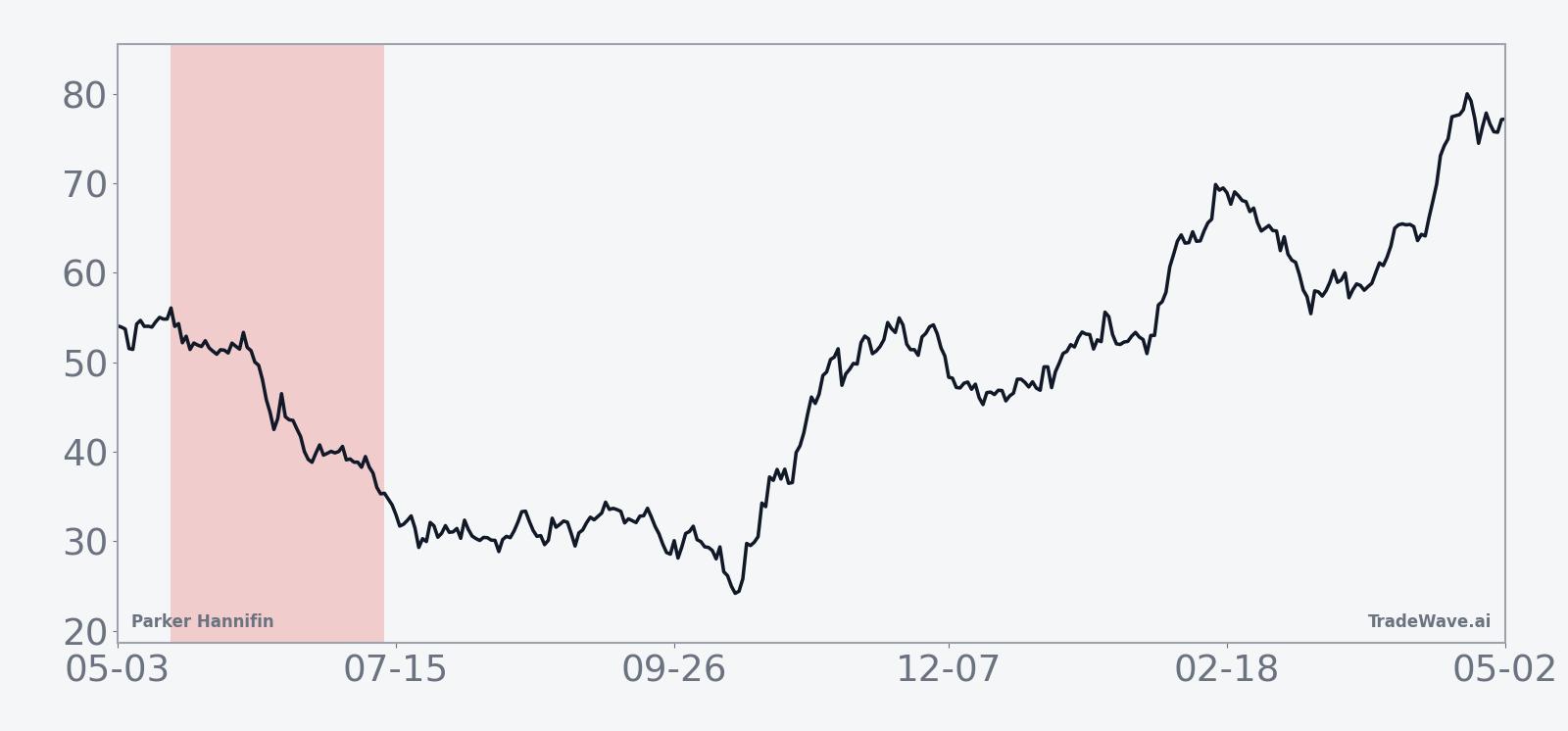
The historical seasonal trend chart for this Parker Hannifin trading window shows a fairly steady downward drift rather than a single air pocket. On average, the stock has tended to weaken early in the window, see a mid-period attempt to stabilize or bounce, and then resume its slide into the final weeks. That shape matters for traders thinking about timing, because it suggests that rallies inside the window have historically been opportunities for the short pattern rather than the start of durable reversals.
The cumulative return chart tells the same story in another way. Instead of a jagged, back-and-forth line, the cumulative curve slopes consistently in favor of the short side across the 57 days, with only brief pauses. There are no years in the sample where a big late-window squeeze flipped a profitable short into a loss, which is unusual for a single-stock pattern over this many cycles.
A second view combines yearly net results with the best and worst intraperiod swings to show how far Parker Hannifin has tended to move in both directions.
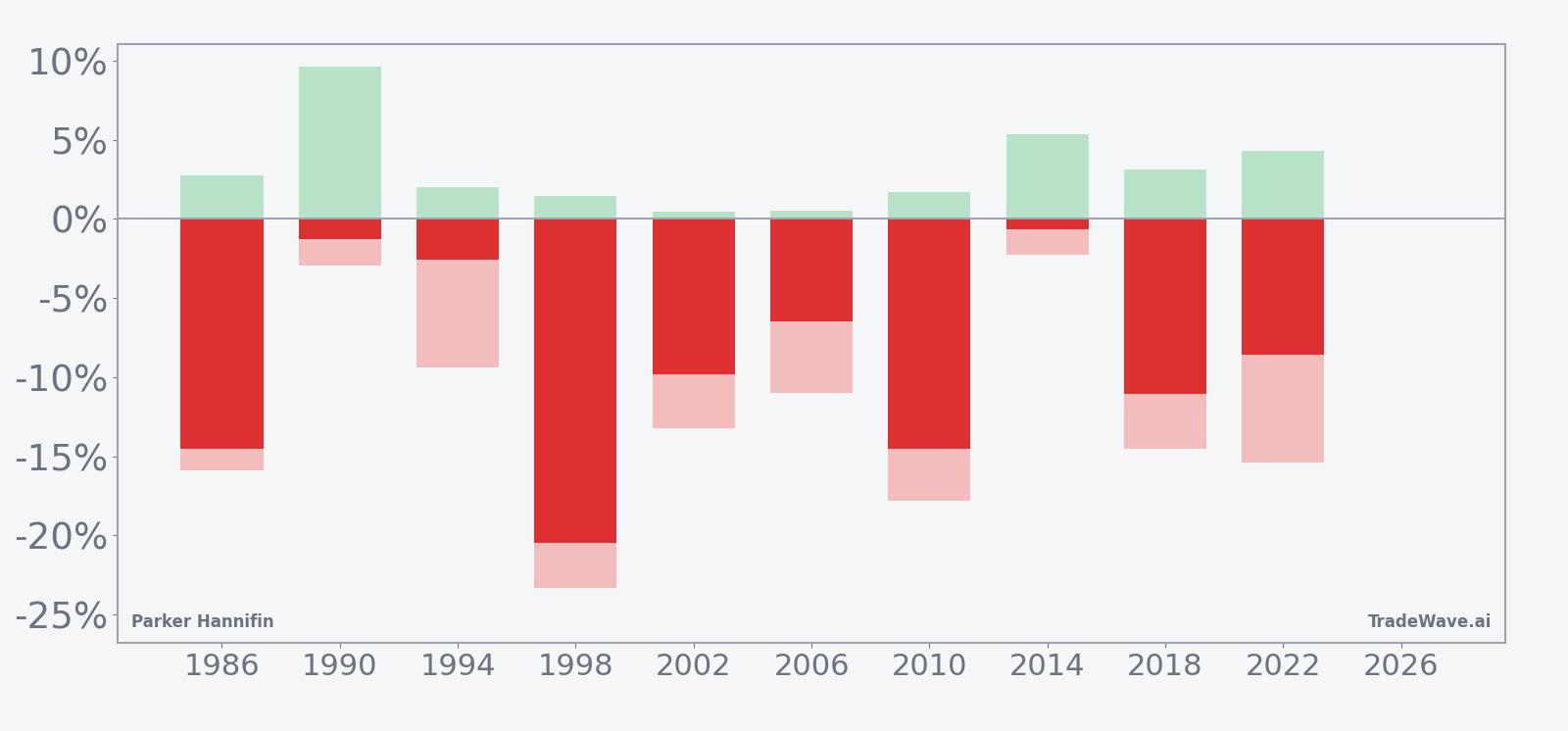
History does not guarantee future results, and adverse excursions within the window can be large even when the pattern ultimately finishes in the trade’s favor.
Why does Parker Hannifin (PH) follow this seasonal pattern?
One likely driver is the way industrial and defense spending expectations reset around midyear in midterm election cycles, as Congress debates budgets and investors reassess growth. Analysts have also pointed to institutional portfolio repositioning in cyclicals during this phase, with some managers trimming winners ahead of potential policy or demand slowdowns. For a stock like Parker Hannifin that sits at the intersection of factory automation, aerospace and energy infrastructure, those shifts can translate into a recurring early-summer air pocket in midterm years.
What is driving Parker Hannifin (PH) today?
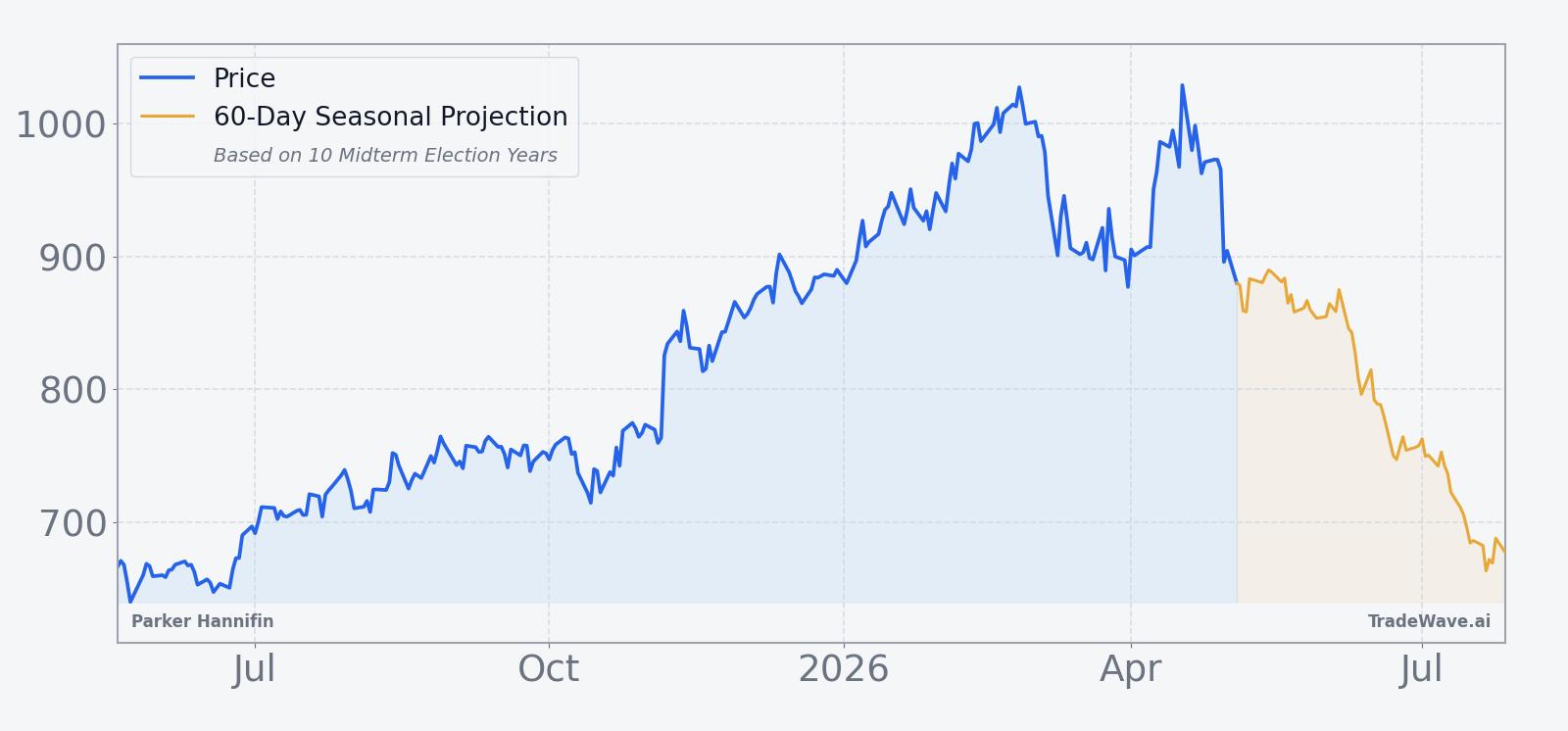
Parker Hannifin slipped 2.26% in the latest session to close at $862.25, leaving the stock about 16.7% below its 52-week high of $1,034.96 and still well above its 52-week low near $597.18. Volume of roughly 699,000 shares ran slightly ahead of the recent 20-day average of about 623,000, a sign that some investors are locking in gains after a strong multi-quarter advance even before the midterm-year seasonal window opens.
The chart below situates the latest pullback against Parker Hannifin’s past year of trading and overlays a 60-day seasonal projection.
What should traders watch as this Parker Hannifin (PH) window approaches?
First, the calendar: the historical window starts on May 17 and runs for 57 trading days, so price behavior in the back half of May will set the tone. If Parker Hannifin continues to fade from the $860–$880 area into the start of the window, it would align with the typical pattern of weakness emerging early in midterm-year summers. A sharp squeeze back toward the $950 region, by contrast, would echo prior years where sizeable rallies occurred inside the window before the seasonal downside reasserted itself.
Second, watch how the stock trades around key macro and policy dates in this period, including any updates on infrastructure spending, defense appropriations or industrial production that could shift sentiment toward cyclical manufacturers. Historically, the worst intraperiod drawdowns against the short side have clustered around bursts of optimism on growth or policy, even in years that ultimately finished lower for the stock.
Finally, monitor volume and volatility as the window progresses. A pickup in trading activity combined with repeated failures to hold rallies would be consistent with the historical pattern of a choppy but ultimately downward seasonal path. On the other hand, a quiet grind higher on light volume would be a clear break from the last 10 midterm election years and a sign that this cycle may be rewriting Parker Hannifin’s usual early-summer script.
Sources
About this seasonal analysis
Seasonal pattern data is sourced from TradeWave.ai, which analyzes historical price behavior across annual calendar windows going back up to 30 years. Read the full data methodology or the book The 100-Year Pattern by Afshin Moshrefi (2026 edition). Past performance of seasonal patterns does not guarantee future results. This article is for informational purposes only and does not constitute investment advice.