15-for-15 Winning Streak: Amazon (AMZN) Enters a 61-Day Summer Window That’s Never Been Negative
Amazon is trading near a fresh 52-week high as it approaches a 61-day summer window that has never been negative in the past 15 years, putting a spotlight on how AI-fueled momentum meets historical seasonality.

What is the seasonal pattern for Amazon (AMZN)?
Amazon has risen in 15 of 15 years during this late-May-to-summer window, with an average gain of 11.75% in winning years.
- 15 for 15 in this window, averaging 11.75% gains in winning years across the past 15 seasons.
- The 61-day window beginning May 23 has been a consistently bullish AMZN seasonal trend with 100% profitable years, 15 winners and 0 losers.
- Average profit of 11.75% in this Amazon trading window compares with a 418% cumulative return across the full 15-year sample.
- The TradeWave Ratio (TWR) of 1.96 signals that price has typically traveled meaningfully in the long direction within the window.
- A Sharpe ratio of 1.78 for this pattern points to strong risk-adjusted returns relative to the volatility of outcomes.
- Intraperiod swings have included sizable drawdowns in some years, so even a historically strong window has carried real downside risk along the way.
According to historical data from TradeWave.ai, this upcoming stretch has behaved very differently from an average summer for Amazon, and the next iteration begins this weekend.
How has Amazon (AMZN) traded in this late-May seasonal window?
Amazon has risen in 15 of the past 15 years during the 61-day window that starts on May 23, averaging an 11.75% gain for long positions. The stock closed Friday at $268.89, up 1.5% on the day and about 3.5% below its 52-week high of $278.56, leaving it near the top of its recent range as this historically strong stretch approaches.
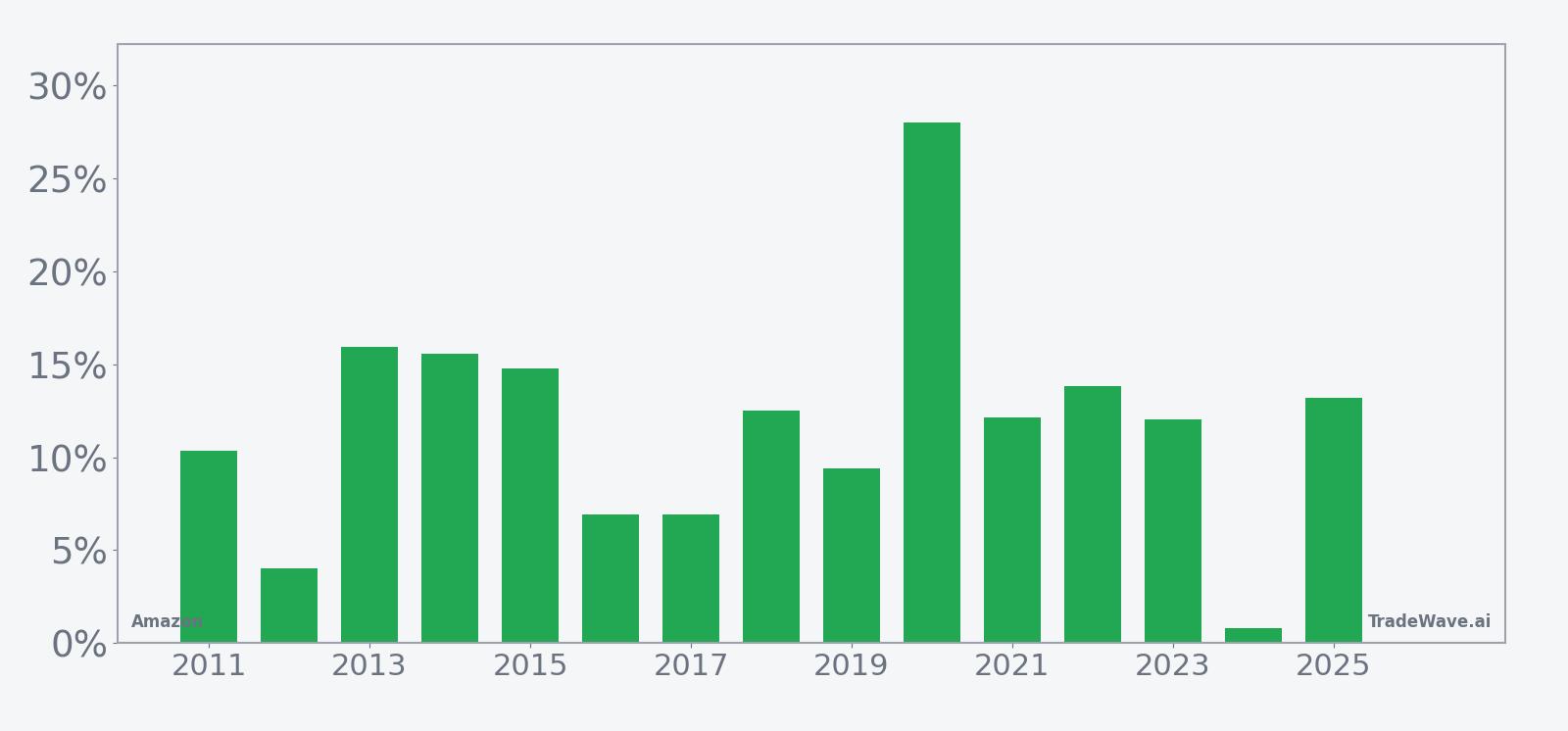
Historically, this has been a clean long-biased setup. Percent Profitable sits at 100%, with 15 winners and 0 losers, and the trade direction is explicitly long. Average profit of 11.75% lines up with a 418% cumulative return across the sample, while the median outcome of 12.11% shows that gains have not been skewed by just one or two outlier years.
The per-year table shows how that plays out in individual seasons. In 2020, for example, Amazon entered the window around $121.09 and finished near $154.99, a 28.0% net return with a maximum favorable move of 38.09% and a maximum adverse move of just 3.79% from the entry. In contrast, 2024 barely finished positive at 0.83%, but even that year saw an 11.13% peak run-up before a 3.97% drawdown pulled the close back toward flat.
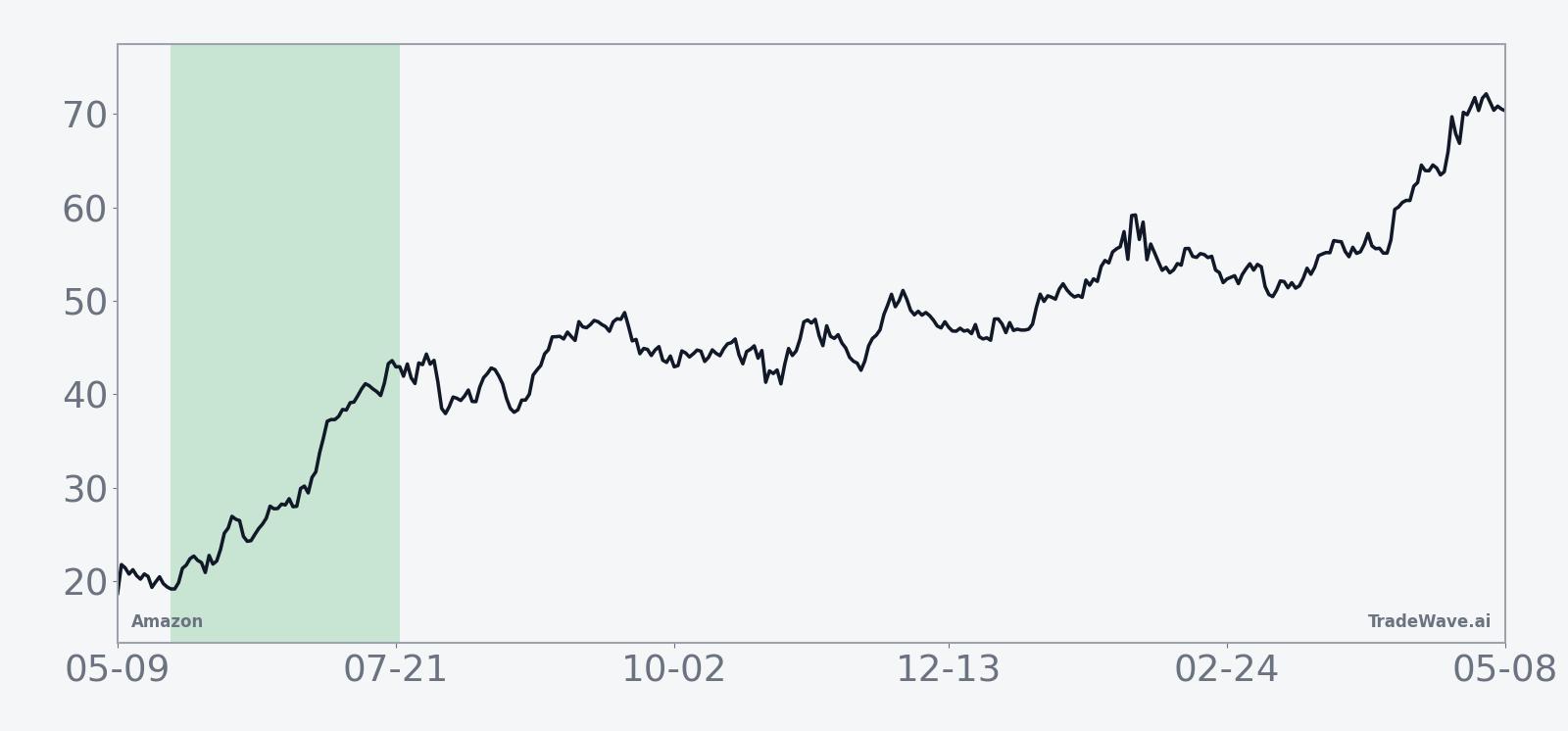
The historical seasonal average trend slopes higher through most of the window, with gains tending to build steadily rather than arriving in a single spike. The pattern often shows an early push in the first few weeks, a mid-window consolidation, and then a second leg higher into the back half of the period. That rhythm suggests a tendency for rallies to pause but not fully unwind before the window ends.
A combined view of net returns and intraperiod swings shows how upside and drawdowns have coexisted in this pattern.
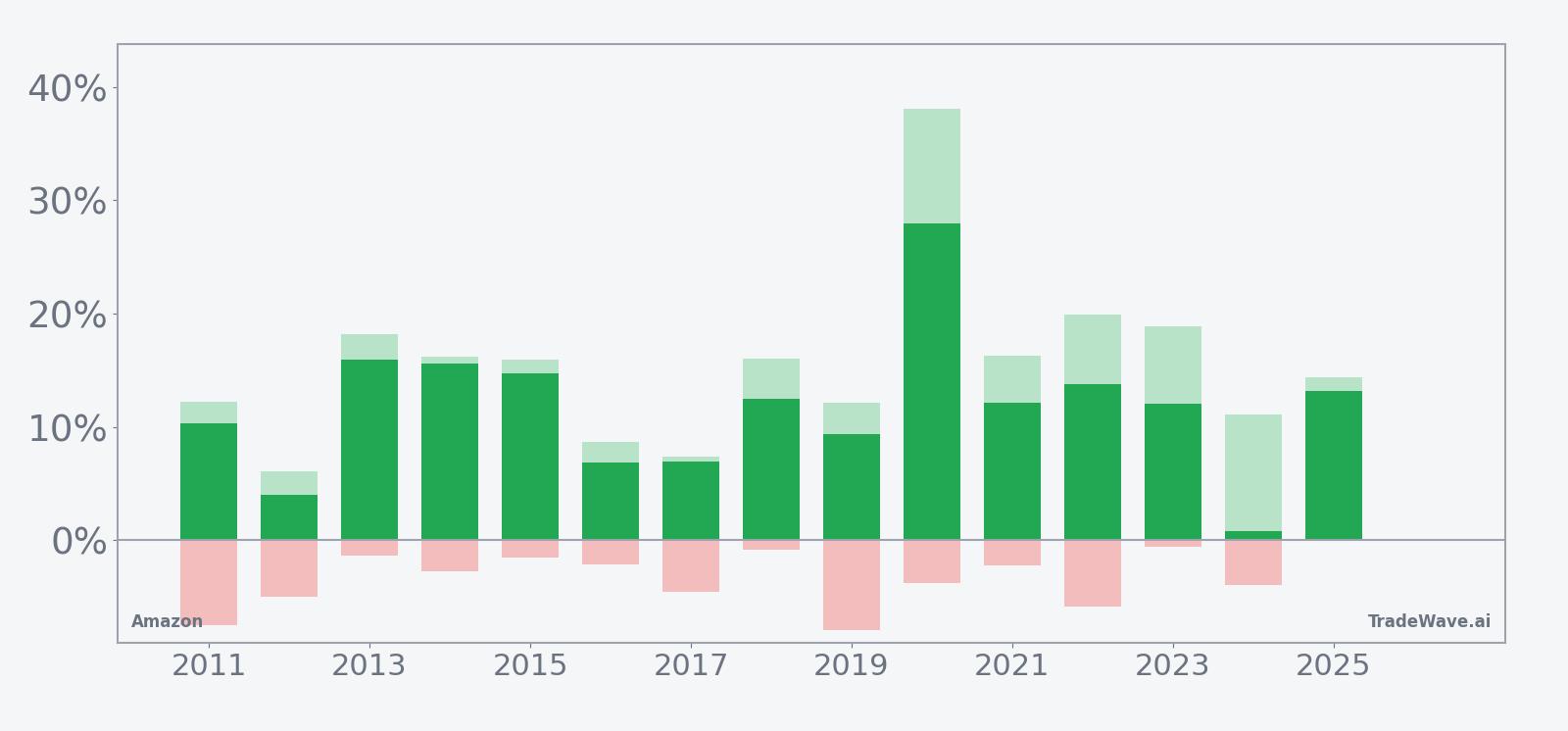
The stacked net, peak run-up and worst drawdown bars underline that even a perfect win record has come with real volatility. In several years, maximum favorable moves in the mid-teens or higher sat alongside adverse excursions of 4% to 8%, meaning traders had to sit through meaningful pullbacks to capture the full seasonal upside. The Sharpe ratio of 1.78 and TradeWave Ratio of 1.96 capture that balance of strong average gains with non-trivial swings along the way.
History does not guarantee future results; adverse excursions can be large even in winning windows, and past seasonal strength does not ensure similar outcomes in 2026.
Why does Amazon (AMZN) follow this seasonal pattern?
One likely driver is the way Amazon’s earnings calendar and guidance cadence cluster around late April and late July, which can leave the late-May to mid-summer stretch free of major company-specific shocks while investors digest fresh numbers. Analysts have also pointed to institutional portfolio repositioning into large-cap growth and e-commerce ahead of mid-year benchmarks, which can favor mega-cap names like Amazon. The pattern may also reflect broader consumer and enterprise spending cycles, as early-summer demand signals for cloud and online retail start to firm up before the back-to-school and holiday periods.
What is driving Amazon (AMZN) today?
Amazon shares finished Friday at $268.89, up 1.5% on the session, extending a roughly 5.25% gain over the past month and leaving the stock about 3.5% below its 52-week high of $278.56. The move caps a strong run since the company’s late-April earnings beat, which reinforced the narrative that Amazon is one of the clearest large-cap winners from the current wave of artificial intelligence spending.[1]
The latest quarter showed just how much that AI push is feeding through to the numbers. For the first quarter of 2026, Amazon reported earnings per share of $2.78 versus Wall Street expectations of $1.62, on revenue of $181.5 billion compared with estimates of $177.2 billion.[1] Amazon Web Services delivered $37.6 billion of that revenue, topping forecasts and growing 28%, as customers ramped up AI-related workloads and data-intensive applications.[1]
Management paired those results with upbeat guidance, telling investors to expect second-quarter revenue between $194 billion and $199 billion and operating income of $20 billion to $24 billion.[1][2] That range implies another step up in profitability even as the company leans into heavy capital spending on AI infrastructure, from custom chips to data centers. In late April, commentary around the print highlighted that AI investments were denting near-term free cash flow but were seen as critical to defending and expanding AWS’s lead in cloud and machine learning services.[2]
Sector-wise, Amazon sits at the center of two of the market’s dominant themes: large-cap tech and AI infrastructure. Recent coverage has emphasized that the company’s AI build-out is driving both AWS growth and a higher capex run-rate, a combination that can amplify volatility when sentiment swings between “growth at any cost” and “show me the cash.”[2] Against that backdrop, the fact that AMZN is entering a historically strong seasonal window while trading near its highs gives traders a clean focal point for how AI optimism and calendar effects might intersect.
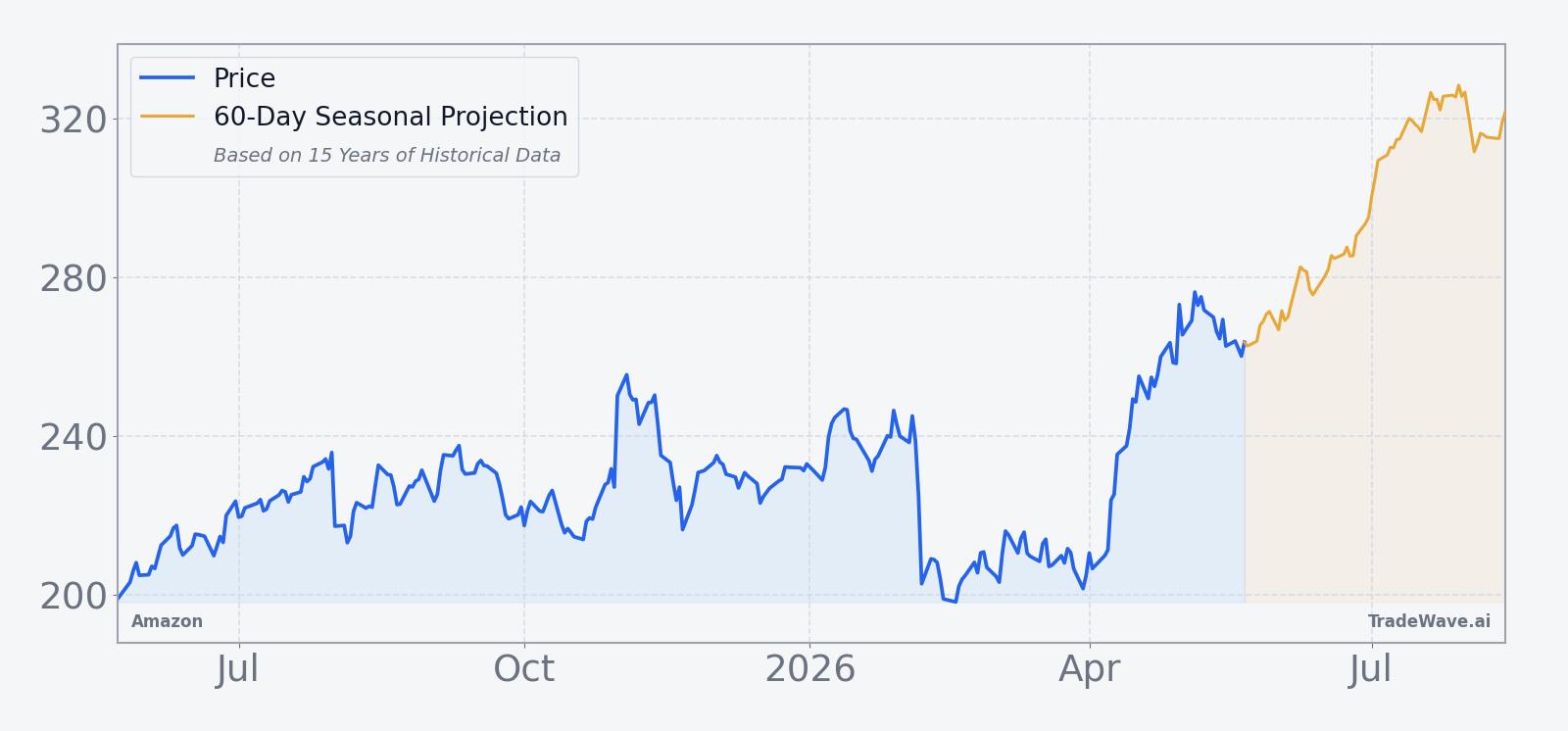
The chart below situates the latest move in its recent multi-month context and overlays the upcoming seasonal projection.
How do earnings and guidance frame this Amazon seasonal window?
The current late-May setup comes just weeks after Amazon’s Q1 2026 earnings beat, which reset expectations higher for both AWS and the broader retail business.[1] With no confirmed date yet for the next earnings release, the bulk of this 61-day seasonal window is likely to play out between major quarterly updates, leaving the stock more sensitive to incremental data points on AI demand, consumer spending and macro conditions than to fresh guidance.
Street commentary around the April report focused on two key threads. First, AWS’s 28% revenue growth and outperformance versus estimates reinforced the idea that cloud and AI workloads are re-accelerating after a period of optimization and cost-cutting by enterprise customers.[1][2] Second, analysts flagged that Amazon’s AI-related capital expenditures were weighing on free cash flow in the near term, but were broadly viewed as necessary to stay competitive with other hyperscalers in training and inference workloads.[2]
That mix of strong top-line growth and heavy reinvestment is typical of periods when Amazon has historically traded with a higher beta to tech sentiment. When combined with a seasonal window that has tended to favor long exposure, it sets up a backdrop where positive AI headlines or incremental demand signals can have an outsized impact on price action.
What macro and sector forces matter for Amazon in this period?
Macro coverage in late April emphasized that Amazon’s AI build-out is part of a broader wave of technology investment that is reshaping capex patterns across the sector.[2] For Amazon, that means its stock is tethered not just to consumer spending and e-commerce trends, but also to the health of corporate IT budgets and the pace of AI adoption in industries from finance to healthcare.
In practice, that leaves AMZN trading as both a cyclical and a structural growth story. When macro data supports the idea of resilient enterprise spending and stable consumers, the stock can benefit from a double tailwind. When growth fears flare, the same AI capex that investors cheer in good times can be reframed as a drag on free cash flow, increasing the risk of sharp pullbacks even inside a historically strong seasonal stretch.
How are investors thinking about Amazon’s valuation into this window?
While specific valuation multiples and consensus price targets were not detailed in the latest coverage, the tone from analysts has remained broadly constructive, with a Buy consensus rating cited in recent summaries.[2][6] That stance reflects confidence that Amazon’s combination of AWS growth, improving retail margins and AI optionality can justify a premium to the broader market, even after a strong run into the upper end of its 52-week range.
For traders focused on stock pattern analysis and historical seasonality, the key question is less about whether AMZN is “cheap” or “expensive” in absolute terms and more about how sentiment reacts to incremental news. A stock priced for strong execution can still rally in a bullish seasonal window if the company keeps beating expectations, but it can also be more vulnerable to disappointments or macro scares.
What should traders watch in this Amazon seasonal window?
First, the calendar itself matters. The 61-day window starting May 23 has delivered gains in every one of the past 15 years, with average profits in the low double digits and a clear long bias. How Amazon behaves in the first two to three weeks will be an early tell on whether 2026 is tracking the historical pattern or diverging from it.
Second, price levels are important. With AMZN sitting just a few percent below its 52-week high, traders will be watching whether the stock can sustain a breakout above that $278.56 area or whether it stalls and consolidates below resistance. A decisive move through the highs on strong volume would be consistent with the historical seasonal trend, while repeated failures there would signal a more cautious tape.
Third, AI and cloud headlines will likely set the tone between earnings reports. Any updates on AWS customer spending, new AI product launches or commentary from peers in the hyperscale and semiconductor space could feed directly into Amazon’s tape during this window.[1][2] Stronger-than-expected signals would align with the bullish seasonal backdrop, while signs of slowing demand or pushback on AI-related pricing could test the pattern’s resilience.
Finally, traders should keep an eye on intraperiod volatility. Past years show that even winning windows have included drawdowns of several percentage points, and in some cases more than 5%, before finishing higher. If Amazon follows that script, pullbacks inside the window would not automatically mean the seasonal tendency has failed, but deeper or earlier-than-usual adverse moves would be a sign that 2026 is breaking from the playbook.
Put together, the setup is straightforward: a mega-cap leader near its highs, a clean 15-for-15 late-May seasonal record, and an AI-driven growth story that keeps delivering big numbers. The next 61 trading days will show whether that combination can extend Amazon’s streak or finally produce the first miss in this window.
Sources
About this seasonal analysis
Seasonal pattern data is sourced from TradeWave.ai, which analyzes historical price behavior across annual calendar windows going back up to 30 years. Read the full data methodology or the book The 100-Year Pattern by Afshin Moshrefi (2026 edition). Past performance of seasonal patterns does not guarantee future results. This article is for informational purposes only and does not constitute investment advice.