Despite AI Tailwinds, HP Inc. (HPQ) Faces a 90% Bearish Midterm Window Starting Jun 21
HP Inc. is heading toward a 13-day midterm-election-year seasonal window that has favored short trades, even as the stock trades well above its 50-day average after an earnings-driven jump.
What is the seasonal pattern for HP Inc. (HPQ)?
HP Inc. has delivered profitable short trades in 9 of the last 10 midterm-election-year windows starting around Jun 21, with average gains of 4.5% in winning years.
- 9 for 10 in this window, with short trades averaging 4.5% gains in winning years across the last 10 midterm election cycles.
- Seasonal window runs for 13 trading days starting Jun 21, targeting HPQ from the short side rather than long.
- Percent Profitable sits at 90%, with 9 winners and 1 loser across the sample of midterm-election-year windows.
- Including all years, the average outcome is a 4% gain for the short setup, showing that the lone losing year did not erase the pattern.
- Intraperiod swings have been meaningful, with several years showing double-digit adverse moves against the short before finishing profitable.
- HPQ currently trades around 24.69, well above its 50-day moving average of 21.47, so this historically bearish window would hit a stock that has recently been strong.
According to historical data from TradeWave.ai, this mid-June pattern for HPQ behaves very differently from an average month on the calendar, and the next iteration is just days away.
How has HP Inc. (HPQ) traded in this mid-June seasonal window?
HP Inc. has produced profitable short trades in 9 of the last 10 midterm-election-year windows that begin around Jun 21 and run for 13 trading days, with an average 4.5% gain in winning years. Today the stock closed at 24.69, down 1% on the day, and sits well above its 50-day moving average of 21.47 after a sharp post-earnings rally.
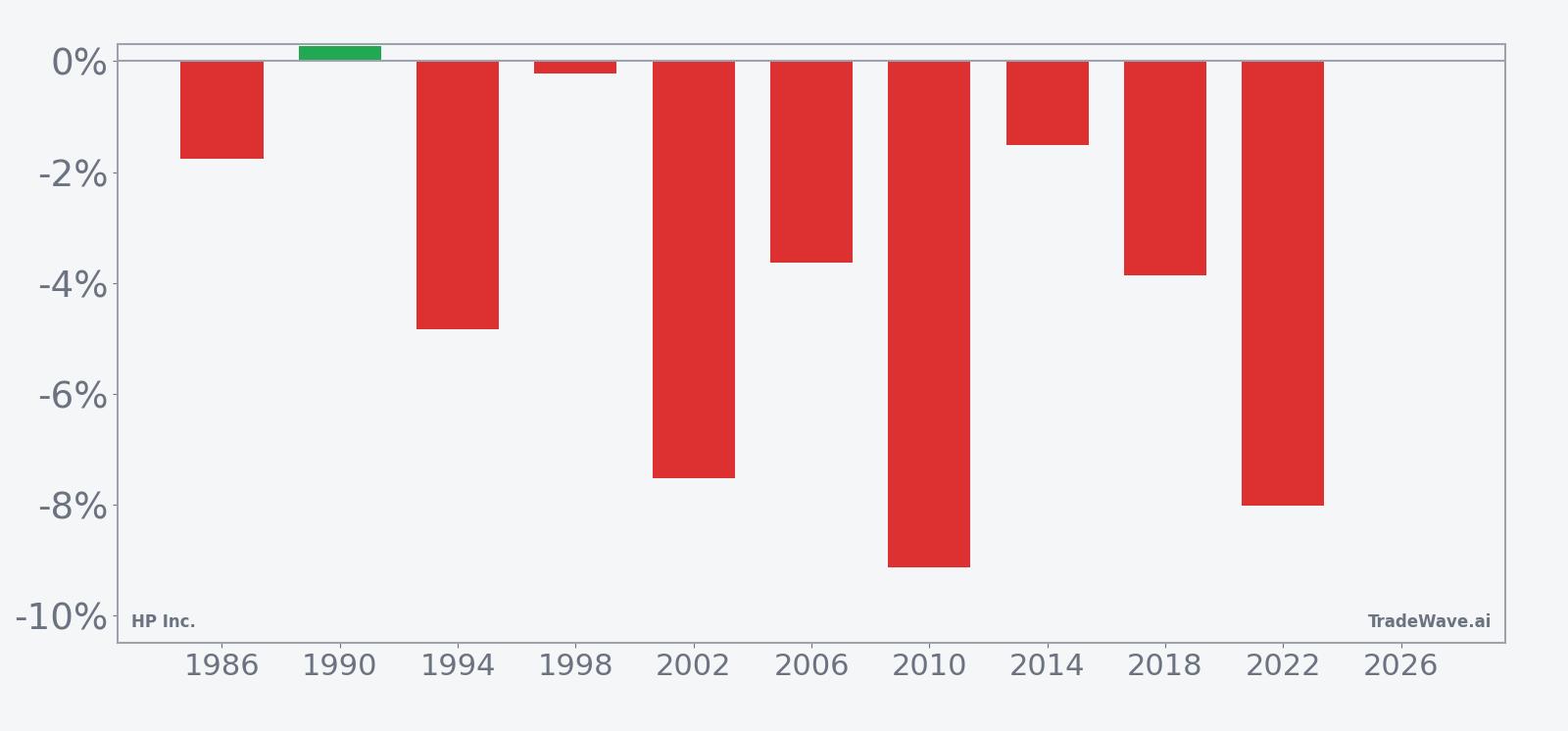
Because this pattern is grouped by the presidential election cycle, it only looks at the last 10 midterm election years, not 10 consecutive calendar years. That matters in 2026, which is itself a midterm election year, so the upcoming window lines up with the same policy and positioning backdrop that shaped prior iterations.
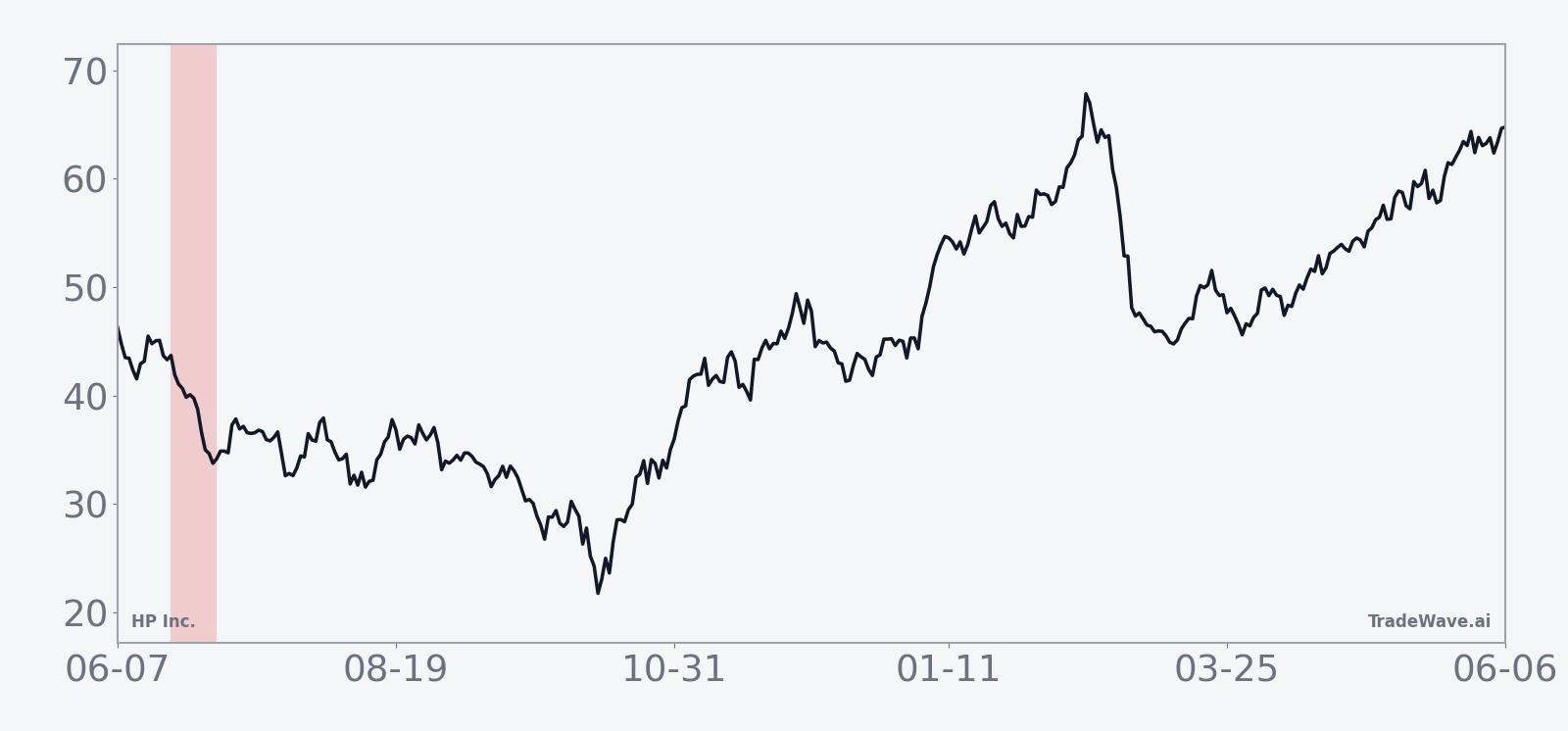
The historical seasonal average shows HPQ tending to drift lower across the 13-day span, with most of the move accruing in the middle of the window rather than at the open or close. That fits a short setup where patience has often mattered more than trying to time the exact first-day entry.
Year-by-year bars that combine net results with peak favorable and worst adverse moves show how much the stock has swung inside this window.
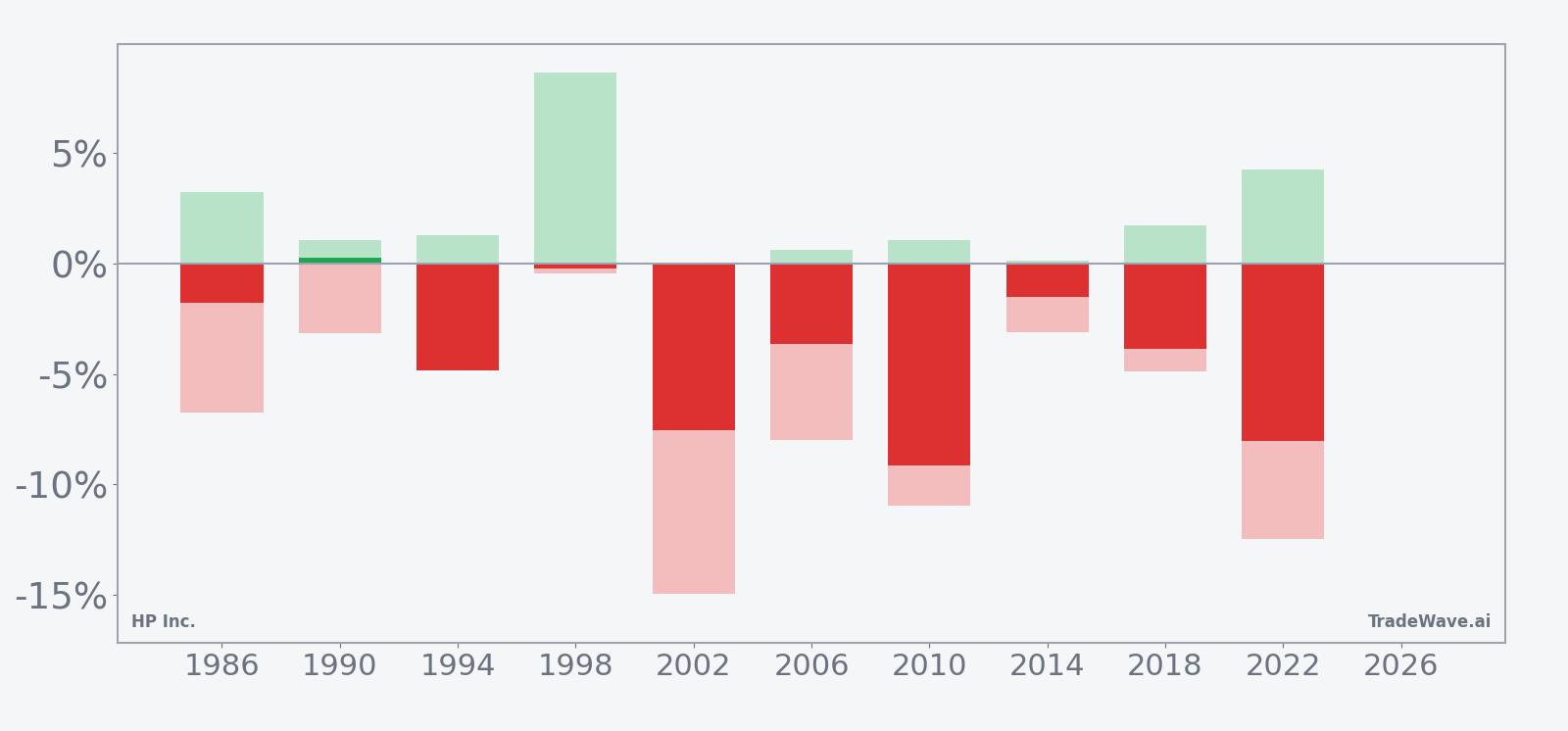
The bars with maximum favorable and adverse excursions show why this pattern is both attractive and risky for shorts. In strong years for the setup, HPQ has logged sizable peak declines within the window, but several cycles also saw double-digit rallies against the short before rolling over, such as 2010 and 2022 where the worst intraperiod drawdowns from entry reached roughly 11% and 12% respectively.
On a per-year basis, the weakest outcome for the short pattern came in 1990, when HPQ finished the window slightly higher, while one of the strongest came in 2002 with a net decline of about 7.5% over the 13 days. That spread underlines how the same calendar slice can deliver very different paths even when the overall bias has leaned in favor of shorts.
Put together, the record is striking: 9 winners, 1 loser, and a 4% average gain across all years for a short setup in a single, repeatable mid-June window. History does not guarantee a repeat, but the consistency across midterm-election-year cycles is hard to ignore.
Why does HP Inc. (HPQ) follow this seasonal pattern?
One likely driver is the way midterm-election-year policy uncertainty and corporate spending plans collide around midyear, which can weigh on enterprise hardware and PC demand expectations. Analysts often point to budget resets and cautious IT ordering in the summer as companies wait for clearer fiscal and regulatory signals, a backdrop that can pressure stocks like HPQ. This pattern may also reflect portfolio managers trimming cyclical tech exposure after early-year rallies, creating a pocket of selling pressure that has historically favored short setups in this specific window.
History does not guarantee future results, and even in winning years for this pattern, the worst adverse moves against the short have sometimes been large.
What is driving HP Inc. (HPQ) today?
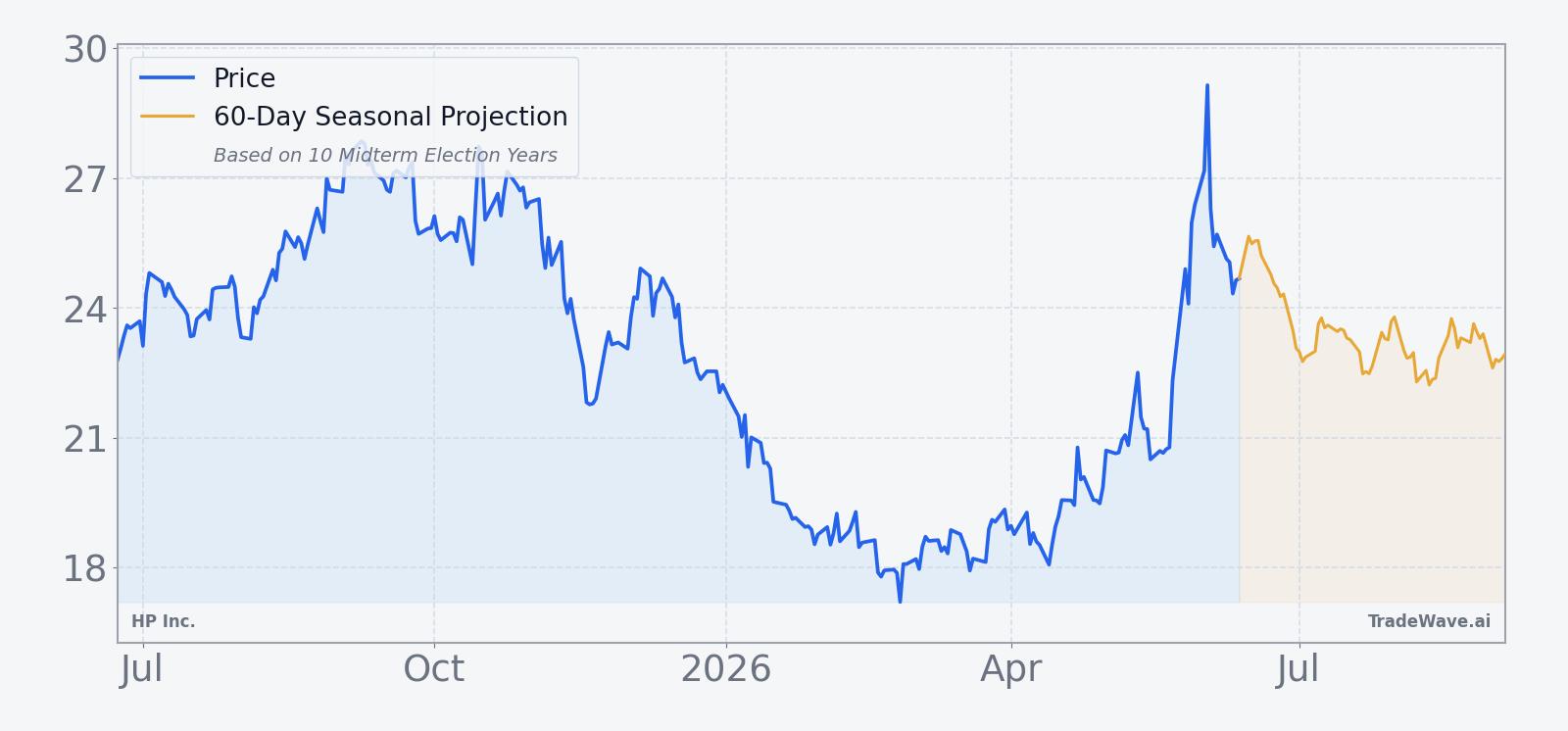
HPQ slipped 1% on Wednesday to 24.69, trading between 24.23 and 25.20 on the day, with volume of about 14.2 million shares against a 20-day average of roughly 24.5 million. The stock remains comfortably above its 50-day moving average of 21.47 and has climbed about 11.9% over the past month, helped by a double-digit jump after HP reported earnings and revenue that beat expectations on May 27.[1]
That earnings pop came as investors leaned into a broader story of AI and data center demand supporting enterprise tech providers, a theme that has helped HP trade more like a cyclical beneficiary of infrastructure spending than a slow-growth PC name.[1] The question for traders heading into late June is whether that upbeat narrative can overpower a midterm-year seasonal window that has historically leaned against the stock from the short side.
The chart below shows HPQ’s post-earnings surge in the context of the past year, along with a 60-day seasonal projection overlay.
What should traders watch as this HPQ seasonal window approaches?
First, the calendar: the 13-day window begins on Jun 21, so any sharp move in HPQ that starts in the days just before or after that date will be trading directly into the historical pattern. If the stock continues to hold above its 50-day moving average into the start of the window, the setup would pit a strong recent uptrend against a historically bearish midterm-year slice, which has often produced choppy, two-way action before resolving lower.
Second, levels: on the upside, the recent post-earnings zone above 25 will be important to watch as potential squeeze territory if buyers stay aggressive. On the downside, traders will be watching whether HPQ can hold the low-20s area that roughly lines up with the 50-day moving average; a decisive break during the window would be more in line with the historical short pattern.
Third, catalysts: while no specific earnings date is on the immediate horizon, any fresh commentary on PC demand, printing margins, or AI-related infrastructure spending could quickly shift sentiment.[1] In prior midterm years, windows like this have sometimes coincided with guidance tweaks or macro headlines that nudged enterprise tech names lower, even without company-specific disappointments.
Finally, behavior inside the window will matter as much as the end result. A repeat of the historical pattern would likely show HPQ struggling to make sustained new highs after Jun 21 and instead grinding or breaking lower over the following two weeks. A clean upside breakout that holds through the entire window would contradict the past 10 midterm-election-year cycles and signal that the current earnings and AI narrative is overpowering the usual seasonal drag.
Sources
About this seasonal analysis
Seasonal pattern data is sourced from TradeWave.ai, which analyzes historical price behavior across annual calendar windows going back up to 30 years. Read the full data methodology or the book The 100-Year Pattern by Afshin Moshrefi (2026 edition). Past performance of seasonal patterns does not guarantee future results. This article is for informational purposes only and does not constitute investment advice.