Copart (CPRT) Near Short-Term Highs as Weak Accident Trends Meet 47-Day Midterm Slide
Copart is approaching a historically weak late‑summer stretch even as the stock trades near short-term highs and investors digest solid earnings and insider selling.
Price as of Aug 7, 2026: $29.66 (last close).

What is the seasonal pattern for Copart (CPRT)?
Copart has fallen in 6 of 7 years during this Aug 18 to Oct 3 midterm-year window, with an average 11.61% gain in winning short trades.
- 6 for 7 in this window for short trades, with Copart closing lower in six of the last seven midterm election years.
- Percent Profitable is 86%, with 6 winning short years and 1 losing year across the sample.
- Avg Profit on winning years is 11.61%, while Avg Profit - All, including the lone loss, is still a strong 10%.
- The 47-day window runs from Aug 18 to Oct 3 and has compounded to an 88% cumulative return for the short side over seven cycles.
- Intraperiod swings have been meaningful, with sizable best-case rallies and deep worst-case drawdowns that make risk management critical.
- The pattern is defined on the short side, so years when Copart rallies sharply in this stretch are losing outcomes for the strategy.
According to historical data from TradeWave.ai, this late‑summer window for Copart behaves very differently from an average month on the calendar, especially in midterm election years.
How has Copart (CPRT) traded in the upcoming Aug 18 to Oct 3 window?
Copart has closed lower in six of the last seven midterm election years during the Aug 18 to Oct 3 window, a short-biased pattern that has delivered an 88% cumulative gain for the strategy across those cycles. Shares finished Monday at 29.66, up 2.2% on the day and sitting between a 52-week low of 26.81 and a high of 50.11, after a 7.78% gain over the past month. That mix of a historically weak late‑summer stretch and a stock pushing higher into the window is the kind of tension short-term traders watch closely.
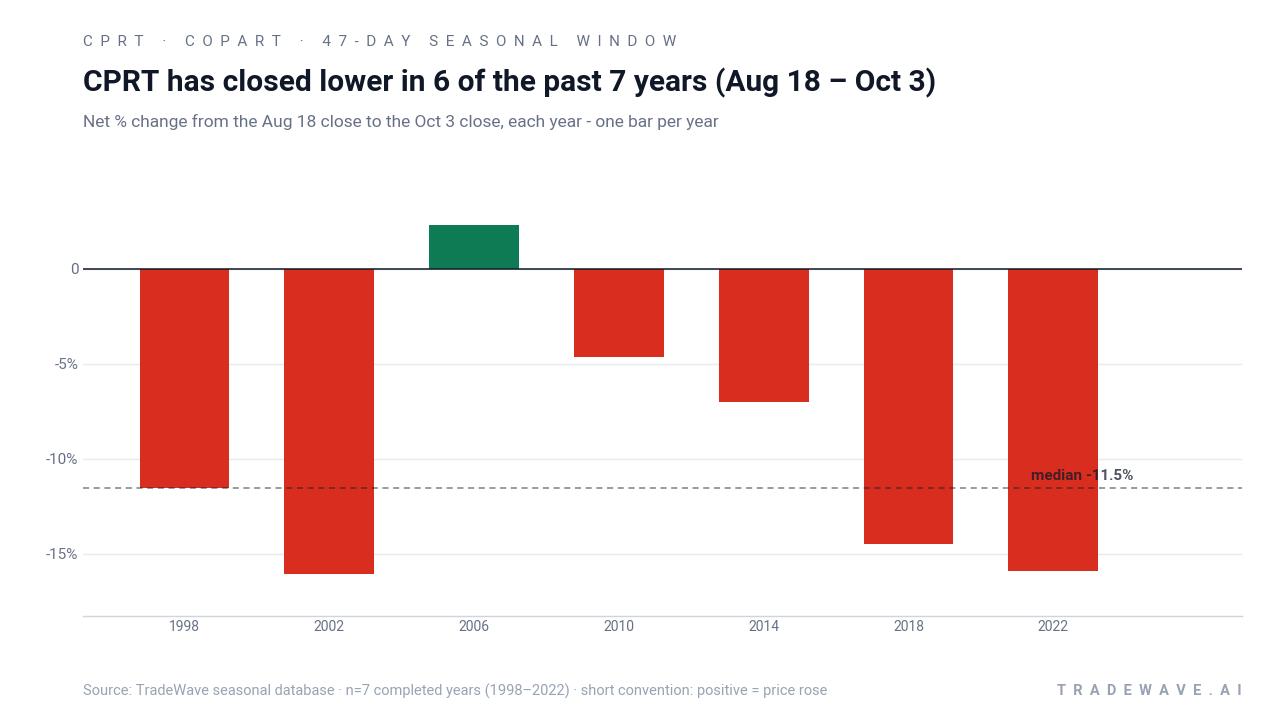
Because this pattern is grouped by the presidential election cycle, it only looks at midterm election years like 1998, 2002 and 2022, when policy uncertainty and shifting regulation often hit economically sensitive industrials differently than in election or pre‑election years. For Copart, which sits at the intersection of insurance, auto demand and salvage pricing, that mid-cycle backdrop has historically lined up with softer late‑summer trading in this specific 47-day stretch.
Across the seven midterm-year samples, the short side has been profitable in 86% of cases, with six winning years and just one losing year. Average profit on those winning shorts is 11.61%, while including the lone loss still leaves an all-years average of 10%, which is unusually strong for a window of less than two months. The median outcome, at 11.54%, is close to the average, suggesting the pattern is not being driven by a single outlier year.
The per-year table shows that the strongest short years were 2002 and 2022, when net returns for the strategy were roughly 16.05% and 15.92% respectively, helped by sizable declines from the Aug 18 entry to the Oct 3 exit. The weakest outcome for the short side came in 2006, when Copart rose about 2.27% over the window, turning that year into a loss for the pattern. In other words, the risk has historically been that the stock grinds higher rather than explodes upward during this slice of the calendar.
Intraperiod behavior has been choppy. Maximum favorable moves within the window have ranged from modest single-digit gains for the short side to double-digit swings, while maximum adverse moves have at times pushed beyond 30% against the trade. That combination of sizable best-case and worst-case excursions means traders who lean on this Copart seasonal trend have historically had to sit through meaningful volatility even in years that finished as winners.
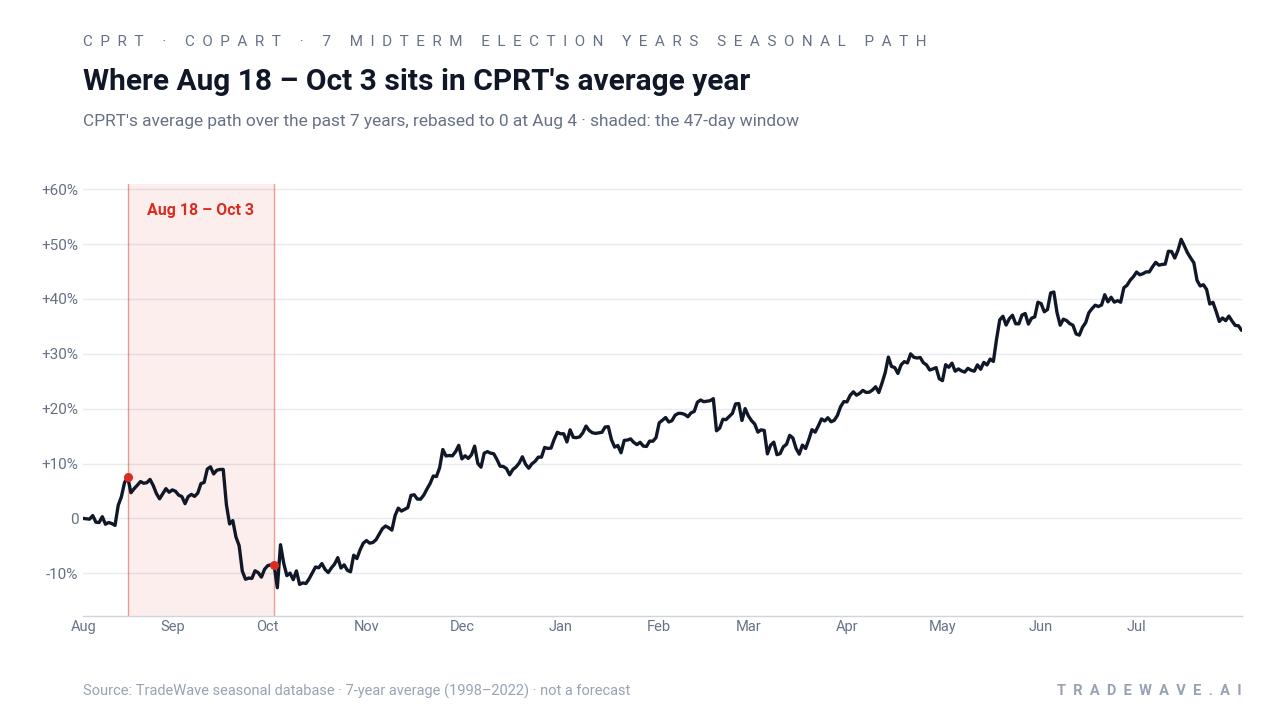
The historical seasonal average chart shows Copart’s typical year in these midterm cycles, rebased to early August. The shaded Aug 18 to Oct 3 window tends to sit in a plateau-to-downshift zone, where the average path drifts lower rather than extending prior gains. That fits the short bias: the stock has often stalled or rolled over in late summer even when the broader year remained constructive.
The next view stacks each year’s net result with its full intraperiod range, highlighting how far Copart has tended to swing inside this window.
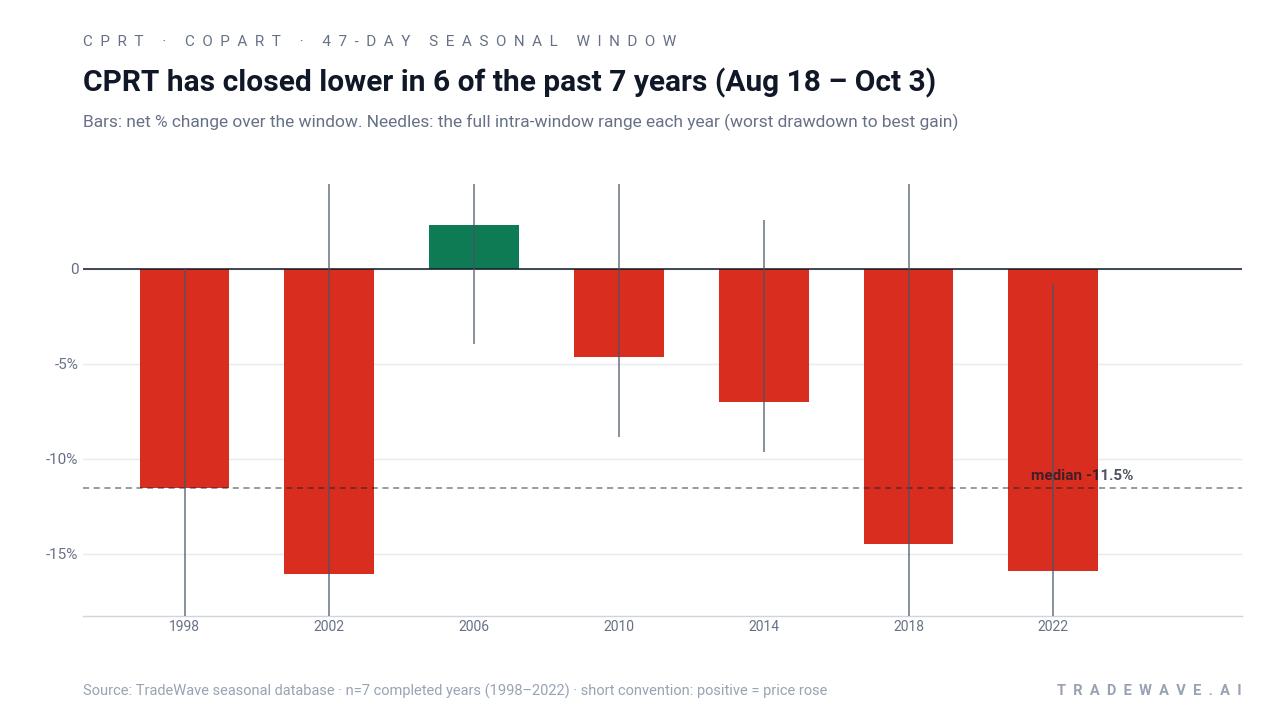
The stacked net/MFE/MAE chart makes the volatility profile clear: in several years, Copart has swung from double-digit favorable territory for shorts to deep adverse drawdowns before the window closed. Large maximum favorable excursions paired with sizable maximum adverse excursions point to a high-variance setup where timing and risk controls matter as much as the underlying seasonal edge.
History does not guarantee future results; adverse excursions can be large even in winning windows, and seasonal patterns can break when fundamentals or macro conditions change.
Why does Copart (CPRT) follow this seasonal pattern?
One likely driver is the clustering of insurance and auto-related catalysts in late summer, when accident frequency, salvage flows and pricing updates often hit ahead of the year-end push. Analysts have also pointed to institutional portfolio repositioning in the midterm election year, when investors reassess exposure to economically sensitive industrials as policy and regulatory signals evolve.[5][11][12] For a niche operator like Copart, those shifts can translate into a tendency for late‑summer profit-taking or de‑risking after stronger stretches earlier in the year.
What is driving Copart (CPRT) today?
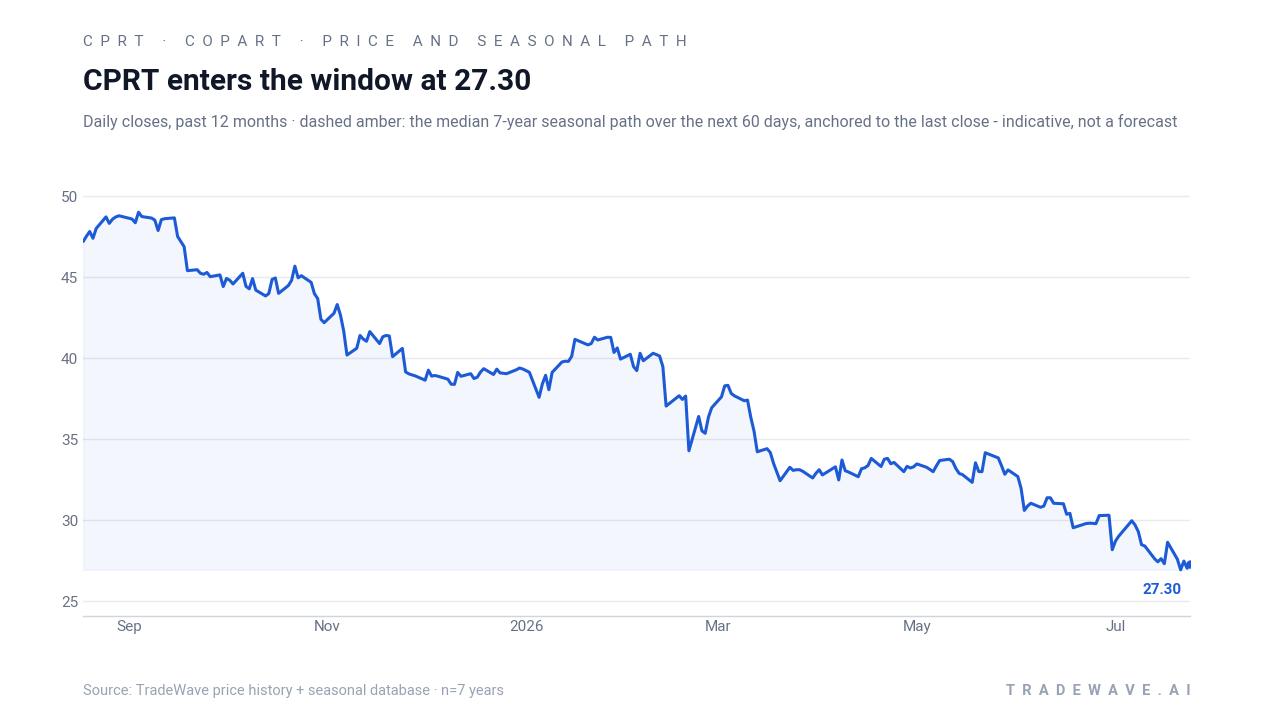
Copart shares closed at 29.66 on Monday, up 0.65 points or 2.2% on the session, extending a roughly 7.78% one-month rally as the stock trades between its 52-week low of 26.81 and high of 50.11. The move comes after Copart’s May 21 fiscal Q2 report delivered $0.43 in EPS versus $0.41 expected and revenue of $1.24 billion against a $1.19 billion consensus, a modest beat that reinforced the company’s steady growth profile even as year-over-year revenue growth slowed to 2.1%.[1][7][11]
Institutional interest has remained active. In late July, Dimensional Fund Advisors and Pacer Advisors both disclosed higher Copart holdings, while London Co. of Virginia trimmed its position, moves that collectively suggest portfolio fine-tuning rather than a wholesale shift in sentiment.[1][2][3] MarketBeat’s compilation of analyst views still shows a “Moderate Buy” rating with a consensus price target of 43.5, implying meaningful upside from current levels even after the recent bounce.[2][3]
Strategic context has also been in focus. Morningstar’s latest research note on Aug 3 highlighted Copart’s wide moat in online salvage auctions and the new CEO’s push for faster growth, citing structural tailwinds from rising vehicle complexity and advanced driver-assistance systems that make repairs more expensive and total losses more common.[5][12] Several commentators have framed Copart as a defensive “anti‑AI” diversifier within industrials, offering exposure to insurance and auto cycles rather than the crowded big-tech trade.[9][12]
At the same time, governance and insider activity are on traders’ radar. Yahoo Finance’s latest news feed shows that CEO Jeffrey Liaw sold 27,745 shares for about $846,000, a sale that some investors view as routine diversification but others treat as a reason to scrutinize near-term positioning more carefully.[6] Combined with the upcoming seasonal window that has historically favored the short side, that insider sale adds another layer to the risk-reward debate around Copart’s late‑summer trading.
The chart below situates the latest move against Copart’s past year of trading and the median seasonal path over the next two months.
What should traders watch as this Copart seasonal window approaches?
First, the calendar: the 47-day window opens on Aug 18 and runs through Oct 3, squarely in the mid part of the midterm election year when policy noise and sector rotation often pick up. Historically, this has been a soft patch for Copart in that specific phase, so how the stock behaves into and through that start date will show whether the pattern is asserting itself again or being overwhelmed by current fundamentals.
Second, price levels and volatility. Traders will be watching whether Copart can hold above the recent breakout zone around the high‑20s and low‑30s as the window begins, or whether profit-taking emerges that lines up with the historical short bias. Given the large maximum favorable and adverse excursions seen in prior cycles, intraday and intraweek swings could be sharp even if the final outcome of the window ends up modest.
Third, the fundamental and policy tape. Any fresh commentary from insurers on claim frequency, salvage values or fee pressure, along with macro data that affects auto demand, could either reinforce or blunt the historical pattern.[5][11][12] In a midterm election year, regulatory headlines around auto safety, emissions or insurance practices can also move sentiment quickly, so traders will be sensitive to Washington and state-level developments that touch Copart’s ecosystem.
Finally, insider and institutional behavior. The recent CEO share sale is a data point, not a verdict, but traders will be watching for follow-on filings or a shift in the pace of insider transactions as the window unfolds.[6] On the fund side, additional 13F updates from large holders like Dimensional, Pacer and London Co. of Virginia will help show whether the late‑summer pattern is prompting real-world de‑risking or if long-term investors are willing to look through it.[1][2][3] If selling pressure and positioning shifts build as the window progresses, that would rhyme with the historical seasonal trend; if buyers keep stepping in on dips, it would be a sign that this midterm-year chapter may break from the script.
Sources
- MarketBeat: London Co. of Virginia Trims Stock Holdings in Copart, Inc. (CPRT) (Jul 26, 2026).
- MarketBeat: Copart, Inc. (CPRT) Stock Holdings Increased by Pacer Advisors Inc. (Aug 3, 2026).
- MarketBeat: Copart, Inc. (CPRT) Shares Purchased by Dimensional Fund Advisors LP (Jul 26, 2026).
- Yahoo Finance: How The Copart (CPRT) Narrative Is Shifting With Lower Price Targets And Earnings Concerns (May 5, 2026).
- Yahoo Finance / Morningstar: Copart, Inc.: Copart's New CEO Seeks Faster Growth (Aug 3, 2026).
- Yahoo Finance: Copart, Inc. (CPRT) Stock Price, News, Quote & History (Aug 8, 2026).
- Yahoo Finance: Copart, Inc. (CPRT) Surpasses Market Returns: Some Facts Worth Knowing (Jul 27, 2026).
- SEC Edgar: Copart, Inc. (CPRT) Form 10-K/10-Q filing cprt-20250731 (Sep 26, 2025).
- Seeking Alpha: Copart: Historically Cheap Following CEO 'Reverse Transition' (Jul 1, 2026).
- Seeking Alpha: Copart: A Wide-Moat Compounder Trading At A Rare Discount (May 7, 2026).
- The Motley Fool: Copart (CPRT) Q2 2026 Earnings Transcript (May 21, 2026).
- Seeking Alpha: Copart: The Anti-AI Diversification With Solid Fundamentals (Jun 25, 2026).
- Seeking Alpha: Copart: A Wonderful Company At A Wonderful Price (Apr 13, 2026).
About this seasonal analysis
Seasonal pattern data is sourced from TradeWave.ai, which analyzes historical price behavior across annual calendar windows going back up to 30 years. Read the full data methodology or the book The 100-Year Pattern by Afshin Moshrefi (2026 edition). Past performance of seasonal patterns does not guarantee future results. This article is for informational purposes only and does not constitute investment advice.