AutoZone (AZO) Has Risen in 8 of 8 Midterm Fall Windows, Averaging 9.89% Gains
AutoZone is approaching a historically strong 46-day fall window in midterm election years just as the stock trades near its 52-week low after a sharp pullback.
Price as of Sep 21, 2026: $2,803.25 (last close).
What is the seasonal pattern for AutoZone (AZO)?
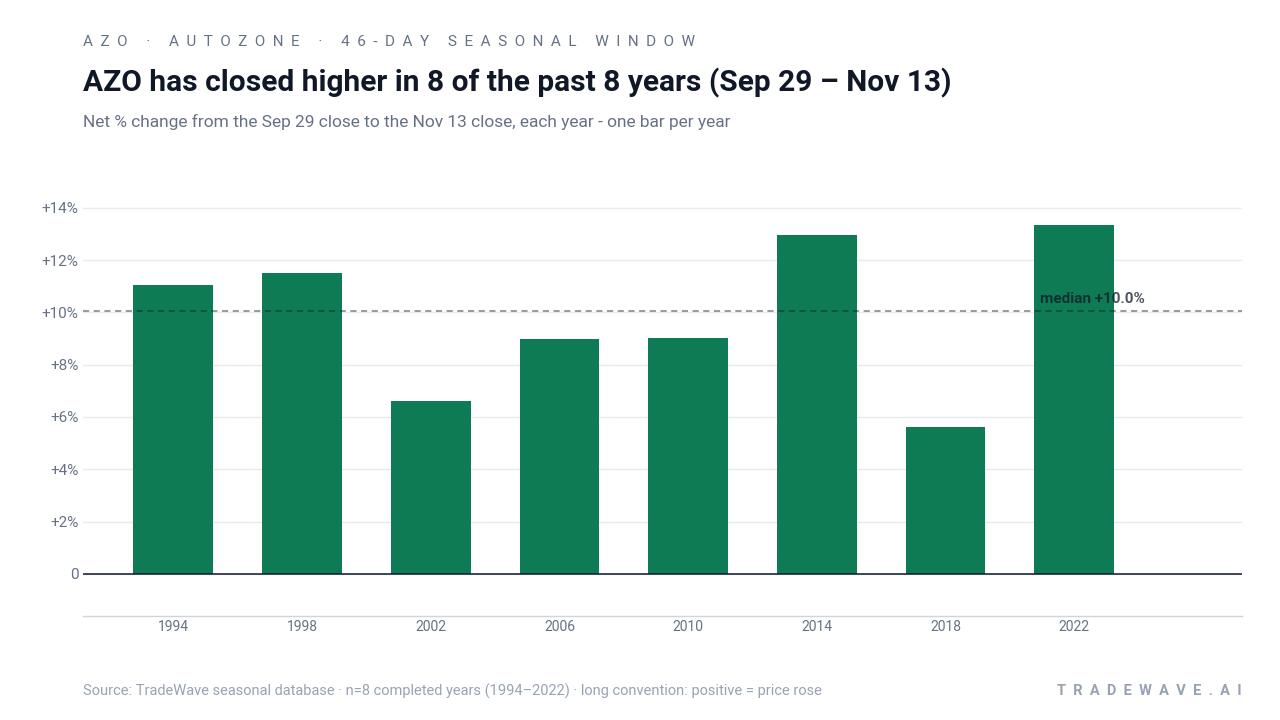
AutoZone has risen in 8 of 8 midterm-year fall windows starting Sep 29, with an average gain of 9.89% in winning years.
- 8 for 8 in this window, averaging 9.89% gains in winning years across the last 8 midterm election cycles.
- Seasonal window runs from Sep 29 through Nov 13, spanning 46 calendar days in the midterm election year.
- Percent Profitable is 100.0%, with 8 winners and 0 losers in the historical sample.
- Average profit of 9.89% reflects that every completed year in this AutoZone trading window finished higher.
- TradeWave Ratio of 3.33 suggests price has typically traveled meaningfully in the long direction within the window.
- Sharpe ratio of 3.32 points to a historically strong risk-adjusted profile for this specific AutoZone seasonal trend.
According to historical data from TradeWave.ai, this midterm-year fall stretch has behaved very differently from an average month on the calendar for AutoZone. The next section walks through how that pattern has played out across prior cycles and what it means as the 2026 window approaches.
How has AutoZone (AZO) traded in this midterm-year fall window?
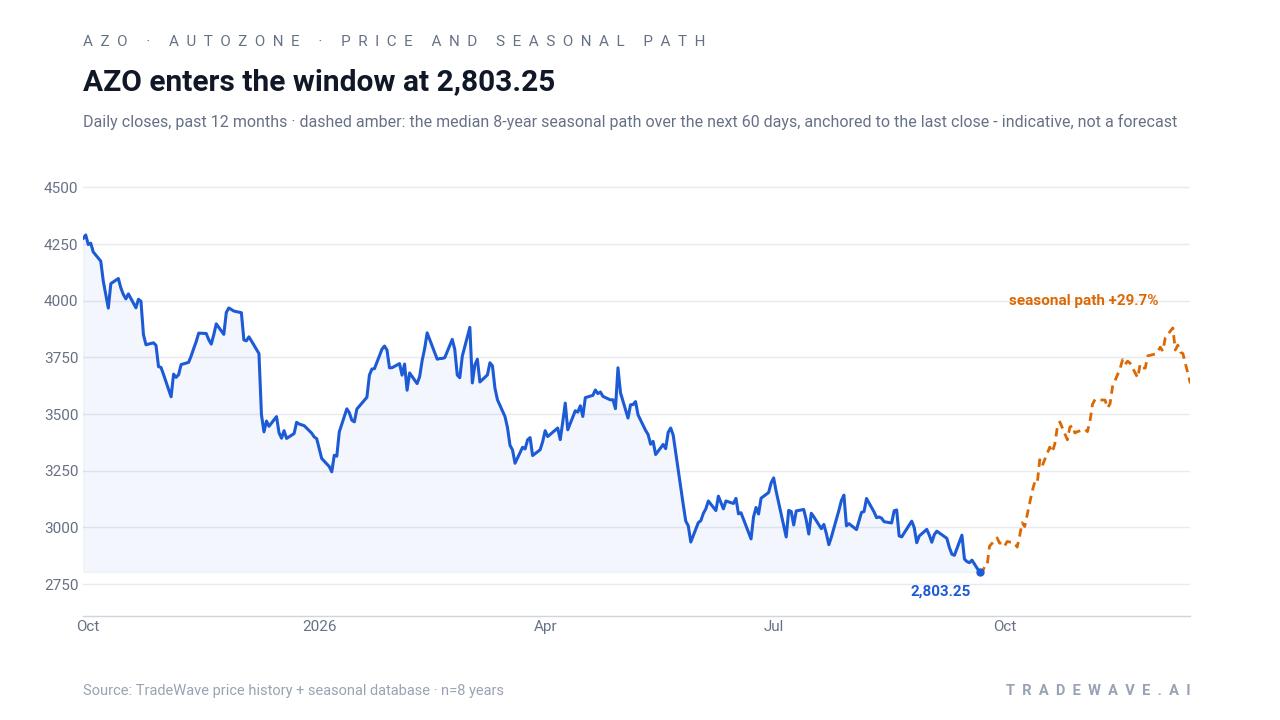
AutoZone has risen in 8 of the last 8 midterm election years during the Sep 29 to Nov 13 window, averaging 9.89% gains and compounding to 112.1% across those cycles. Shares finished the prior session at 2,803.25, down 1.8% on the day and sitting just above a 52-week low of 2,796.85 while roughly 35.3% below the 52-week high of 4,332.68. That combination of a strong historical seasonal tailwind and a stock pinned near the bottom of its one-year range gives this upcoming AutoZone trading window unusual focus for investors watching the auto parts retail sector.
Grouping the data by the presidential election cycle matters here because this window sits in the concluding midterm election year, just before the calendar flips into the year before the presidential election, a phase that has often seen risk appetite rebuild as policy uncertainty clears. In AutoZone’s case, the last 8 midterm-year iterations of this specific Sep 29 to Nov 13 slice have all rewarded long exposure, even when the broader market backdrop was mixed.
Across those 8 completed years, the average winner gained 9.89%, with a median outcome of 10.04%, which means the typical result has been a high single-digit to low double-digit move higher rather than a one-off outlier. The strongest year in the sample was 2022, when AutoZone rallied 13.33% over the window, reaching a maximum favorable move of 18.57% at one point before settling back by the close. The softest year was 2018, which still delivered a 5.6% net gain despite an intraperiod pullback of 8.48% from the entry level.
The intraday and intra-window swings matter because they show how bumpy the ride has been inside an otherwise clean win streak. In 1998, for example, AutoZone finished the window up 11.5% but not before enduring a worst drawdown of 18.0% from the starting price, a reminder that even “all green” seasonal histories can hide sharp air pockets. Other years, such as 2006 and 2010, saw much shallower adverse moves of less than 2% while still posting solid high single-digit gains by the end of the window.
On a cumulative basis, stacking this 46-day midterm-year window across the eight historical cycles compounds to a 112.1% total return. Add it up and the pattern has effectively doubled capital across those specific slices of the calendar, even though the broader auto parts retail sector has faced very different macro and competitive conditions from one cycle to the next. The Sharpe ratio of 3.32 underlines that, at least historically, the payoff per unit of volatility in this AutoZone seasonal pattern has been unusually strong.
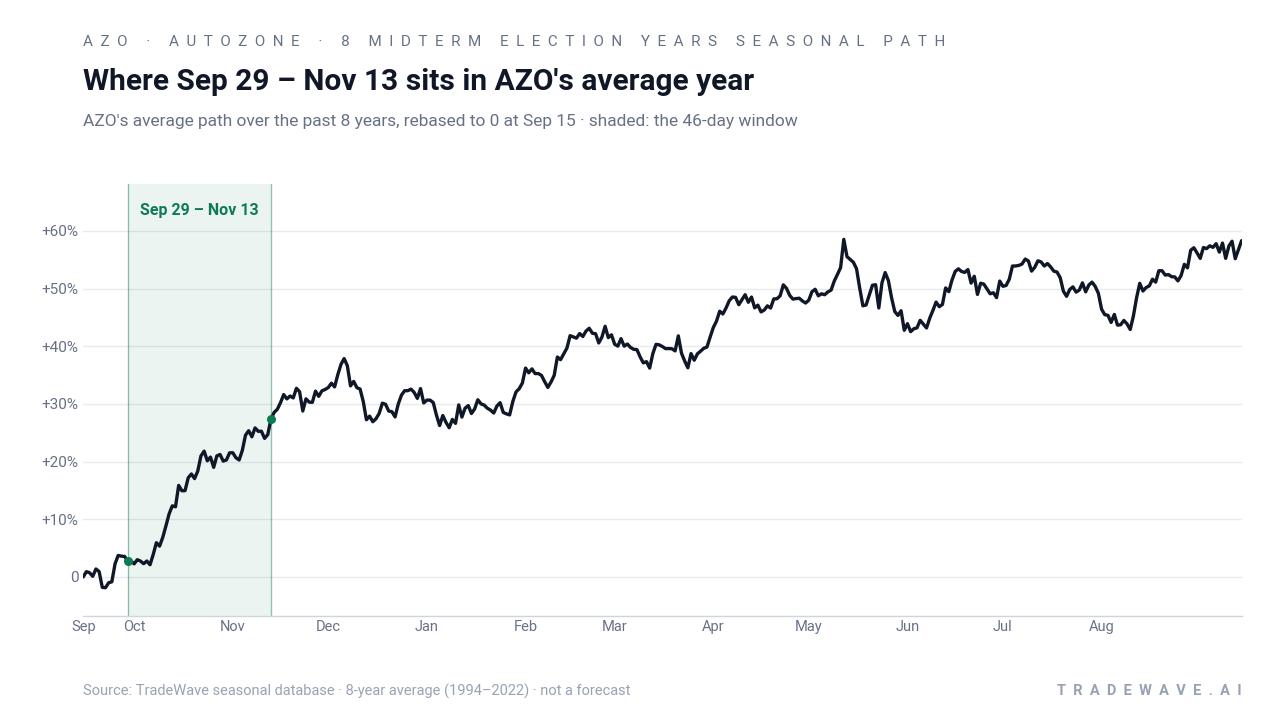
Yearly net and peak moves highlight upside persistence amid typical drawdowns.
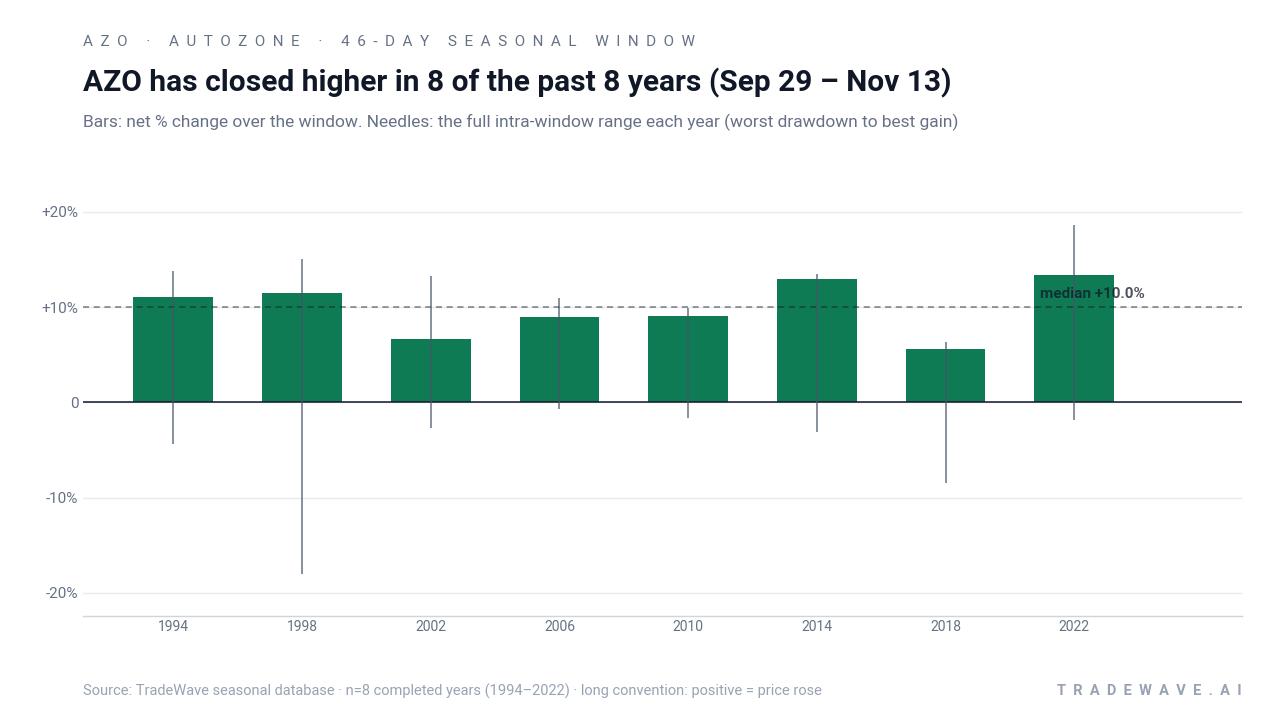
History does not guarantee future results; adverse excursions can be large even in winning windows, and AutoZone’s past seasonal behavior may not repeat.
Why does AutoZone (AZO) follow this seasonal pattern?
One likely driver is the clustering of AutoZone’s fiscal reporting and guidance updates around the fall, which can reset expectations for the coming winter repair season and tax-year planning. Analysts have also pointed to consumer spending cycles, with cooler weather and early holiday travel often pushing more drivers into maintenance and repair work that benefits auto parts retailers. This midterm-year slice may further reflect institutional portfolio repositioning as investors balance policy risk with defensive, cash-generative names heading into the year before the presidential election.
What is driving AutoZone (AZO) today?
AutoZone closed the latest session at 2,803.25, down 1.8% on the day, leaving the stock about 35.3% below its 52-week high of 4,332.68 and only a few dollars above its 52-week low of 2,796.85. Trading volume of roughly 600,000 shares ran well above the recent 20-day average of about 331,600, suggesting active repositioning as investors digest a difficult year that has erased earlier gains. The stock’s 50-day moving average sits near 2,991.47, so price is trading meaningfully below that short-term trend line, underscoring how sharp the pullback has been.
Back on May 9, 2026, AutoZone reported fiscal-quarter earnings that beat Wall Street’s EPS and revenue estimates, but the stock sold off as investors focused on margin compression, cooling weather-related categories and softer international growth in Mexico and Brazil.[1][3] In March 2026, another quarter showed revenue growth but a drop in net income as inflation and higher costs, including tariffs, squeezed profitability.[2] Those earlier reports framed AutoZone as a company still growing the top line but fighting macro headwinds that have weighed on sentiment toward the auto parts retail group.[1][2]
More recently, insider-trading disclosures compiled by MarketBeat through Sep 11, 2026, show multiple buys and sells by AutoZone executives and directors, signaling active portfolio management by insiders rather than a one-way bet.[4] While the filings span a range of dates and sizes, they give traders another lens on how management is navigating a stock that has swung from record highs to fresh lows within a year. For a name that once traded as a steady compounder, that shift in volatility is a key part of today’s setup.
The chart below situates the latest move in its recent multi-month context alongside the historical seasonal projection.
What should traders watch as this AutoZone (AZO) window opens?
First, the calendar: the 46-day window begins on Sep 29 and runs through Nov 13, so any sharp move that starts inside that band will be viewed against a backdrop of eight straight historical wins for the long side. Traders will be watching whether price can reclaim the 50-day moving average near 2,991 in the early part of the window or whether AutoZone remains pinned near its 52-week low, which would mark a clear break from the typical midterm-year seasonal pattern.
Second, macro and policy catalysts matter because this is the concluding stretch of the midterm election year, when Washington’s fiscal stance, tariff policy and regulatory tone around autos and retail can shift quickly. Any fresh headlines on inflation, energy costs or trade that affect vehicle ownership and repair budgets could either reinforce or overwhelm the historical seasonality that has favored AutoZone in this period.[1][2] If the stock rallies on improving macro signals, that would line up with the historical pattern; if it stays weak despite better news, traders may question whether this particular cycle is breaking the mold.
Third, positioning and flow will be in focus. The heavy volume on recent down days suggests some investors have already thrown in the towel, which can sometimes set the stage for sharp mean-reversion moves when selling pressure exhausts. Market participants will be watching whether volume remains elevated on up days as the window opens, a sign that new buyers are stepping in rather than just short covering.
Finally, insider activity is a quiet but important tell. If the pattern of mixed insider buys and sells documented through Sep 11, 2026, shifts toward more concentrated buying as the stock trades near its lows, traders may see that as a vote of confidence that aligns with the historically strong fall window.[4] If, instead, insiders lean into selling into any seasonal bounce, that would be a clear sign that this cycle’s fundamentals may not support a repeat of the past eight midterm-year gains.
Sources
- CNBC - AutoZone stock on pace for worst trading day since March 2020, despite retailer beating Wall Street estimates - CNBC
- Reuters - AutoZone's second-quarter profit falls after inflationary headwinds - Reuters
- The Wall Street Journal - AutoZone Says Cool Weather Led to Slowing Sales Growth - WSJ
- MarketBeat - AutoZone (AZO) Insider Trading Activity 2026
About this seasonal analysis
Seasonal pattern data is sourced from TradeWave.ai, which analyzes historical price behavior across annual calendar windows going back up to 30 years. Read the full data methodology or the book The 100-Year Pattern by Afshin Moshrefi (2026 edition). Past performance of seasonal patterns does not guarantee future results. This article is for informational purposes only and does not constitute investment advice.