Take-Two Interactive (TTWO) Has Risen in 6 of 6 Oct-Aug Midterm Windows, Averaging 21.48% Gains
Take-Two Interactive heads toward a historically strong 309-day trading window just as GTA VI hype builds and the stock trades well below its 52-week high.
Price as of Sep 25, 2026: $201.44 (last close).
What is the seasonal pattern for Take-Two Interactive (TTWO)?
Take-Two Interactive has risen in 6 of 6 midterm-year windows starting Oct 27 and running 309 days, with an average gain of 21.48% in winning years.
- 6 for 6 in this window, with Take-Two Interactive averaging 21.48% gains in winning years across the last six midterm election cycles.
- Percent Profitable is 100.0%, with 6 winners and 0 losers in the Oct 27 to Aug 31 trading window.
- The window spans 309 calendar days, starting Oct 27, and has historically aligned with the midterm-to-pre-election phase of the presidential cycle.
- Average profit of 21.48% reflects all years in the sample, since every historical window finished positive.
- The TradeWave Ratio (TWR) of 1.73 indicates that price has typically traveled meaningfully in the long direction within the window, independent of the final close.
- A Sharpe ratio of 2.53 points to a historically strong risk-adjusted profile for this TTWO seasonal trend.
According to historical data from TradeWave.ai, this upcoming stretch for Take-Two Interactive behaves very differently from an average year. The next section looks at how that election-cycle seasonal pattern has played out in prior midterm years.
How has Take-Two Interactive (TTWO) traded in the Oct 27 to Aug 31 seasonal window?
Take-Two Interactive has risen in 6 of the last 6 midterm election years during the Oct 27 to Aug 31 window, averaging 21.48% gains and compounding to 218.65% across those cycles. The stock enters this setup at 201.44, down 0.8% on the day and roughly 24.2% below its 52-week high of 265.94, with year-to-date performance off about 14%. That combination of a strong historical seasonal tailwind and a stock trading well under its prior peak gives this TTWO seasonal trend unusual weight heading into the GTA VI launch period.
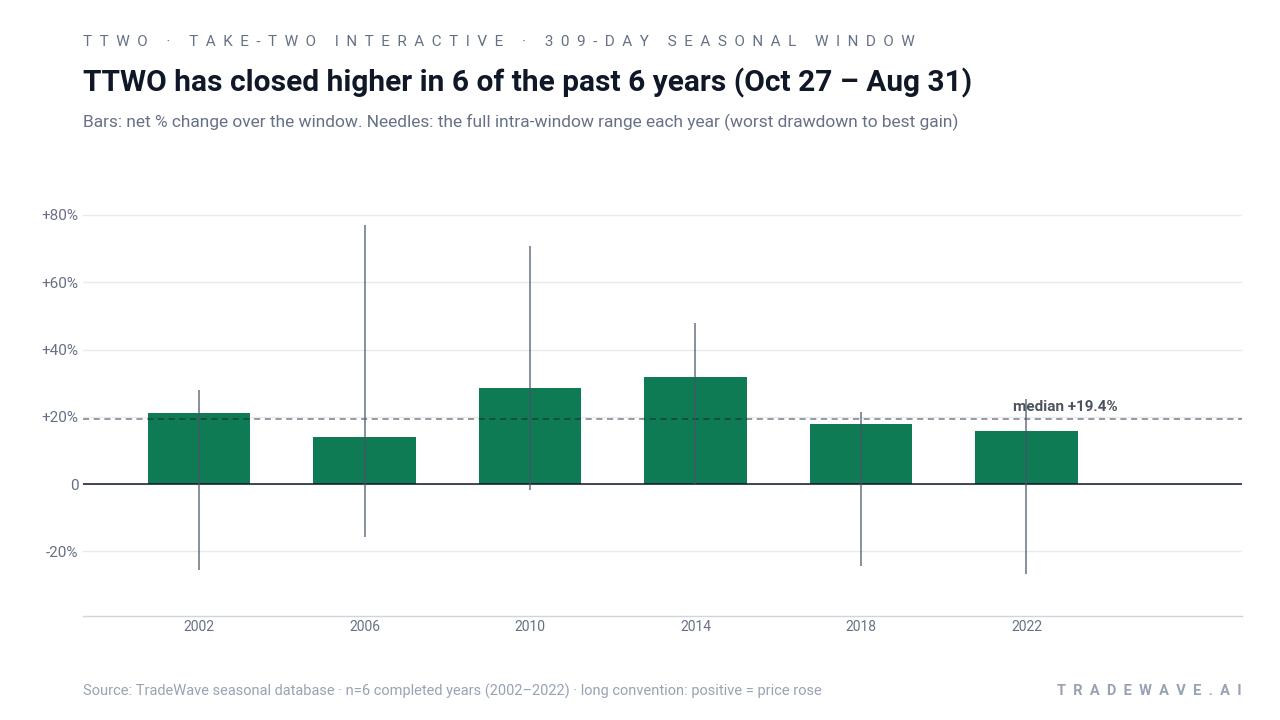
Historically, this 309-day TTWO seasonal window has been a clean long setup. Percent Profitable is 100.0%, with 6 winners and 0 losers, and the average profit of 21.48% matches the all-years average because there have been no losing cycles. The median gain of 19.42% shows that results have clustered around high-teens to low-20s returns rather than being driven by a single outlier year.
The per-year record shows how those gains have arrived. The strongest close-to-close performance came in 2014, when TTWO returned 31.75% between the Oct 27 entry and the Aug 31 exit, while the softest outcome was 13.98% in 2006. Even in that weakest year, the stock still finished the window higher, which is unusual for a single-stock pattern over such a long span.
Intraperiod swings have been large. Maximum favorable moves inside the window have ranged from 21.46% in 2018 to 76.89% in 2006, showing that TTWO has often overshot the final gain at some point during the period. On the downside, maximum adverse moves have reached as deep as -26.67% in 2022 and -25.58% in 2002, underscoring that even winning years have included sizable drawdowns before finishing higher.
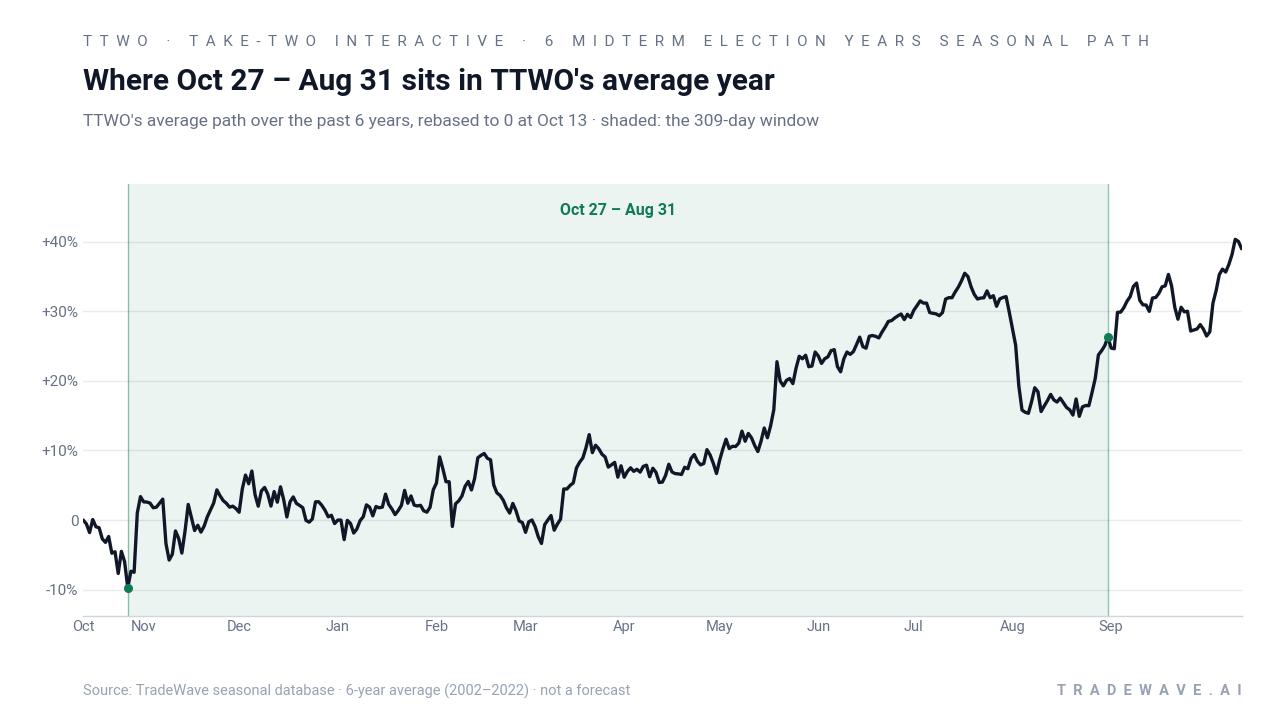
The historical seasonal average suggests that TTWO’s typical path in this window is not a straight line. The average curve shows early choppiness, followed by a more persistent grind higher as the window progresses, consistent with the idea that midterm-year volatility gives way to a more supportive pre-election backdrop for growth names.
Year-by-year ranges show how upside potential and downside risk have coexisted inside this TTWO trading window.
The stacked net, best-case, and worst-case excursions highlight a key point for traders: this has been a high-variance but consistently positive window for longs. Large maximum favorable moves have often come alongside double-digit maximum adverse moves, which means the pattern has rewarded patience but punished tight risk limits.
History does not guarantee future results; adverse excursions can be large even in winning windows, and past TTWO seasonal behavior may not repeat.
Why does Take-Two Interactive (TTWO) follow this seasonal pattern?
One likely driver is the way Take-Two’s release slate and bookings guidance tend to cluster around the holiday season and the following fiscal year, which often falls inside this Oct 27 to Aug 31 window.[2][5] Analysts have also pointed to institutional portfolio repositioning around midterm and pre-election years, when investors often lean back into growth and entertainment names as policy visibility improves. For TTWO specifically, recurring excitement around flagship titles and live-service monetization may help sustain interest across much of this seasonal stretch.
What is driving Take-Two Interactive (TTWO) today?
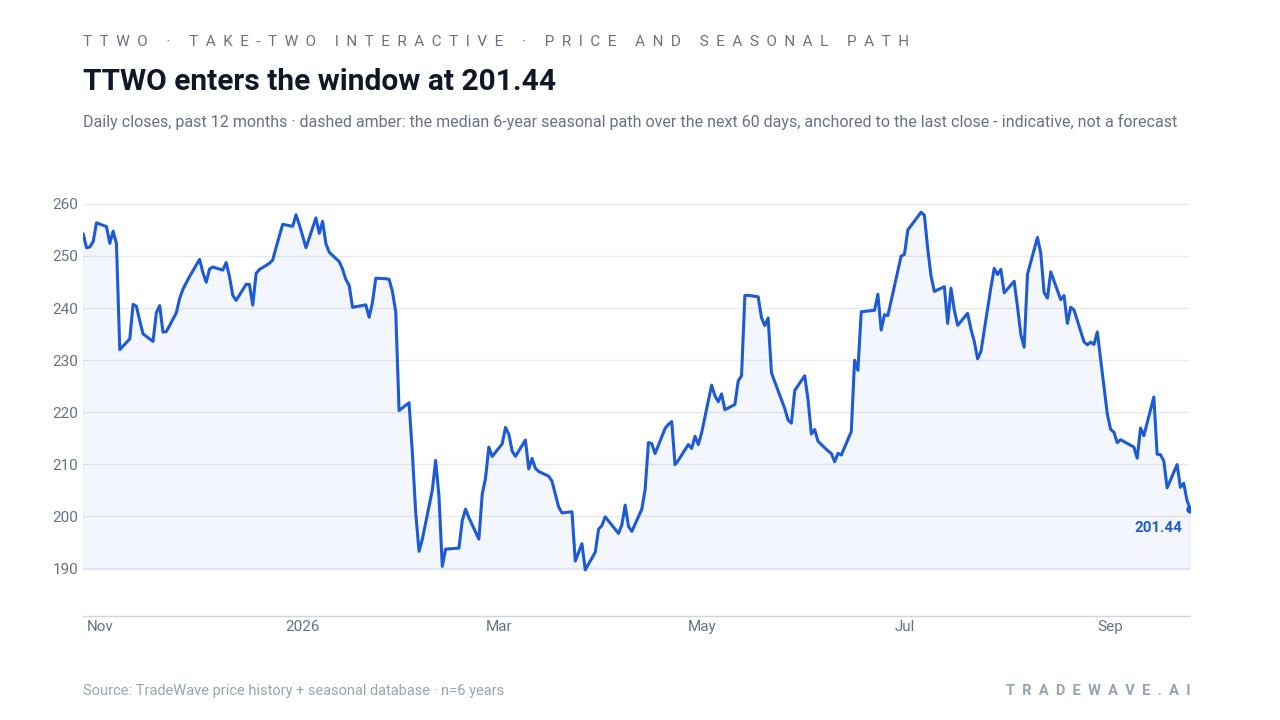
Take-Two Interactive closed Monday at 201.44, down 0.8% on the session, extending a one-month slide of 13.55% and leaving the stock about 24.2% below its 52-week high of 265.94. Shares are down roughly 14.0% year to date, even as management has reiterated a November 19 launch date for Grand Theft Auto VI and stuck to an ambitious bookings outlook that stretches into fiscal 2027.[2][5] In August, the company reported net bookings of $1.39 billion for the quarter ended Jun 30, slightly ahead of estimates, but its guidance for the current quarter came in below some analyst expectations, keeping the focus on execution around GTA VI and live-service revenue.[2][5]
On the macro side, Take-Two sits in the crosshairs of two big debates: how much higher-for-longer interest rates will weigh on growth valuations, and whether new AI tools from large tech platforms will reshape game development economics over time.[6] In February 2026, executives played down the near-term threat from Google’s AI for game development, calling it early-stage and not comparable to full game engines, but investors remain sensitive to any sign that competitive dynamics could compress margins in premium franchises.[6] At the same time, the broader gaming and live-services sector is leaning heavily on recurring monetization from titles like GTA Online, which investors see as critical for smoothing revenue between blockbuster releases.[5]
Corporate behavior has added another layer to the story. Yahoo Finance’s insider transaction records show multiple director and officer share sales across 2025 and 2026, including transactions by senior figures such as Strauss Zelnick and other executives.[7] Insider selling does not automatically signal trouble, but in a stock that has pulled back sharply from its highs ahead of a major product cycle, it gives traders one more reason to scrutinize how management frames risk and reward on upcoming calls.
The chart below situates the latest pullback against TTWO’s past year of trading and a historical seasonal projection for the next two months.
What should traders watch as this TTWO seasonal window approaches?
The first checkpoint is the calendar itself: the Oct 27 start date for this 309-day window lands just three weeks ahead of the scheduled Nov 19 GTA VI launch, so any shift in guidance or chatter around that release could interact directly with the historical pattern.[2][5] Traders will be watching whether TTWO can stabilize above the recent 52-week low of 187.63 and start to build a base into the window, or whether further weakness undercuts the typical midterm-year seasonal trend.
Second, the policy and macro backdrop matters. As markets move from the concluding midterm election year into the year before the presidential election, risk appetite in growth and entertainment stocks has often improved, but that tailwind could be blunted if rate expectations reprice higher or if consumer spending data softens. Any sign that higher borrowing costs are biting into discretionary spending on games would test how resilient this TTWO seasonal pattern really is.
Third, insider behavior bears watching. If the pace of director and officer selling slows or reverses into the GTA VI launch and early post-launch period, that could ease some of the skepticism that has built up during the recent drawdown.[7] On the other hand, continued heavy selling into strength would raise questions about how management views the balance between upside from the release and execution risk in the live-services model.
Finally, the seasonal playbook itself offers a simple litmus test. In prior midterm election years, TTWO has tended to be volatile early in the window but has ultimately finished higher in every case. If the stock spends the first few months of this window making lower lows or failing to participate in broader pre-election-year rallies, that would be a clear sign that this cycle is diverging from the historical TTWO trading window pattern. If, instead, TTWO absorbs early volatility and grinds higher into and after the GTA VI launch, it would mark a seventh straight win for this unusually consistent seasonal regime.
Sources
- Seeking Alpha - Take-Two rallies after confirming Grand Theft Auto 6 will be released on November 19
- Take-Two Interactive (Investor Relations) - Take-Two Interactive Software, Inc. Reports Results for Fiscal First Quarter 2027
- CNBC - Take-Two Interactive shares plummet more than 10% on news of another Grand Theft Auto 6 delay
- Forbes - What’s Happening With TTWO Stock?
- Reuters - Take-Two sticks to annual bookings outlook, says on track for 'GTA VI' November launch
- Reuters - Take-Two raises annual bookings forecast, sticks with 'GTA VI' November launch
- Yahoo Finance (Insider Transactions) - Take-Two Interactive Software, Inc. (TTWO) Recent Insider Transactions
About this seasonal analysis
Seasonal pattern data is sourced from TradeWave.ai, which analyzes historical price behavior across annual calendar windows going back up to 30 years. Read the full data methodology or the book The 100-Year Pattern by Afshin Moshrefi (2026 edition). Past performance of seasonal patterns does not guarantee future results. This article is for informational purposes only and does not constitute investment advice.