Micron Technology (MU) Has Dropped in 9 of 10 Midterm Windows Starting Jun 28
Micron Technology is heading toward a historically weak 101-day midterm-election seasonal window just as the stock trades near its 52-week high and options positioning stays aggressively bullish.

What is the seasonal pattern for Micron Technology (MU)?
Micron Technology has fallen in 9 of 10 years during this midterm-year summer-to-fall window, with an average gain of 17.36% in winning years for the short side.
- 9 for 10 in this window, with short trades averaging 17.36% gains in winning years.
- Seasonal window starts Jun 28 and runs 101 trading days across the last 10 midterm election years.
- Percent Profitable is 90%, with 9 winners and 1 loser for the short-direction pattern.
- Avg Profit - All, including the lone losing year, is still a strong 15% for the short side.
- The TradeWave Ratio of 1.85 signals that price has typically traveled meaningfully in the trade direction within the window.
- Intraperiod swings have been wide, with large best-case rallies for shorts but also deep adverse moves in some years.
According to historical data from TradeWave.ai, this upcoming stretch for Micron has behaved very differently from an average summer in prior midterm election years. The next section walks through how that election-cycle seasonality lines up with today’s price and macro backdrop.
How has Micron Technology (MU) traded in this midterm-year window?
Micron Technology has delivered profitable short-side trades in 9 of the last 10 midterm election years during the 101-day window that begins on Jun 28, with average winning returns of 17.36% and a 15% average across all years. Today the stock last traded around 1,211.38, putting it about 0.2% below its 52-week high of 1,213.56 and capping a 58.95% gain over the past month. Options traders leaned heavily into bullish $500 calls ahead of Micron’s blockbuster March earnings, with implied moves of roughly 8% to 9% around the event, underscoring how aggressively the market has been positioned on the upside.[9]
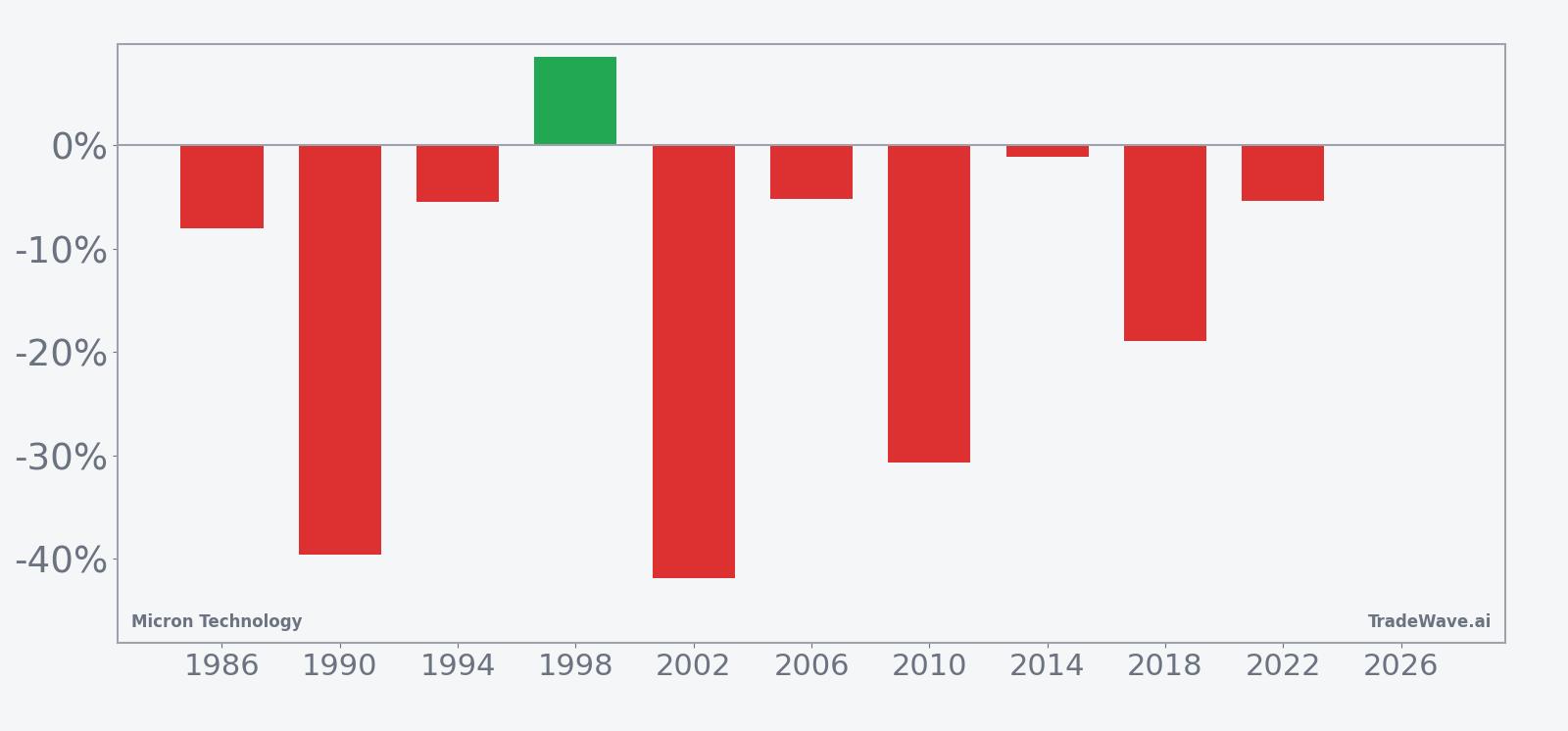
The presidential election cycle matters here because this pattern only looks at the last 10 midterm election years, a phase that has often featured policy uncertainty, shifting fiscal priorities and choppy risk appetite. Grouping Micron’s behavior by this specific year in the cycle filters out noise from other regimes and focuses on how the stock has traded when Washington is in the middle of a term and investors are weighing regulation, spending and tax debates that can hit capital-intensive chipmakers.
Historically, this 101-day window has been a clear negative stretch for Micron when viewed through a short lens. Percent Profitable sits at 90%, with 9 winning short years against just 1 losing year, and the all-years average return of 15% for the short side is unusually strong for a single seasonal slice. The median outcome of 6.72% suggests that while a few big years drive the 259% cumulative return, even the “typical” midterm-year iteration has delivered meaningful downside for the stock price.
Avg Profit of 17.36% reflects only the winning short years, while Avg Profit - All at 15% folds in the one losing year and still leaves a double-digit average. That gap between winners-only and all-years averages is modest, which tells you the lone losing year did not completely erase the pattern’s edge. For a short-direction seasonal setup, that consistency is rare and makes this MU seasonal trend stand out among large-cap tech names.
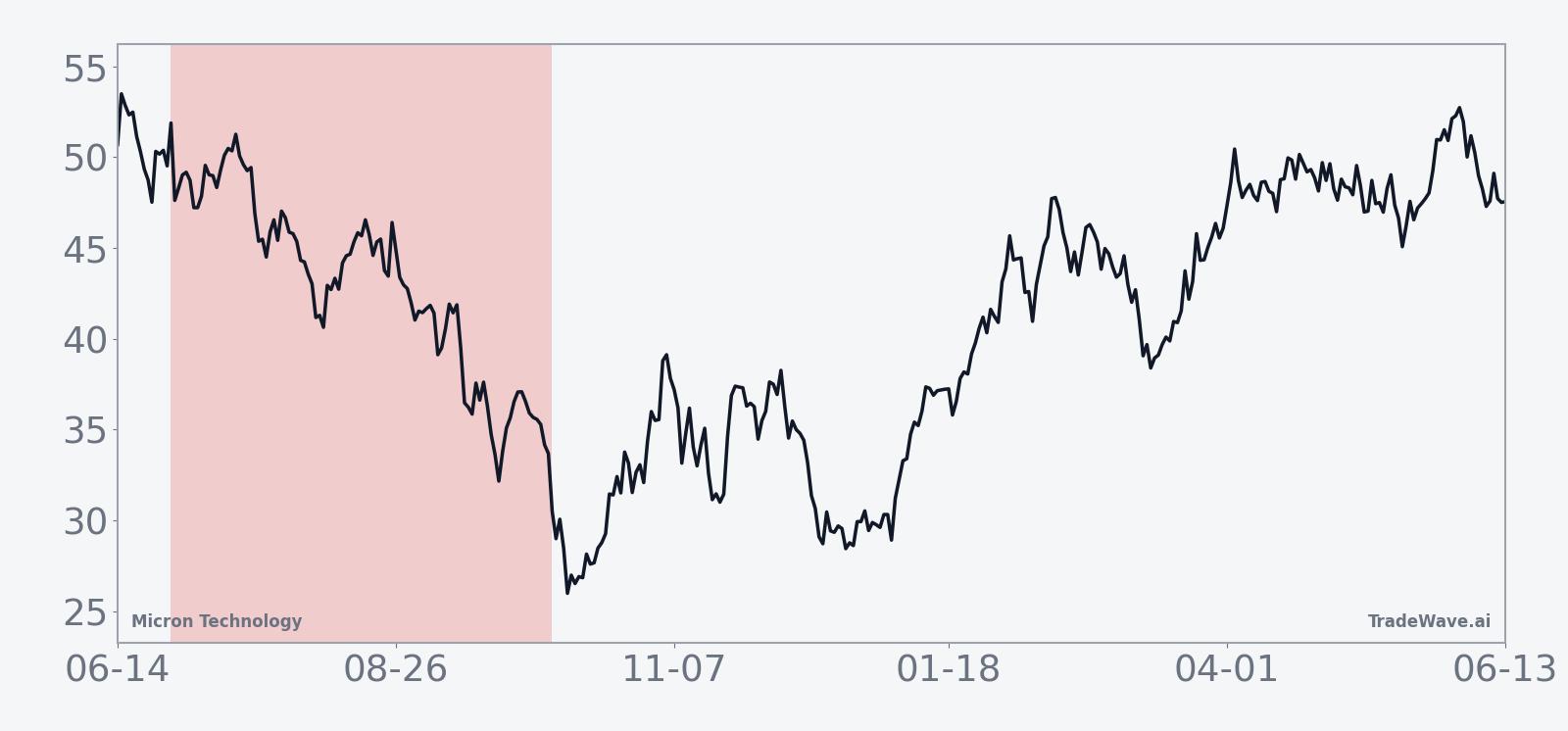
The historical seasonal average curve for this Micron Technology trading window slopes steadily in favor of the short side, with much of the net move accruing in the middle portion of the period rather than in a single sharp break. That profile suggests a tendency toward grinding weakness rather than one-off crashes, even though some individual years have seen abrupt air pockets. The cumulative return line, which reaches 259% across the ten midterm-year samples, shows that these short-side gains have stacked rather than canceling out over time.
The per-year bar chart with maximum favorable and adverse excursions shows how far Micron has swung inside the window before settling at the final result.
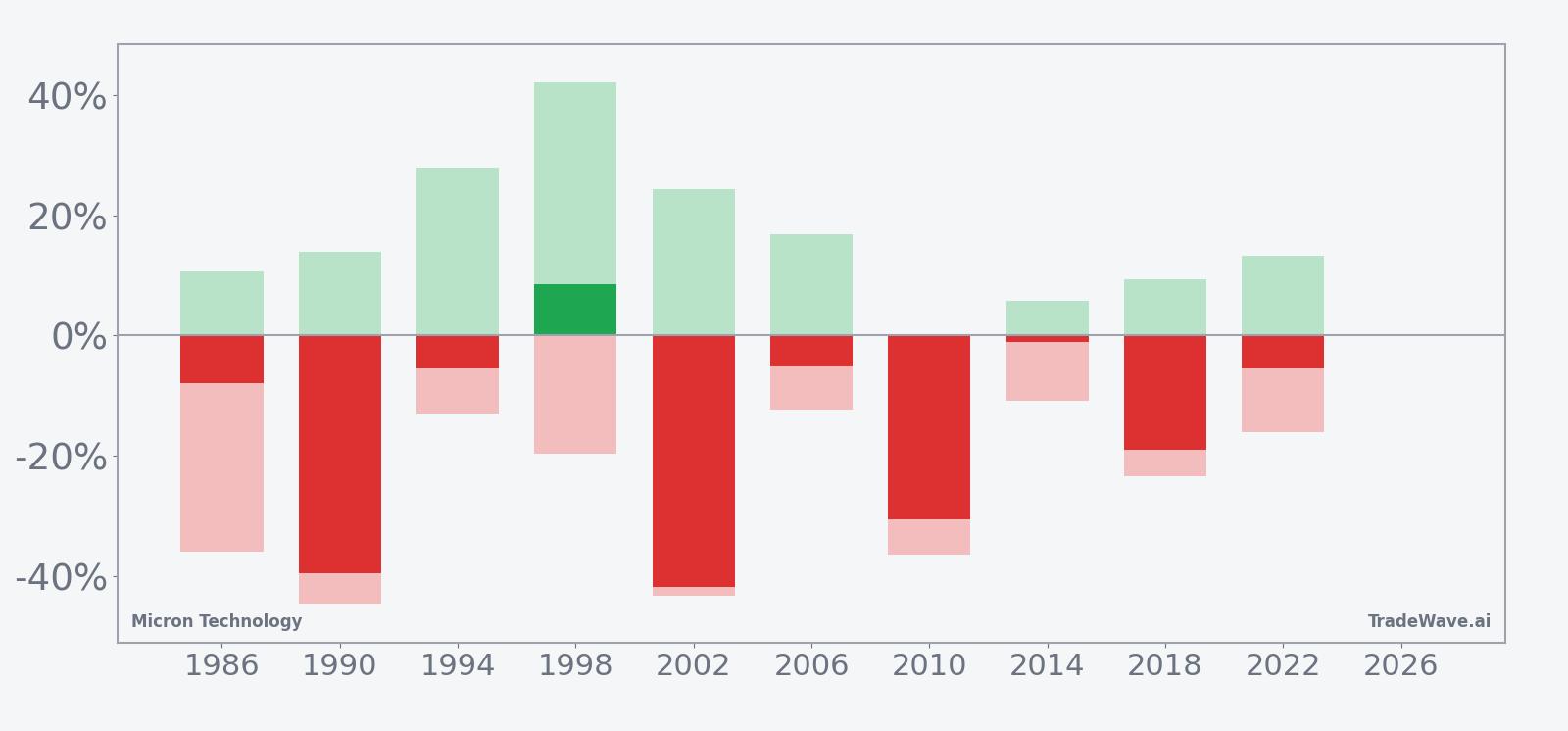
The stacked net, maximum favorable move and maximum adverse move bars underline how volatile this seasonal window can be even when the short side ultimately wins. In 1990 and 2002, for example, Micron’s net returns of about -39.6% and -41.89% for the stock were accompanied by adverse excursions near -44%, showing that even strong short years saw deep swings against the position before the trend reasserted. By contrast, 1998 delivered a losing year for shorts with an 8.54% net gain for the stock and a huge 42.2% best-case rally from the entry, a reminder that this historically weak stretch for MU can still produce powerful squeezes.
Add it up: 9 for 10 with double-digit average short-side gains and a 259% cumulative return makes this one of the more striking midterm-year seasonal patterns on the semiconductor calendar. History does not guarantee a repeat, but the consistency across four decades of midterm cycles is hard to ignore.
Why does Micron Technology (MU) follow this seasonal pattern?
This pattern may reflect how Micron’s earnings calendar and capex guidance often collide with midyear macro and policy debates in midterm election years, when investors reassess growth and spending. One likely driver is that memory and HBM demand tied to hyperscaler AI projects can look hottest early in the year, only to meet concerns about supply, pricing and a potential downcycle as the year progresses.[3] Analysts have also pointed to sector rotation within semiconductors, where investors periodically shift from high-beta memory names into steadier analog or diversified chipmakers as volatility picks up.[8]
History does not guarantee future results, and maximum adverse excursions inside this window have been large even in years that ultimately finished as winners for the short side.
What is driving Micron Technology (MU) today?
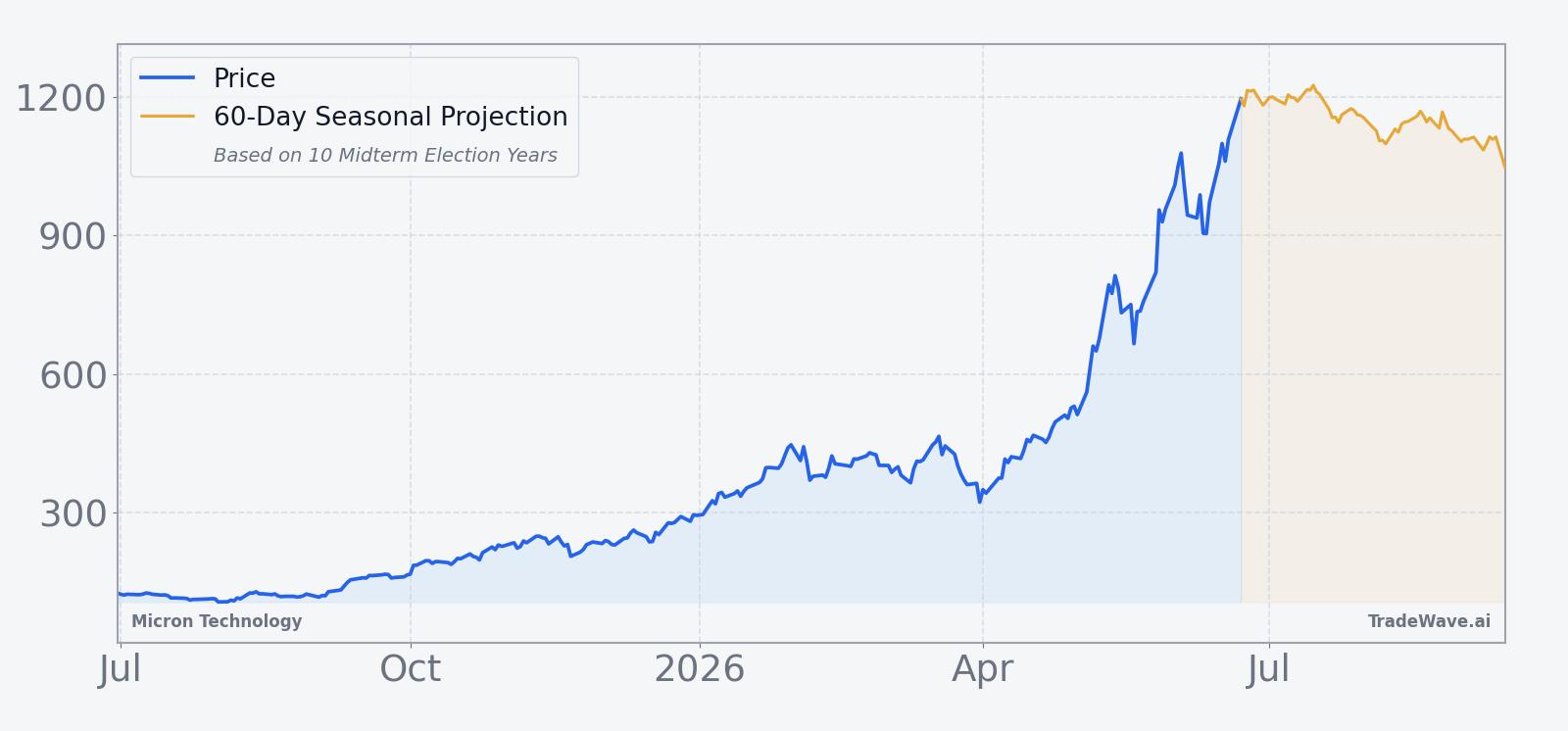
Micron Technology closed at 1,193.49 on the latest session, up 5.25% on the day, and is trading around 1,211.38 intraday, less than 0.2% below its 52-week high of 1,213.56 after a 58.95% surge over the past month. That move builds on a string of historic earnings beats, including Q2 FY26 revenue of roughly $23.86 billion, up about 196% year over year, and EPS of about $12.20 alongside very bullish guidance for revenue, EPS and gross margins.[4] In March 2026, analysts described those results as among the biggest upside surprises they had seen for a chipmaker, tying the strength directly to AI infrastructure demand from hyperscalers and tight DRAM, NAND and HBM supply conditions.[5]
Behind the price action, the macro and sector story is still about AI-driven demand and constrained memory supply. In March 2026, a Bloomberg excerpt on Yahoo Finance highlighted how hyperscaler capex from Amazon, Microsoft, Alphabet and Meta has been driving structural demand for Micron’s high-bandwidth memory and advanced DRAM, with analysts expecting that tailwind to last through at least 2027.[7] Around the same time, other research flagged that supply is likely to lag demand for several years, supporting elevated pricing and margins but also raising the risk that long-term contracts or a future downcycle could eventually cap upside.[1] Some commentators have already warned that the memory cycle could peak sooner than bulls expect, even as current fundamentals look exceptionally strong.[8]
Options positioning has mirrored that optimism. In March 2026, one analysis noted that Micron options “leaned bullish” ahead of earnings, with notable activity in the $500 calls and an implied move of roughly 8% to 9% priced into the event.[9] That kind of aggressive upside skew can amplify volatility if sentiment shifts, especially heading into a seasonal window that has historically favored the short side. For a stock that has already delivered a massive run, the combination of crowded bullish positioning and a historically weak midterm-year stretch is a tension traders will be watching closely.
The chart below situates the latest surge and the looming seasonal window in Micron’s recent 12-month trading range.
What should traders watch as this Micron Technology seasonal window approaches?
First, the calendar: the 101-day midterm-year window starts on Jun 28 and runs deep into the fall, so any shift from relentless buying to more two-way trade in Micron around that date will be notable. Second, levels: with the stock sitting just under its 52-week high, how MU behaves around that 1,213.56 area will help show whether this remains a momentum breakout or starts to resemble a topping process. Third, catalysts: while Micron’s next earnings date is not yet set, any guidance updates on AI-related demand, supply constraints or pricing will be key for testing whether the memory upcycle can keep outrunning concerns about a future downshift.[3][7]
Finally, watch the options tape that served as a Special Insight earlier in the year. If bullish call activity and implied volatility continue to build as the seasonal window opens, it would signal that investors are still leaning hard into the upside despite a historical pattern that has favored shorts.[9] A fade in upside call demand or a pickup in put buying, by contrast, would suggest that some of the crowding is easing and that traders are starting to respect the midterm-year seasonal risk. How Micron trades inside this window will not just matter for MU holders; given the stock’s role in the AI and memory complex, any sharp swings could ripple across the broader semiconductor sector.
Sources
- [1] Yahoo Finance: Micron Target Raised to $500 After Strong Q1 Earnings Beat (Dec 23, 2025)
- [2] CNBC: Micron earnings are out after the bell following a big move higher (Mar 18, 2026)
- [3] Seeking Alpha: Micron slides as investors take profits after historic run; analysts praise guidance (Mar 19, 2026)
- [4] Seeking Alpha: Micron Just Smashed Estimates - Buy The Dip (Mar 18, 2026)
- [5] Business Insider: Wall Street is raving about Micron earnings as one of the biggest-ever surprises (Dec 18, 2025)
- [6] Seeking Alpha: Micron Is Still One Of The Best Stocks In This Current Market (Mar 26, 2026)
- [7] Yahoo Finance (Bloomberg excerpt): Micron Earnings Face High Expectations as Its Stock Keeps Rising (Mar 18, 2026)
- [8] Seeking Alpha: Micron: Memory Downcycle Sooner Than Expected (Mar 16, 2026)
- [9] Seeking Alpha: Micron options lean bullish ahead of earnings with ~8% move priced in (Mar 18, 2026)
- [10] Zacks Investment Research: The Surge in Micron Technology Stock Looks Poised to Continue (Feb 13, 2026)
About this seasonal analysis
Seasonal pattern data is sourced from TradeWave.ai, which analyzes historical price behavior across annual calendar windows going back up to 30 years. Read the full data methodology or the book The 100-Year Pattern by Afshin Moshrefi (2026 edition). Past performance of seasonal patterns does not guarantee future results. This article is for informational purposes only and does not constitute investment advice.