Analysts Keep Copart (CPRT) at Moderate Buy With a 100% Midterm Late-October Win Record
Copart is trading near its 52-week lows after a tough year, just weeks before a late-October window that has quietly delivered gains in every midterm election year in the past quarter century.
Price as of Sep 28, 2026: $27.22 (last close).

What is the seasonal pattern for Copart (CPRT)?
Copart has risen in 7 of 7 midterm-year late-October windows, with an average gain of 9.16% in winning years.
- 7 for 7 in this window, averaging 9.16% gains across the last 7 midterm election years.
- Seasonal window runs from Oct 25 for 35 days, covering late October through late November.
- Percent Profitable is 100.0%, with 7 winners and 0 losers in the historical sample.
- Median gain across those years is 9.8%, pointing to a consistently positive CPRT seasonal trend.
- TradeWave Ratio of 2.16 signals that price has typically traveled meaningfully in the long direction within the window.
- Sharpe ratio of 2.47 indicates strong risk-adjusted returns for this Copart trading window in prior midterm cycles.
According to historical data from TradeWave.ai, Copart’s late-October behavior in midterm election years has not looked like an average month on the calendar. The next section steps through what that pattern has looked like and how it lines up with today’s setup.
How has Copart (CPRT) traded in late October during midterm years?
Copart has closed higher in every single late-October to late-November window across the last 7 midterm election years, averaging 9.16% gains over each 35-day stretch. Shares finished Monday at 27.22, leaving the stock about 40.7% below its 52-week high of 45.89 and down 29.53% year to date as investors digest a recent earnings miss and a sharp derating in high-multiple growth names.[1][5]
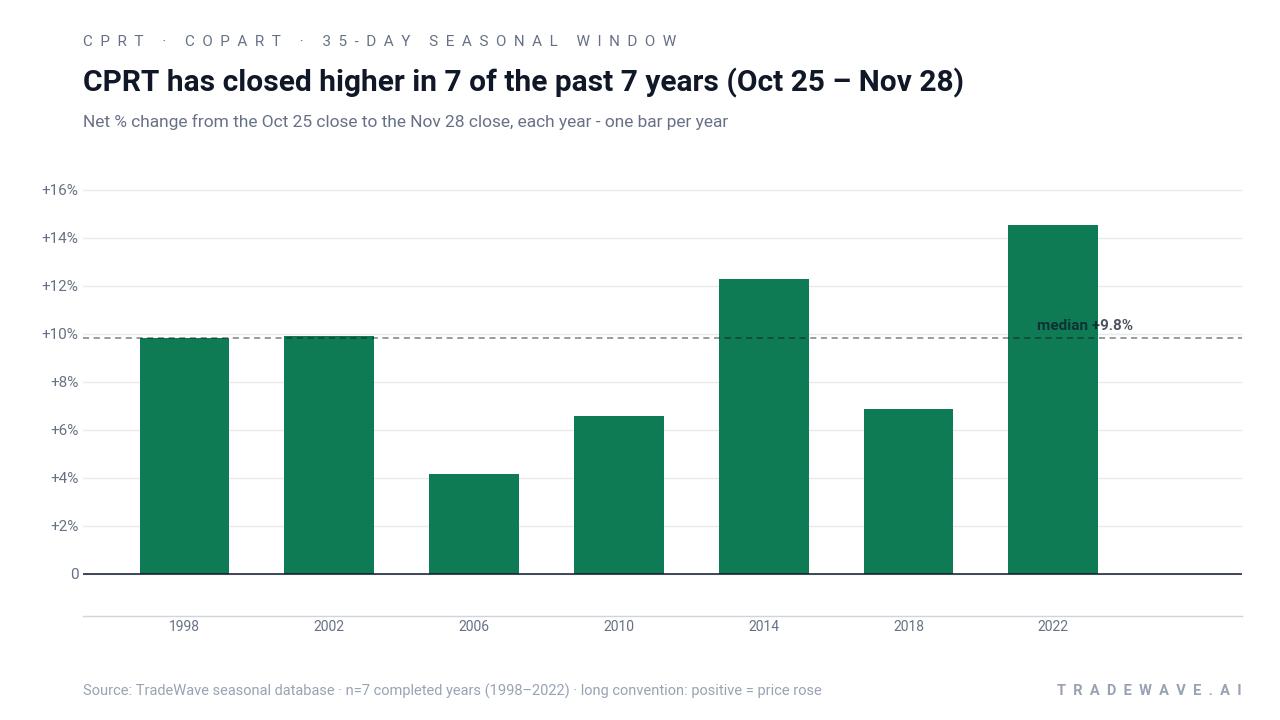
The presidential election cycle matters here because this pattern only looks at the last 7 midterm election years, a phase that often brings policy uncertainty, tighter financial conditions and choppy trading before risk appetite improves into the year before the presidential election. Today’s calendar sits in the late part of the midterm year, so the upcoming Oct 25 start date lines up with the historical handoff from midterm volatility into the typically stronger pre-election backdrop.
This seasonal window begins on Oct 25 and spans 35 days. Historically, during this period in midterm election years, Copart has shown a strong bullish tendency in the long direction, with 7 winners and 0 losers and a median gain of 9.8%.
The average profit of 9.16% across all years means the typical midterm-year late-October window has delivered a high single-digit move higher from entry to exit. Because there are no losing years in the sample, the average winner and the all-years average are the same, which is unusual even for strong seasonal patterns.
The per-year table shows that the weakest outcome was still a 4.17% gain in 2006, while the strongest was a 14.51% jump in 2022. In several cycles, including 1998, 2002 and 2014, Copart logged double-digit percentage gains over this 35-day stretch, underscoring how concentrated some of its upside has been in this part of the calendar.
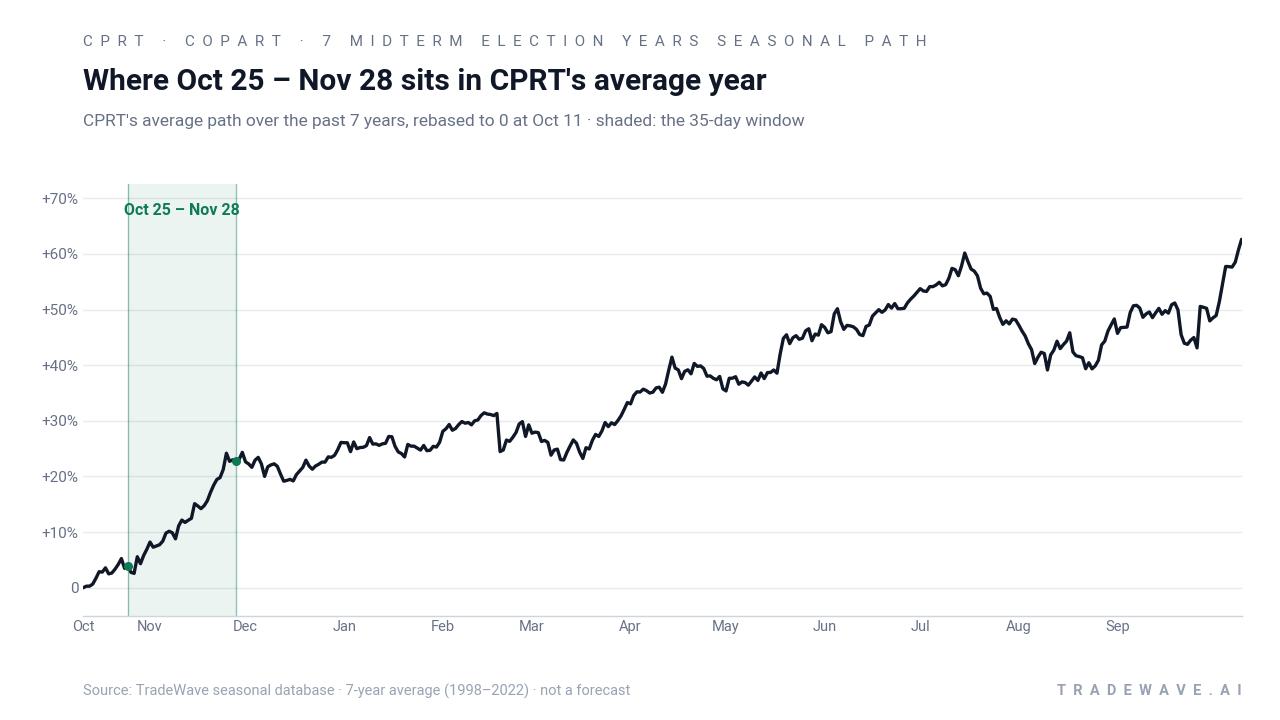
Year-by-year ranges show how far Copart has typically swung inside the window before settling at those positive closes.
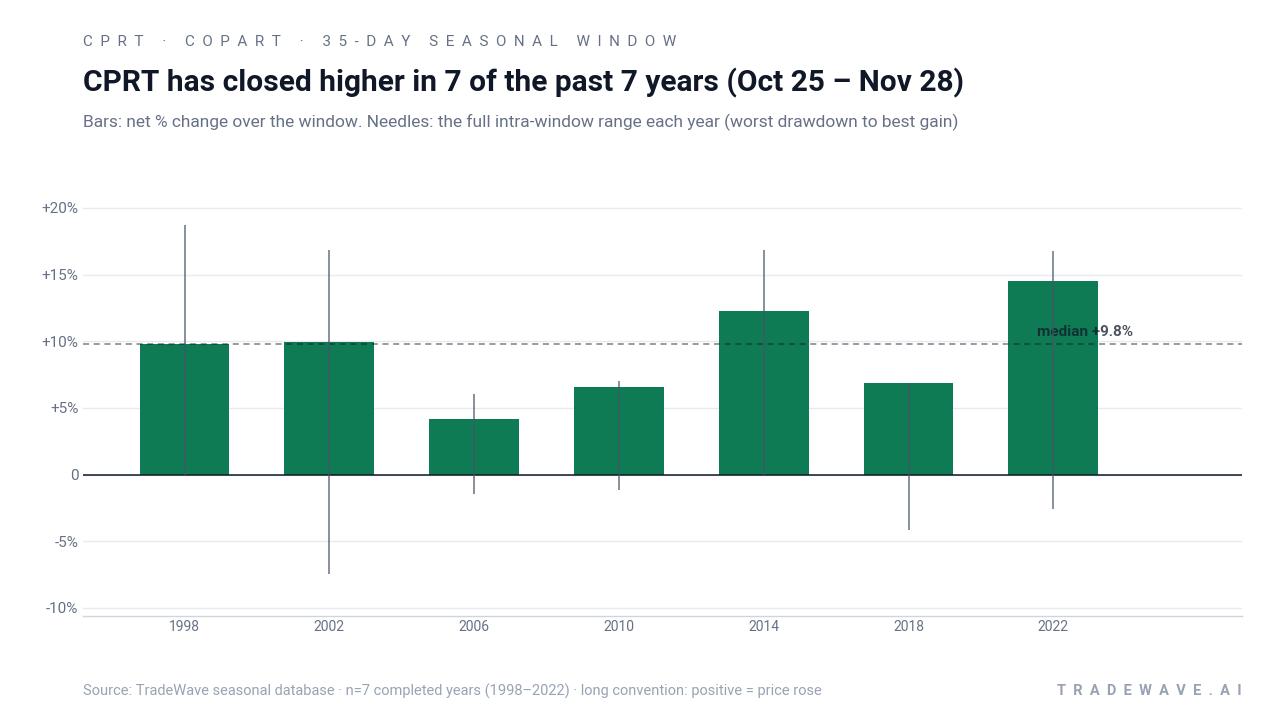
The maximum favorable move inside the window has often been larger than the final gain, with peak run-ups between roughly 6% and almost 19% in prior years. At the same time, the worst intraperiod drawdowns have ranged from flat in 1998 and 2014 to about 7.45% in 2002, showing that even winning years have included meaningful dips before finishing higher.
Put together, the pattern is clear: this 35-day stretch has favored long exposure in 7 of 7 midterm election years, with sizable upside moves and manageable but non-trivial pullbacks along the way.
History does not guarantee future results; adverse excursions (MAE) can be large even in winning windows.
Why does Copart (CPRT) follow this seasonal pattern?
One likely driver is the clustering of Copart’s earnings and guidance updates around the autumn period, which can reset expectations for salvage volumes, pricing and international expansion. Analysts have also pointed to year-end portfolio repositioning in industrial and infrastructure names, where managers add to structural growth stories after midyear volatility.[3][4] This pattern may also reflect broader midterm-to-pre-election risk-on behavior, as investors grow more comfortable with the policy path heading into the presidential election year.
What is driving Copart (CPRT) today?
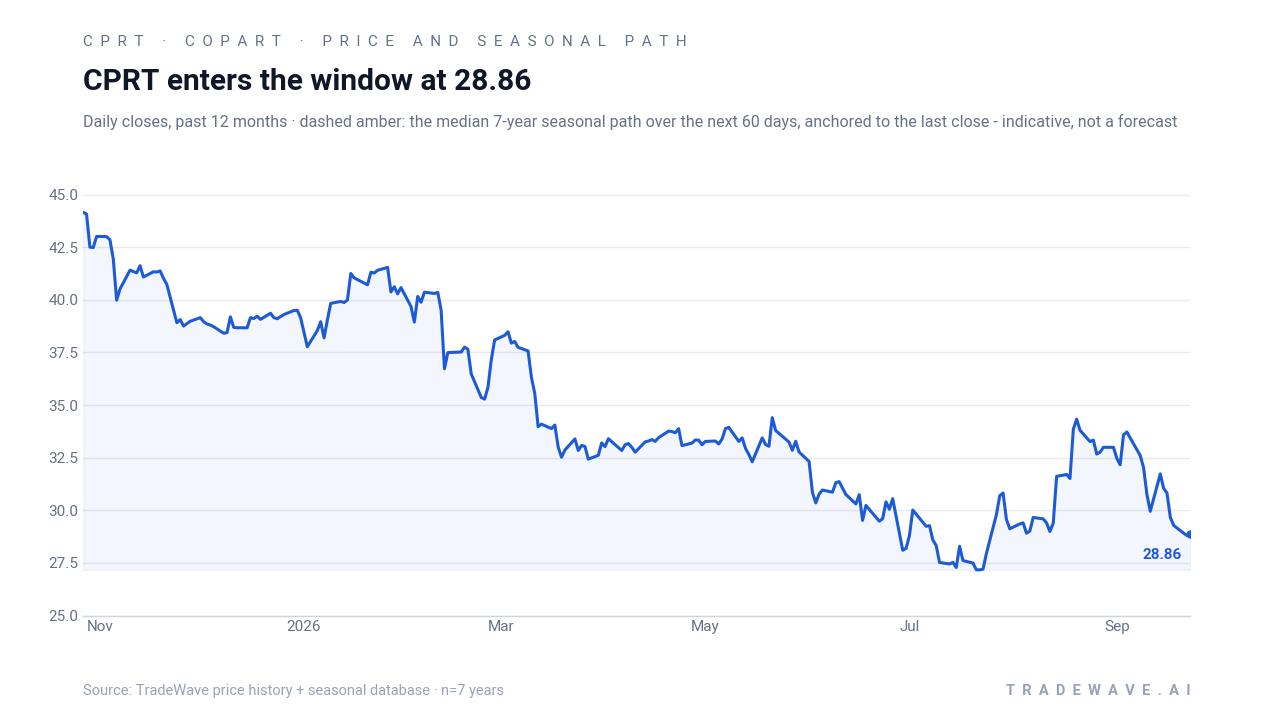
Copart closed Monday at 27.22, down 1.34% on the day and roughly 40.7% below its 52-week high of 45.89, leaving the stock deep in correction territory even after years of strong fundamental execution.[5] The slide has pushed year-to-date performance to a loss of 29.53%, a sharp reset for a company that had been a market favorite in the auto services space.[5]
The latest leg lower followed Copart’s Sep 10 quarterly report, where revenue of $1.15 billion slightly beat estimates but earnings per share of $0.35 missed consensus by $0.03 as margins compressed versus the prior year.[1][3] Analysts at Barrington Research and BNP Paribas Exane have kept positive ratings on the stock, citing durable demand for vehicle remarketing and Copart’s global footprint, even as they acknowledge that higher costs and a softer used-car backdrop are weighing on near-term profitability.[1][3][4]
Despite the drawdown, Copart still carries a “Moderate Buy” consensus rating and a MarketBeat-compiled average price target of about 37.8, which sits well above the current share price and reflects expectations for earnings to recover over the next 12 to 18 months.[1][3] Technical screens show the stock trading below its 50-day moving average of roughly 30.49, with one-month returns of -17.49% and volume running near its 20-day average of just over 10.4 million shares, a setup that often signals a reset phase rather than outright capitulation.[5][7]
Positioning has also shifted. ChartMill’s technical overview notes that Copart’s trend metrics have deteriorated alongside the broader pullback, while FactSet short-interest data compiled by Barron’s shows roughly 33.97 million shares sold short with a recent 10.19% decline in bearish bets, suggesting some shorts have already taken profits.[5][7] On the insider front, MarketBeat’s Form 4 tracker shows multiple sales by CEO Jeffrey Liaw earlier this year, including 26,213 shares at $33.18 on Apr 15 and 27,745 shares at $30.49 on Jul 28, alongside a mix of trades by directors and politically exposed holders in 2025 and 2026.[8][9]
The chart below situates the latest move in its recent multi-month context and overlays the historical seasonal path for the coming weeks.
What should traders watch as Copart (CPRT) approaches this window?
First, the calendar: the 35-day midterm-year window opens on Oct 25, so price action in the next three weeks will set the starting point for any seasonal move. A flat or weaker tape into that date would mean the historical late-October strength is kicking off from depressed levels, while a sharp rebound ahead of the window would compress the room for further upside.
Second, levels: traders are watching the recent 52-week low near 26.81 as immediate support and the 50-day moving average around 30.49 as the first serious resistance band.[5] A sustained break back above the 50-day line during the window would rhyme with prior years where gains built steadily through November, while repeated failures there would mark a clear departure from the historical pattern.
Third, fundamentals and policy: any updates on used-vehicle pricing, insurance total-loss trends or regulatory shifts around salvage auctions could matter more than usual in this part of the election cycle, as investors handicap how infrastructure spending and auto demand will evolve heading into the presidential election year.[1][3][4] Stronger commentary from management or analysts about volume growth and international expansion during this stretch would align with the bullish historical seasonality, while cautious tone or guidance cuts would work against it.
Finally, positioning: watch whether short interest continues to edge lower or rebuilds as the stock trades through the window, and whether insider activity remains skewed to sales or turns more balanced.[5][8][9] If shorts keep covering and insiders step back from selling while price respects support and starts to trend higher inside the Oct 25 to Nov 28 band, that would echo the prior 7-for-7 record; a renewed build in bearish bets or fresh insider selling into any bounce would be a clear sign that this midterm-year pattern may be losing some of its punch.
Sources
- MarketBeat - Copart (NASDAQ:CPRT) Stock Rating Reaffirmed as "Outperform" by BNP Paribas Exane
- Yahoo Finance - Copart, Inc. (CPRT) Analyst Ratings, Estimates & Forecasts - Yahoo Finance
- MarketBeat - Copart (NASDAQ:CPRT) Upgraded at Barrington Research
- Seeking Alpha - Copart, Inc. (CPRT) Latest Stock Analysis | Seeking Alpha
- Barron's (FactSet data) - Copart Inc. Research & Ratings | CPRT | Barron's
- Wall Street Journal - CPRT | Copart Inc. Analyst Estimates & Ratings – WSJ
- ChartMill - CPRT | Copart Inc - Technical Analysis
- MarketBeat (Insider Trades) - Copart (CPRT) Insider Trading Activity 2026
- OpenInsider - CPRT - Copart Inc - SEC Form 4 Insider Trading Screener - OpenInsider
- Fintel - CPRT / Copart, Inc. Stock - Short Interest, Short Squeeze ...
About this seasonal analysis
Seasonal pattern data is sourced from TradeWave.ai, which analyzes historical price behavior across annual calendar windows going back up to 30 years. Read the full data methodology or the book The 100-Year Pattern by Afshin Moshrefi (2026 edition). Past performance of seasonal patterns does not guarantee future results. This article is for informational purposes only and does not constitute investment advice.